
As a Heilpraktiker, a state-licensed non-medical practitioner, you want your website to explain your work without a warning letter in the post. Germany's health advertising law, the Heilmittelwerbegesetz (HWG), sets the limits. It does not stop you presenting your practice. It bans misleading claims, promises of success and a list of specific tactics (§ 3 HWG, § 11 HWG).
This guide goes through the rules that matter for a practice website and blog, one at a time. Each rule links to the law itself, so you can read the original wording.
What is the HWG and does it apply to your practice?
The HWG applies to you as soon as your page talks about illness. It covers advertising for medicines, and for other means, procedures, treatments and objects when the claim relates to illness. That means detecting, removing or easing diseases, ailments, bodily harm or pathological complaints in humans (§ 1 HWG). Your treatments fit that wording when you advertise them for a health problem.
The law also separates two kinds of reader. Members of the healing professions and trades count as health professionals in the sense of the law (§ 2 HWG). Several rules, in § 11 and § 12, apply only to advertising aimed at everyone else (§ 11 HWG, § 12 HWG). A public website can be read by anyone, so plan for those rules to apply to it.
Image advertising and treatment advertising
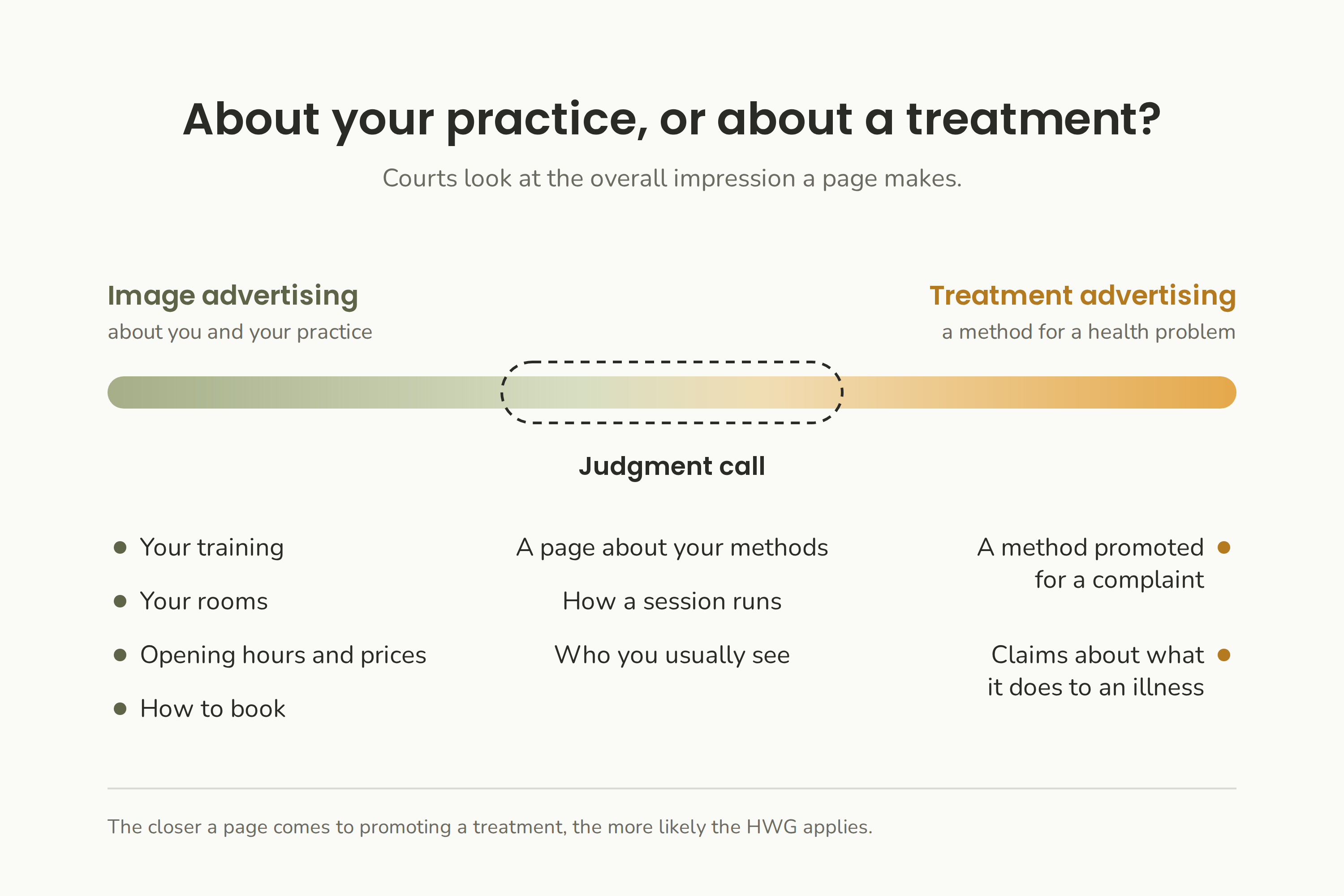
Courts draw one more line. The HWG covers advertising for specific products, not general advertising for the standing and ability of a business. Which one a piece of advertising is depends on its overall impression (Higher Regional Court of Nuremberg, 3 U 2204/20, 2021, citing earlier BGH rulings).
That court spoke about products, not treatments, so applying the test to your pages is a judgment call. A page about you, your training and your rooms leans toward image advertising. A page that promotes a method for a complaint leans the other way.
What happens if you get it wrong
Many breaches of the HWG are administrative offences. The fine can reach 50,000 euros, and 20,000 euros for negligent misleading advertising (§ 15 HWG, law as of 2026). Misleading advertising under § 3 can also be a criminal offence, with up to one year in prison or a fine (§ 14 HWG).
There is a second route as well. The Federal Court of Justice (BGH) treats the HWG's remote-treatment rule as a market conduct rule, so a breach is also unfair competition (BGH press release on I ZR 146/20, 2021, § 3a UWG). Competitors and qualified associations can then demand that you stop (§ 8 UWG). They are expected to send a warning letter before they go to court (§ 13 UWG).
What may your Heilpraktiker website say?
Quite a lot, as long as it is true and promises no result. You can present yourself, your training, your methods, your prices and your rooms. The HWG limits how health claims are made. It does not decide whether your practice may be visible.
- Who you are and your training. State it exactly as it is. The HWG calls it misleading to make untrue or deceptive claims about the person, training, ability or successes of the people involved (§ 3 no. 3 b HWG).
- Photos of you at work. A 2012 reform, in force since 26 October 2012, lifted the old ban on showing health professionals in their work clothes (Pharmazeutische Zeitung, 5 February 2013, amendment history of § 11 HWG).
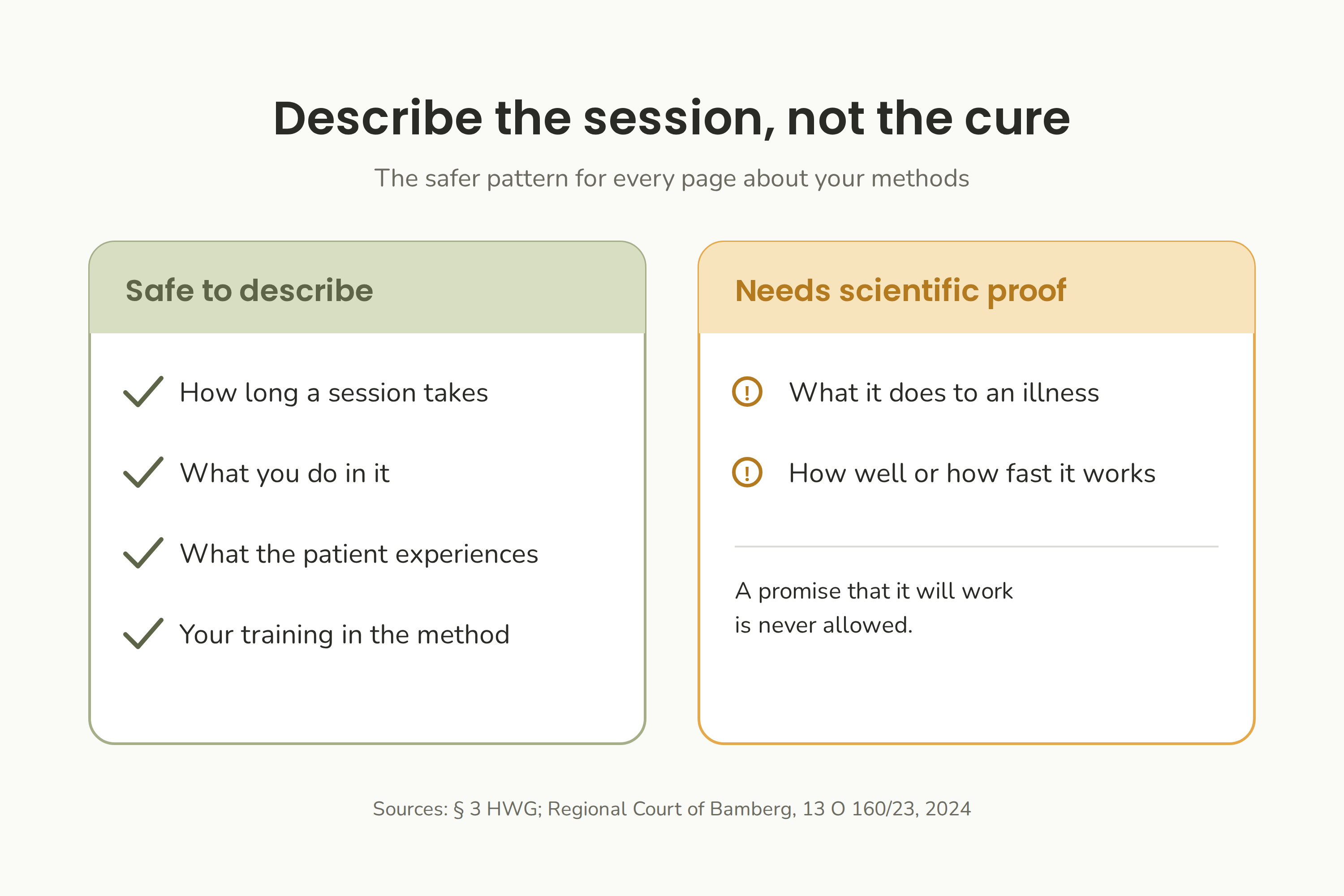
- Your methods, described as what happens in a session. The HWG calls it misleading to give a procedure or treatment a therapeutic effect it does not have (§ 3 no. 1 HWG).
- Practical facts. Prices, opening hours, how to book and how to find you are not health claims.
The bar for describing an effect is high
German courts apply strict standards to health advertising. A health claim is only allowed when it matches established scientific knowledge (Regional Court of Bamberg, 13 O 160/23, 2024, citing BGH I ZR 204/19 from 2020). As a rule, the court said, that means a randomised, placebo-controlled double-blind study.
In principle, the person who complains has to prove that your claim lacks that backing. The burden can shift to you, though. One example the court gives is advertising a disputed view without mentioning the opposing one (Regional Court of Bamberg, 13 O 160/23, 2024).
The safer pattern follows from this. Describe what you do and how a session runs, and leave out what it does to an illness.
What does the Heilmittelwerbegesetz ban on your website?
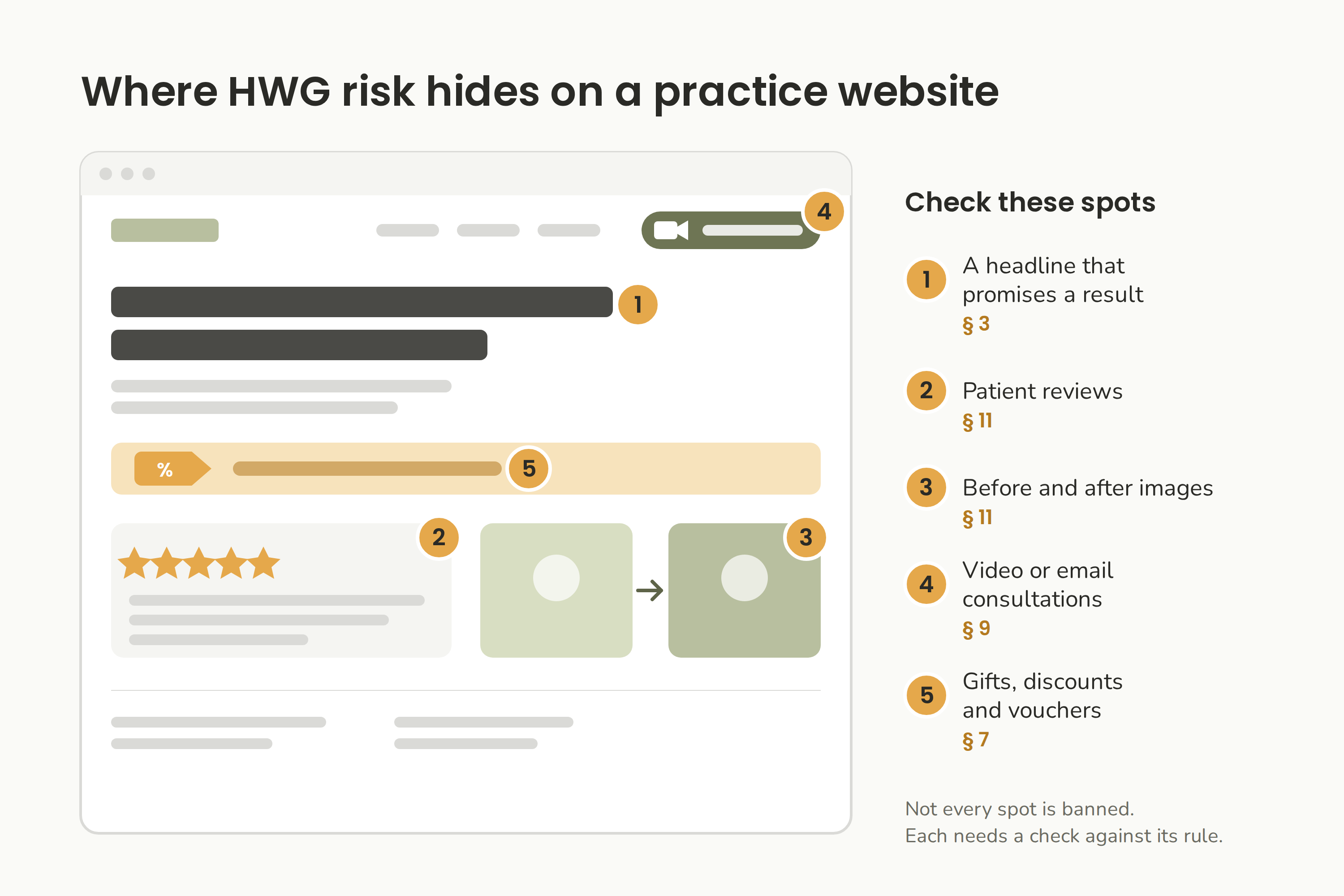
Five rules matter most for a practice website. Four are flat bans. The rule on patient statements and images applies only when the content is abusive, repellent or misleading. Before and after comparisons for cosmetic surgery are the stricter case.
| Rule | What it says | Flat ban or conditional |
|---|---|---|
| Success promises (§ 3 no. 2 a) | It is misleading to falsely suggest that success can be expected with certainty | Flat ban |
| Patient statements and before and after images (§ 11 (1) nos. 3, 5, 11) | Banned when abusive, repellent or misleading; case histories also when they could lead to a false self-diagnosis | Conditional; before and after comparisons are a flat ban only for cosmetic surgery without medical need |
| Fear and "better with it" claims (§ 11 (1) no. 7) | No claims suggesting that health suffers without the medicine, or improves with it | Flat ban, worded for medicines |
| Homeopathic medicines with an area of use (§ 5) | Registered homeopathic medicines may not be advertised with their areas of use | Flat ban |
| The disease list (§ 12 and annex) | Advertising may not refer to removing or easing the listed diseases | Flat ban for the listed groups |
Patient reviews and before and after images
The 2012 reform freed before and after photos, except in cosmetic surgery (Pharmazeutische Zeitung, 5 February 2013). Today, statements by third parties are banned outside health professionals only when used in an abusive, repellent or misleading way (§ 11 (1) no. 11 HWG). That includes thank-you and recommendation letters. Images showing bodily changes from illness, or the effect of a medicine on the body, follow the same test (§ 11 (1) no. 5 HWG).
That is not a free pass. A review that says your method worked can still give it an effect it does not have, which § 3 bans (§ 3 no. 1 HWG). Case histories stay banned when a detailed description could lead a reader to a false self-diagnosis (§ 11 (1) no. 3 HWG).
§ 11 does not spell out what makes a statement misleading, and § 3 only gives examples. This is the rule where a lawyer's view of your actual page is worth the most.
Fear appeals
The HWG bans claims outside health professionals that suggest health could suffer without a medicine, or improve with it (§ 11 (1) no. 7 HWG). The wording names medicines. If your page advertises a medicine you use, it reaches you directly.
The disease list in § 12
Outside health professionals, advertising for treatments may not refer to removing or easing the diseases listed in the annex to § 12 (§ 12 (2) HWG). The annex names four groups for humans (annex to § 12 HWG):
| Group | What it covers |
|---|---|
| 1 | Diseases that must be reported under the Infection Protection Act, and infections caused by reportable pathogens |
| 2 | Malignant growths |
| 3 | Addictions, except nicotine dependence |
| 4 | Pathological complications of pregnancy, childbirth and the period after birth |
The exception in group 3 has a practical side. The VUH is an association of independent Heilpraktiker. Its legal adviser reads the exception as allowing advertising for treating nicotine dependence in principle. That holds if the ad is not misleading and follows the other HWG rules (VUH, legal question of the month, 2019).
Can you advertise video or email consultations?
Be careful here, because this rule is strict and partly unsettled. The HWG bans advertising for detecting or treating illness that does not rest on your own perception of the person in front of you. The law calls this remote treatment (§ 9 HWG).
Since 19 December 2019 there is an exception for communication media. It applies when, by generally recognised professional standards, personal contact with a doctor is not needed (§ 9 HWG, BGH press release, 2021).
What the BGH decided in 2021
The case was about an app that advertised a "digital doctor's visit" with diagnoses, therapy recommendations and sick notes. The BGH found the ad unlawful under both the old and the new version of § 9 (BGH, I ZR 146/20, 9 December 2021).
Own perception, the court said, means the doctor can examine the patient, not only see and hear them. That needs both people in the same room and is not possible in a video consultation. The exception did not help, because broad remote primary care was not shown to meet professional standards (BGH press release, 2021).
What this means for a Heilpraktiker
The exception is worded around contact with a doctor. We found no ruling on how it applies to a Heilpraktiker, so this point is open. Until a court decides, treat advertising for diagnosis or treatment at a distance as off limits.
In our reading, a call that is clearly a conversation is a different thing. Booking questions, an introductory talk or organising a follow-up are not, on their face, a diagnosis at a distance. Ask a lawyer to check the exact sentence on your page.
| What your page advertises | Where it stands | Basis |
|---|---|---|
| Diagnosis or treatment by video, phone or email | Treat as off limits until a court decides how the exception applies to Heilpraktiker | § 9 HWG, BGH, I ZR 146/20 |
| Booking questions, an introductory talk, organising a follow-up | In our reading not a diagnosis at a distance; have a lawyer check the exact sentence | Our reading |
Gifts, discounts and vouchers on your website
The HWG bans gifts and other promotional benefits unless they fit one of its exceptions (§ 7 (1) HWG). Breaking this rule is an administrative offence (§ 15 (1) no. 4 HWG).
The exceptions that fit a practice best are these (§ 7 (1) HWG):
- Items of low value that carry your name or the product's name in a lasting, clearly visible way, or trivial small items
- A discount of a fixed amount of money, or one calculated in a fixed way
- Customary accessories or customary side services
- Information or advice
Vouchers need extra care. The VUH's legal adviser calls vouchers for a specific treatment legally problematic, because you first have to judge whether the treatment suits the person. He recommends a voucher for a fixed sum instead, such as 30 euros, that can then be used for a treatment (VUH, legal question of the month, 2019).
| Voucher | The VUH legal adviser's view |
|---|---|
| For a specific treatment | Legally problematic: you first have to judge whether the treatment suits the person |
| For a fixed sum, such as 30 euros | Recommended instead; it can then be used for a treatment |
When does a blog post become advertising?
A blog post becomes advertising when it promotes your treatment instead of explaining a topic. The label "blog" does not change the rules. The HWG bans publications outside health professionals whose advertising purpose is misleading or not clearly recognisable (§ 11 (1) no. 9 HWG).
Two patterns carry most of the risk in an explainer:
- The hidden ad. An article that reads like general information but steers readers to your treatment for a complaint. The overall impression decides whether a piece is advertising for a specific offer (Higher Regional Court of Nuremberg, 3 U 2204/20, 2021).
- The symptom guide. A detailed description that could lead a reader to a false self-diagnosis (§ 11 (1) no. 3 HWG). Write for understanding, not for a reader checking their own symptoms.
The second law: misleading commercial practices
The Unfair Competition Act (UWG) adds its own ban on misleading commercial practices. Among other things, it covers untrue or deceptive claims about the results to expect from a service. It also covers claims about the provider's qualifications or status (§ 5 UWG). A claim that passes the HWG can still fail here.
A quick self-check before you publish a page
Run through these questions for every page and post. If an answer points to a risk, rewrite the page or get a lawyer's view before it goes live.
- Does any sentence promise that a treatment will work? (§ 3 HWG)
- Does any sentence give a method an effect you could not back with established scientific knowledge? (§ 3 HWG)
- Are your training, titles and memberships stated exactly as they are? (§ 3 HWG, § 5 UWG)
- Do reviews or patient stories suggest a result, or describe symptoms in enough detail to invite self-diagnosis? (§ 11 HWG)
- Do images show bodily changes in a way that could mislead or repel? (§ 11 HWG)
- Does any text suggest health suffers without a medicine? (§ 11 HWG)
- Do you name an area of use for a homeopathic medicine? (§ 5 HWG)
- Does any page refer to treating a disease group from the § 12 annex? (§ 12 HWG)
- Do you advertise diagnosis or treatment at a distance? (§ 9 HWG)
- Do your gifts, discounts or vouchers fit an exception in § 7? (§ 7 HWG)
- Is every blog post clearly what it is, information or an offer? (§ 11 HWG)
If you belong to a professional association, check its own code as well. It may set rules for advertising that go further than the law.
This article is general information, not legal advice. Talk to a lawyer who knows health advertising law for your own case. All law texts were read on gesetze-im-internet.de on 9 October 2026.
Frequently asked
Can a Heilpraktiker advertise video consultations?
Treat advertising for diagnosis or treatment at a distance as off limits until a court decides. The 2019 exception in § 9 HWG is worded around contact with a doctor, and in 2021 the BGH found an ad for broad remote care unlawful. A call that is clearly organisational, such as booking or an introductory talk, is a different thing.
Are patient reviews allowed on a Heilpraktiker website?
Yes, in principle. Since the 2012 reform, statements by third parties are banned only when used in an abusive, repellent or misleading way (§ 11 HWG). A review that says your method worked can still give it an effect it does not have, which § 3 HWG bans.
Can a Heilpraktiker offer gift vouchers?
The HWG bans gifts unless they fit an exception in § 7, such as a fixed discount or low-value items. The VUH's legal adviser calls vouchers for a specific treatment legally problematic and recommends a voucher for a fixed sum, such as 30 euros, instead.
Sources
- § 1 HWG - scope
- § 2 HWG - health professionals
- § 3 HWG - misleading advertising
- § 5 HWG - homeopathic medicines
- § 7 HWG - gifts and promotional benefits
- § 9 HWG - remote treatment
- § 11 HWG - advertising outside health professionals
- § 12 HWG - disease list
- annex
- § 14 HWG - criminal offence
- § 15 HWG - fines
- § 3a UWG
- § 5 UWG
- § 8 UWG
- § 13 UWG
- BGH, I ZR 146/20, 9 December 2021, press release 224/2021
- Higher Regional Court of Nuremberg, 3 U 2204/20, 16 February 2021
- Regional Court of Bamberg, 13 O 160/23, court order of 16 February 2024
- Pharmazeutische Zeitung, 5 February 2013, on the 2012 reform
- Amendment history of § 11 HWG (buzer.de)
- VUH, legal question of the month, 7 October 2019
Written by
Vitalmyn Team
Editorial team
We are building the ordering service for practitioner recommendations. Here we write down what we learn about recommending, practice finances and advertising law, so you do not have to dig it up yourself.