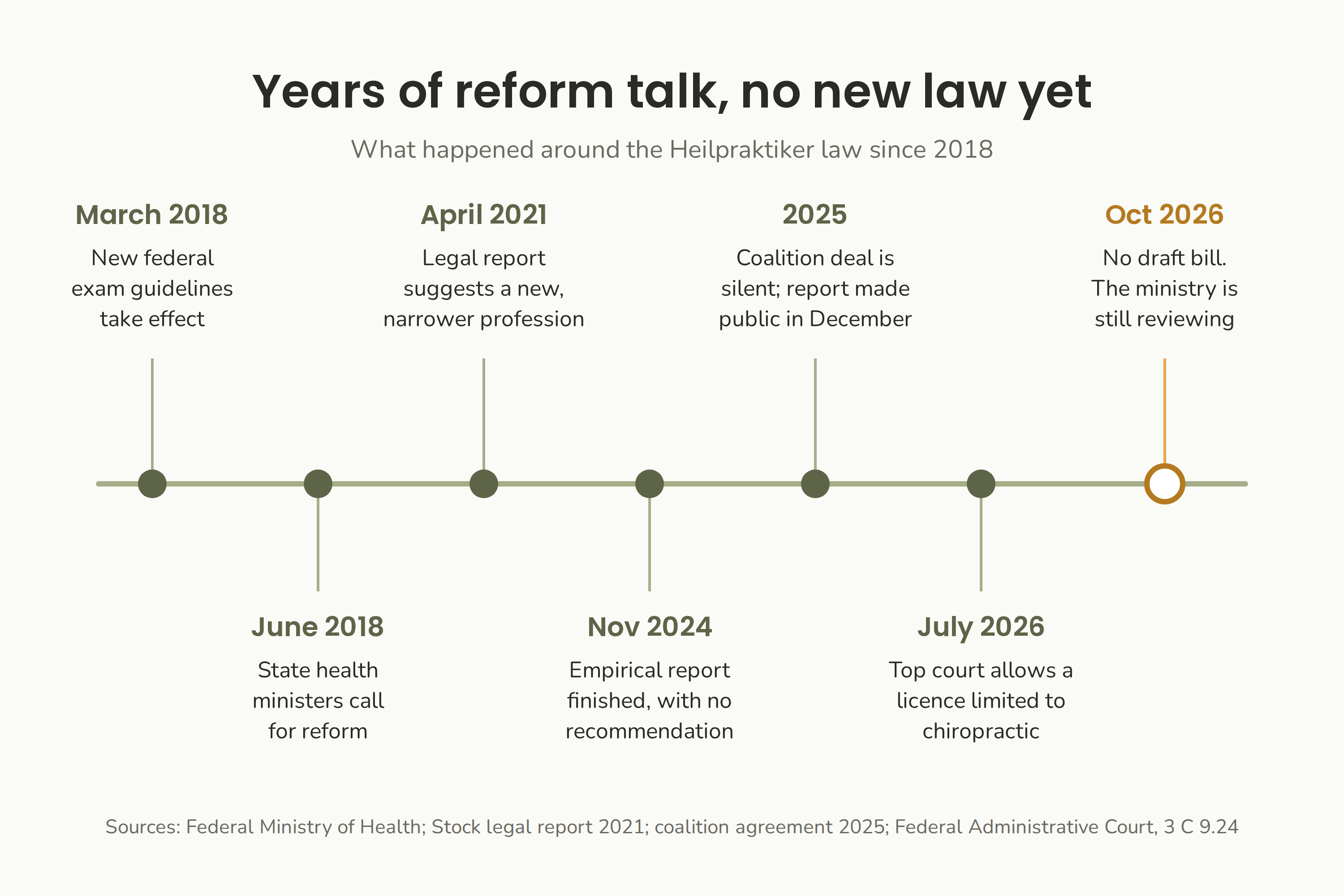
As of October 2026, no Heilpraktikergesetz reform has been decided. We found no draft bill and no timeline. The Federal Ministry of Health (BMG) published an empirical report on the profession in December 2025. It describes how Heilpraktiker work, makes no recommendation, and the ministry says it now needs "a deeper review" (BMG short report).
If you work as a Heilpraktiker, a state-licensed non-medical practitioner, you have probably heard that the profession could be abolished. This guide sets out what the law says today, what the two federal reports found, and which changes are being discussed. Every point links to its source, so you can tell facts from association commentary.
What the Heilpraktikergesetz says today
The Heilpraktiker Act (Heilpraktikergesetz, HeilprG) dates from 1939 and is still in force. Its core rule is short: anyone who wants to practise medicine without being licensed as a doctor needs a permit (§ 1 HeilprG). Practising without that permit can lead to up to one year in prison or a fine (§ 5 HeilprG).
The permit is not a degree. Before granting it, the local health office checks your knowledge and skills in an exam. The first implementing regulation says this check follows federal guidelines (1. DVO HeilprG, § 2).
Those guidelines are the last real change. They were published on 22 December 2017 and took effect on 22 March 2018 (BMG, exam guidelines). They made the exam more uniform across the federal states. The law itself was last amended in 2016 (HeilprG).
Full licence and sector licences
Besides the full licence, health offices grant licences limited to one field, such as psychotherapy or physiotherapy. These sector licences are much more common than many people think. The empirical report counts about 37,394 holders of a psychotherapy licence in 2022 (BMG empirical report, full text).
In July 2026 the Federal Administrative Court added a new case. It ruled that a licence limited to chiropractic is possible. The applicant still has to pass a knowledge check (Federal Administrative Court, 3 C 9.24 and 3 C 10.24, press release).
What did the empirical report on the Heilpraktiker profession find?
The report found that the exam only checks for danger to patients and that training varies widely. The data were too thin to judge safety. It recommends no reform and does not judge whether methods work. In German it is called the "Empirisches Gutachten zum Heilpraktikerwesen", Gutachten meaning an expert report. The BMG commissioned it in 2023 (BMG tender notice).
The research firm in vivo GmbH wrote it. The final version is dated 8 November 2024 and runs to 334 pages (BMG publication page). It only became public around December 2025, more than a year later, as associations reported at the time (FDH news).
The authors surveyed practitioners, health offices and court records. After cleaning, they used 2,297 questionnaires from full licence holders and 2,268 from psychotherapy licence holders. Most respondents were reached through professional associations (BMG empirical report, chapter 5.1).
The key numbers
| What was measured | Figure in the report |
|---|---|
| People with a full licence, 2022 | about 67,387 |
| Practices, 2022 | about 47,549 |
| People with a psychotherapy licence, 2022 | about 37,394 |
| Patients per practice per year | 619 on average |
| Average practice revenue per year | 59,479 euros |
| Self-employed | 97 percent |
| Licence withdrawals reported by health offices | 0.3 per year, 2017 to 2022 |
All figures come from the report itself (BMG empirical report).
The headcounts are estimates. They are extrapolated from about 70 health offices, and figures for several federal states were filled in by the authors (BMG empirical report).
On the exam and training
The report is plain about what the exam does. In our translation: the check only clarifies whether a candidate is a danger to public or patient health. It does not test whether, or which, medical expertise they have (BMG empirical report, page 5).
It also finds there is no uniform path of qualification and training. The short report calls the differences between practitioners "considerable" (BMG short report). Quality assurance rests largely on each practitioner's own responsibility. Members of an association take part in more continuing education (BMG empirical report, chapter 7).
For sector licences the report is more critical. They can be granted on paper, without an exam. For physiotherapists it describes a 40-hour course and a 60-minute written test as a "relatively low requirement" (BMG empirical report, page 5 and chapter 7).
On patient safety
The report could not answer the safety question either way. A full analysis of the benefits and risks of the many methods "could not be carried out because of the limited data" (BMG short report).
A database search found 6 criminal convictions and 9 civil cases linked to the profession between 1949 and 2023. Federal prosecution statistics show 146 people tried under the HeilprG from 2007 to 2023, and 103 convicted. Those statistics cannot tell licensed Heilpraktiker apart from people practising without a licence (BMG empirical report).
On your place in care
The report calls Heilpraktiker a substantial complement to conventional care. It also notes that cooperation with doctors is made harder by § 29a of the doctors' model professional code (BMG empirical report, chapter 7). About 42 percent of full licence holders place their methods in complementary medicine (BMG empirical report).
What did the 2021 legal report propose?
The 2021 legal report advised against abolition and proposed a new, narrower Heilpraktiker profession instead. Professor Christof Stock wrote it for the BMG, dated 21 April 2021 (Stock, legal report on Heilpraktiker law). It looked at the law, not at practices, and its conclusions are the author's own views, not government policy.
On abolition, the report is clear. It found "neither a sufficient factual nor legal basis" for abolishing the profession. Doing so would be a massive interference with the freedom to choose an occupation, which the German constitution protects (Stock, summary item 5).
It did propose a different structure. Stock suggested redefining what counts as practising medicine and splitting it into medical, sector and alternative fields. A new state-recognised Heilpraktiker profession would be limited to alternative medicine. He also considered the 2018 exam guidelines unconstitutional and said they largely missed their goals (Stock, summary items 1 and 7).
Will the Heilpraktiker profession be abolished?
Nothing points to that today. We found no such proposal from the governing parties, the 2021 legal report advised against it, and no bill exists. The current coalition agreement of the CDU/CSU and SPD does not mention Heilpraktiker at all (coalition agreement 2025, page 113).
The nearest passage is about related fields. The coalition plans a professional law for osteopathy. It also supports research and care in naturopathy and integrative medicine to promote prevention.
Which party wants to abolish Heilpraktiker?
This is one of the most searched questions on the topic. We found no party in the federal government that currently calls for abolition. In 2018 the state health ministers said the profession was "urgently in need of reform". They asked for a working group (NRW health ministry press release, June 2018). The published minutes of their June 2026 conference contain no Heilpraktiker item (minutes of the 99th conference).
In parliament, the AfD, an opposition party, tabled a motion in June 2026 to keep Heilpraktiker as part of care (Bundestag printed paper 21/6356). An opposition motion is not law and has not been adopted.
What the ministry says
The BMG's official line is short. The results "feed into the discussion process", and the reports show the "legal and factual complexity", so a deeper review is needed. Care provision and patient safety are named as key points. The report itself asks for systematic official data collection and more research (BMG short report, section 5).
One association reports that the ministry plans an open-ended process, first with the federal states and then with the associations (BDH). The ministry has had a new minister, Carsten Linnemann, since 29 July 2026 (BMG). We found no statement from him on the profession.
What may change for your practice
Nothing changes for your practice today. Your licence, your exam result and your rules stay as they are. If a reform comes, the two reports and past debates point to a few directions. None of them is decided, and any change would need a law passed by parliament.
| Possible direction | Where it comes from | What it would mean for you |
|---|---|---|
| Keep the law as it is | No bill so far; the coalition agreement is silent | Nothing changes |
| Stricter rules for sector licences | The empirical report calls the paper route a low bar | Our reading: mainly new psychotherapy and physiotherapy licences |
| More official data and research | The report asks for systematic data collection | Possible surveys or reporting duties |
| A redefined, narrower profession | Stock legal report, 2021 | New scope rules; how existing licences would be treated is open |
| Abolition | Called for by critics; the legal report advises against it | No basis in any current proposal |
Any change to a federal law starts with a draft bill, which is public before parliament votes on it. How a reform would treat licences that already exist is open until such a draft is published.
What to do now
You do not need to change anything in your practice because of the report. What helps is staying informed from primary sources and keeping your own records in order.
- Read the BMG short report yourself. It is a few pages and states plainly what the report does and does not say (BMG short report).
- Keep association summaries apart from the report. Some summaries say the data show "no need for action". That is the association's own reading, not a finding of the report (Freie Heilpraktiker, 66 key findings).
- Document your continuing education. The report ties quality assurance to each practitioner's own responsibility (BMG empirical report).
- If you hold a sector licence, follow the debate closely. That is where the report is most critical.
- Watch for a draft bill on the BMG website. Until one exists, any claim that a specific change is coming is speculation.
This article is general information, not legal advice. For your own case, talk to a lawyer who knows health professions law, or to your professional association. All sources were read on 15 October 2026.
Frequently asked
Is the Heilpraktiker profession being abolished?
Not according to any current proposal. As of October 2026 we found no draft bill, the coalition agreement does not mention Heilpraktiker, and the 2021 legal report for the Federal Ministry of Health found no sufficient basis for abolition.
What does the empirical report on the Heilpraktiker profession recommend?
Nothing on reform. It describes the profession with survey and official data, asks for better official data collection and more research, and leaves the policy decision to the ministry, which says it now needs a deeper review.
Which party wants to abolish Heilpraktiker?
We found no party in the federal government that currently calls for abolition. In 2018 the state health ministers called for reform, and critics outside parliament have called for abolition or a narrower model since 2017.
Will my existing Heilpraktiker licence stay valid?
Yes, today nothing changes. Any reform would need a new federal law. How it would treat existing licences is open until a draft bill exists.
Sources
- Heilpraktikergesetz (HeilprG), § 1 and § 5
- First implementing regulation to the HeilprG
- BMG, exam guidelines for Heilpraktiker candidates (2018)
- BMG, empirical report on the Heilpraktiker profession, publication page
- BMG, empirical report, full text (8 November 2024)
- BMG, empirical report, short report
- BMG, tender notice for the empirical report (2023)
- Stock, legal report on Heilpraktiker law, 21 April 2021
- Coalition agreement CDU/CSU and SPD 2025
- Federal Administrative Court, 3 C 9.24 and 3 C 10.24, July 2026
- NRW health ministry, 91st health ministers' conference, June 2018
- Health ministers' conference, minutes of the 99th conference, 2026
- Bundestag printed paper 21/6356, June 2026
- BMG, change of minister, July 2026
- BDH, on the publication of the empirical report
- FDH, current news
- Freie Heilpraktiker, 66 key findings of the empirical report (association summary)
Written by
Vitalmyn Team
Editorial team
We are building the ordering service for practitioner recommendations. Here we write down what we learn about recommending, practice finances and advertising law, so you do not have to dig it up yourself.