The Health Claims Verordnung is the EU regulation that decides what anyone may say about a food's effect on health, and supplements are food. As a Heilpraktiker, a state-licensed non-medical practitioner, you may only use claims the EU has authorised, in the authorised wording and under its conditions. Everything else is banned.
That rule reaches further than many practitioners think. It covers your website, your flyers and your social posts as soon as they promote a supplement. This guide explains the rule step by step, with links to the law, so you can check your own wording against the original.
What is the Health Claims Verordnung?
The Health Claims Verordnung, or HCVO, is Regulation (EC) No 1924/2006 on nutrition and health claims made on foods. It sets one rule for the whole EU. A health claim is banned unless it is authorised and on an official list (Art. 10(1)). Lawyers call this a positive list.
The regulation applies to claims "made in commercial communications, whether in the labelling, presentation or advertising of foods" for the final consumer (Art. 1(2)). A food supplement counts as a food under EU law (Directive 2002/46/EC, Art. 2). So the HCVO covers every capsule, powder and drop you recommend.
What are health claims?
A claim is any message that is not required by law and "states, suggests or implies that a food has particular characteristics". Pictures and symbols count too (Art. 2(2) no. 1). The law then splits claims into two groups:
- A nutrition claim says what a food contains, or contains more or less of. "Source of" or "high in" a vitamin are nutrition claims (Art. 2(2) no. 4).
- A health claim suggests "that a relationship exists between a food category, a food or one of its constituents and health" (Art. 2(2) no. 5).
Because the definition says "suggests", a claim does not need the word "health" to be a health claim. A product name, an image or a tagline can carry one on its own.
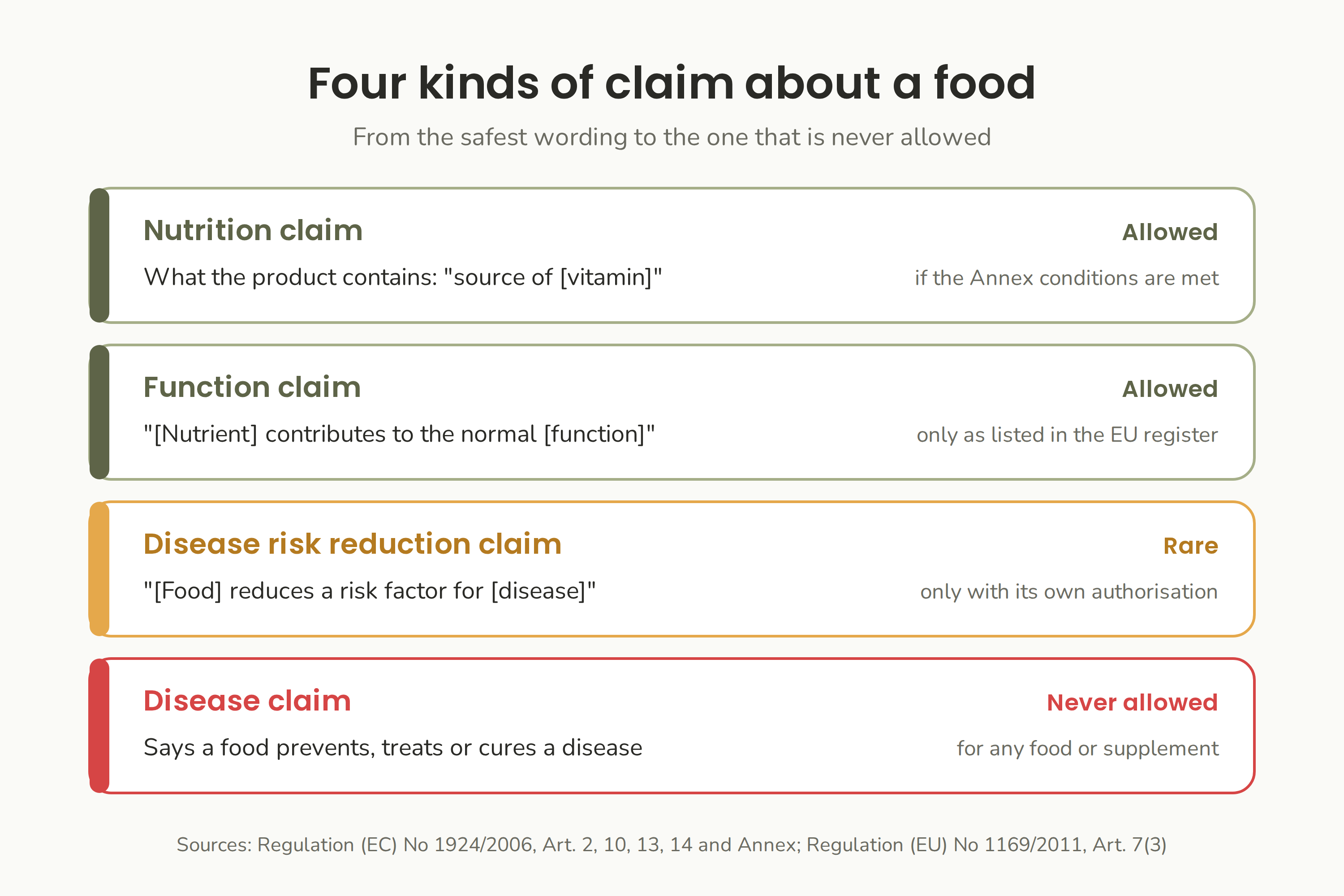
The four kinds of claim
| Kind of claim | What it says | When it is allowed |
|---|---|---|
| Nutrition claim | What the product contains, such as "source of [vitamin]" | When the product meets the conditions in the Annex of the regulation |
| Function claim | The role of a nutrient in the body, such as "[nutrient] contributes to the normal [function]" | Only as listed in the EU register, under its conditions (Art. 13) |
| Disease risk reduction claim | That a food reduces a risk factor for a disease | Only with its own authorisation (Art. 14) |
| Disease claim | That a food prevents, treats or cures a disease | Never (Regulation (EU) No 1169/2011, Art. 7(3)) |
Does the Health Claims Verordnung apply to your practice?
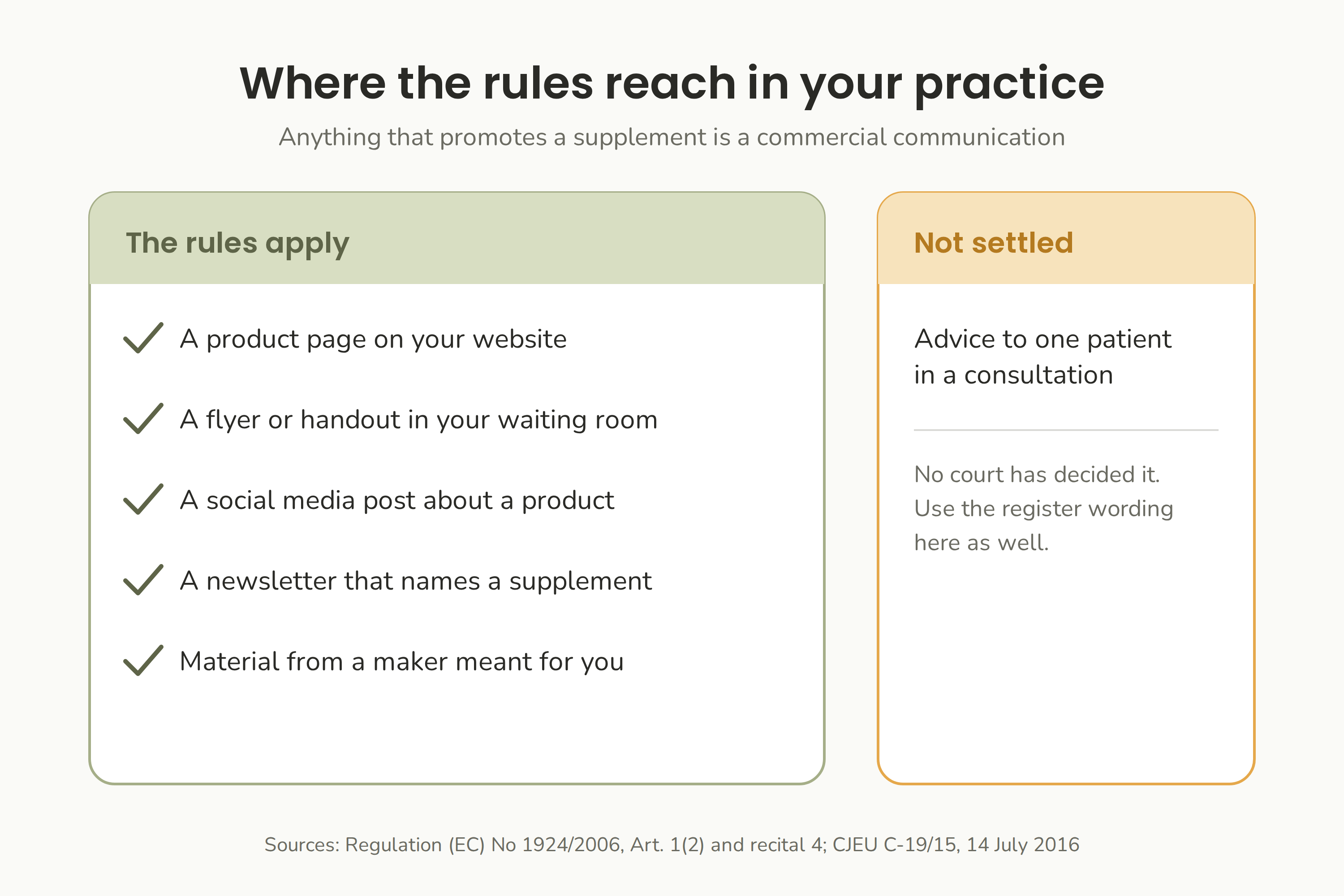
Yes, as soon as you promote a supplement. The HCVO covers commercial communications, and the Court of Justice of the EU has read that term widely (C-19/15). A product page, a flyer or a post that names a supplement and describes what it does is a commercial communication. The rules apply to it in full.
The court has also said the rules apply when a supplement maker writes only to health professionals. In its 2016 ruling, the court gave the reason. Professionals may "in all good faith" pass incorrect information on to their patients, because patients trust them (CJEU, C-19/15, 14 July 2016).
What about advice in a consultation?
This question is open. The regulation says it should not apply to claims made in non-commercial communications (recital 4). Recitals are the reasons printed before the articles of a regulation. No court and no authority has yet decided where a one-to-one consultation falls. The 2016 ruling counts communication that promotes the services or image of a regulated profession as commercial (C-19/15).
Until that changes, use the register wording in the consultation room as well. If you hand your patient anything in writing, treat it like your website.
The HCVO and the HWG side by side
Two laws can apply to the same page on your website. The Heilmittelwerbegesetz (HWG), Germany's health advertising law, covers how you advertise your treatments and methods. Food law, with the HCVO at its centre, covers what you say about a food. We cover the first law in our guide to the HWG for Heilpraktiker.
A page about your practice that also names a supplement has to pass both. A sentence that is fine under one law can still break the other.
Where do you find the allowed wording?
The allowed wording lives in the EU Register of nutrition and health claims, run by the European Commission. It lists every authorised health claim with its conditions of use. It also lists claims that were refused, and why (EU Register). Start every claim with this register.
Most function claims come from one list, Regulation (EU) No 432/2012, in force since 14 December 2012. Each claim in its Annex "may be made on foods in compliance with the conditions set out in the Annex" (Regulation (EU) No 432/2012, Art. 1(2) and Art. 2). The Commission notes that the register is for information only (Commission register page). The legal text in the regulation decides.
How to read a register entry
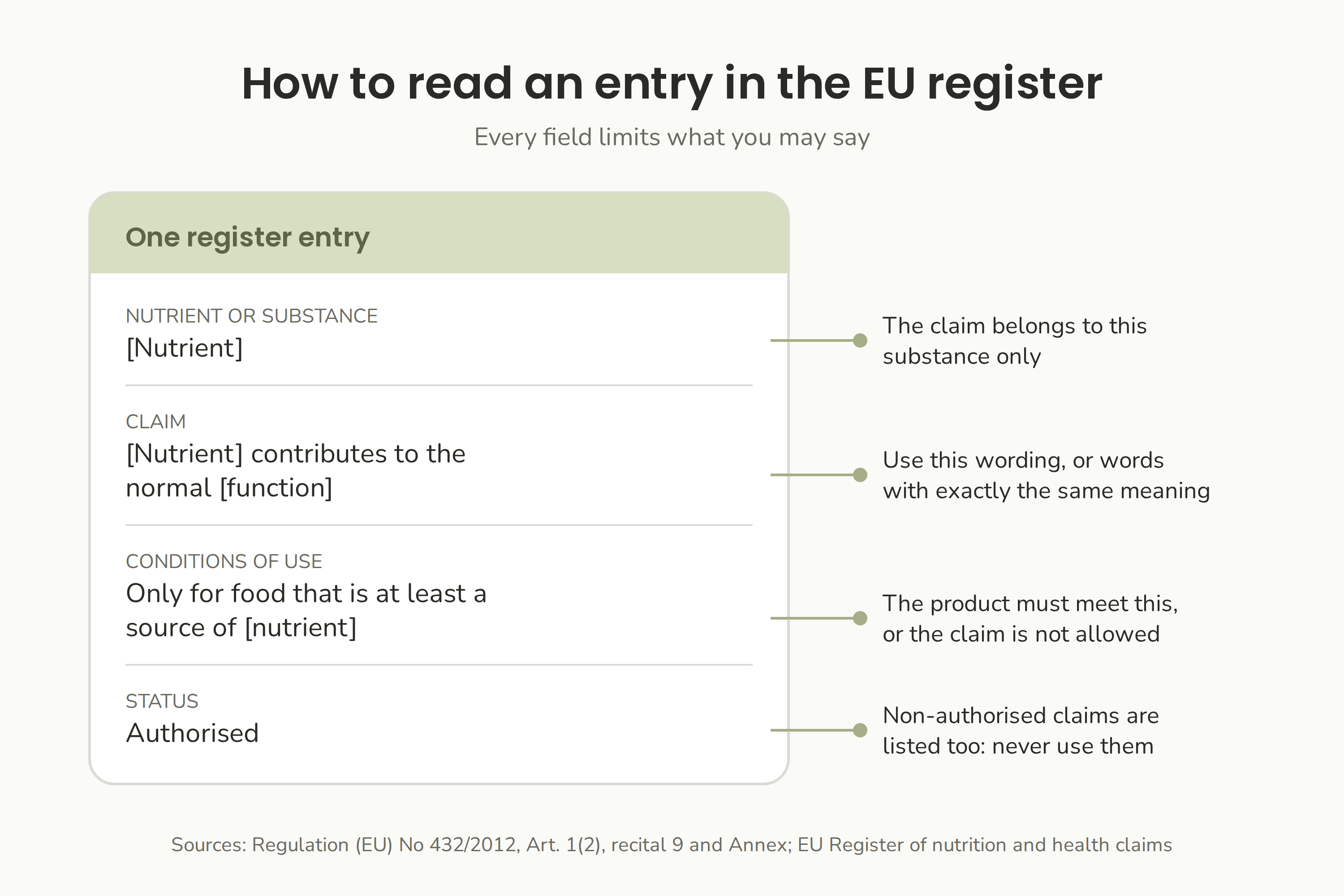
Each entry names a nutrient or substance, the claim, the conditions of use and a status. Read all four before you use a claim:
- The substance. The claim belongs to this nutrient only, not to the product as a whole.
- The claim. Use this wording. Wording that means the same to a consumer falls under the same conditions (Regulation 432/2012, recital 9). Stronger wording is a new claim, and it is not authorised.
- The conditions of use. Many claims may only be used for food that is at least a "source of" the nutrient. If the product does not meet the condition, the claim is not allowed.
- The status. Only "authorised" entries may be used. A refused claim stays banned, however well it reads.
What "source of" means
"Source of" is a nutrition claim with a fixed threshold. The product must contain at least a "significant amount" of the vitamin or mineral (Regulation 1924/2006, Annex). EU food law sets that at 15 percent of the nutrient reference value, the reference amount set in EU law, per 100 g. Drinks and single portions have their own rules (Regulation 1169/2011, Annex XIII).
"High in" needs at least twice that amount (Regulation 1924/2006, Annex). Check the label against the threshold before you use either phrase. The same check decides whether a function claim with a "source of" condition is allowed at all.
What may you never say about a supplement?
Some claims are banned outright, whatever the product contains. A food may never be presented as preventing, treating or curing a disease. Three more types of health claim are banned by name in Article 12. A general promise of wellbeing is only allowed with an authorised claim right next to it.
Disease claims
Food information "shall not attribute to any food the property of preventing, treating or curing a human disease" (Regulation 1169/2011, Art. 7(3)). This also covers advertising and the way a product is presented (Art. 7(4)). No register entry can make a disease claim lawful for a supplement.
The three claims banned by name
Article 12 of the HCVO lists three health claims that are never allowed (Art. 12):
- Claims "which suggest that health could be affected by not consuming the food".
- Claims "which make reference to the rate or amount of weight loss".
- Claims "which make reference to recommendations of individual doctors or health professionals".
The third ban is the one closest to your work. A product page or flyer that says a named practitioner recommends a product breaks it. Whether it also catches a line about your own recommendation on your own page has not been decided. The safe course is to keep endorsements out of promotional material.
Health claims examples to check your wording against
| Sentence on a flyer or website | Verdict | Why |
|---|---|---|
| "Contains [vitamin]" | Usually fine | A plain fact about the content, not a promise |
| "Source of [vitamin]" | Allowed with conditions | Nutrition claim: the product must reach the threshold |
| "[Nutrient] contributes to the normal [function]" | Allowed with conditions | Only in the register wording, under its conditions |
| "For your wellbeing" on its own | Not allowed | A general benefit with no authorised claim beside it |
| "Recommended by Heilpraktiker [name]" | Not allowed | Art. 12: recommendation of an individual health professional |
| "Without it, your health suffers" | Not allowed | Art. 12: suggests health is affected if you do not take it |
| "Helps against [disease]" | Never allowed | Disease claim under Art. 7(3) of Regulation 1169/2011 |
General benefits need an authorised claim beside them
Words like "good for you" or "for your wellbeing" are general, non-specific benefits. They "may only be made if accompanied by a specific health claim" from the authorised lists (Art. 10(3)). In 2020 the Court of Justice added that the link must be clear. A general promise on the front of a pack does not count as accompanied by a claim on the back. That needs a clear reference, such as an asterisk (CJEU, C-524/18, 30 January 2020).
Plant substances are a special case
Many claims for plant substances, known as botanicals, have never been decided. The Commission put them on hold, and they appear on a list of claims whose "finalisation is pending" (Commission list of pending botanical claims). Under a transitional rule, some of these claims could still be used (Regulation 432/2012, recital 11).
In April 2025 the Court of Justice narrowed that room. Some botanical claims on hold may not be used until the Commission finishes its review. The exception is a specific transitional rule (CJEU, C-386/23, 30 April 2025).
For a plant extract, the safe course is to describe the product, not its effect. Ask a lawyer before you use any effect wording.
What happens if you get it wrong?
A breach of the HCVO can cost you in two ways. The state can prosecute it or fine you under the German Food and Feed Code (LFGB). Competitors and associations can send you a warning letter and take you to court under unfair competition law.
| Route | Who acts | What can follow |
|---|---|---|
| Criminal offence, § 59 LFGB | The state | Up to one year in prison or a fine, for a deliberate breach |
| Administrative offence, § 60 LFGB | The state | A fine of up to 50,000 euros, for a negligent breach |
| Unfair competition, §§ 3a and 8 UWG | Competitors and qualified associations | A warning letter, a demand to stop and a court case |
Using a banned health claim in advertising on purpose is a criminal offence under § 59 LFGB. The penalty is up to one year in prison or a fine (§ 59(1) and (2) no. 3 LFGB). A negligent breach is an administrative offence with a fine of up to 50,000 euros (§ 60 LFGB, law as of 2026).
The second route runs through the civil courts. A breach of a rule that governs market conduct counts as unfair competition (§ 3a UWG). Competitors and qualified associations can then demand that you stop (§ 8 UWG). They are expected to send a warning letter before they go to court (§ 13 UWG).
A quick self-check before a supplement appears in your material
Run through these questions for every page, flyer and post that names a supplement. Each question links to the rule it tests. If an answer points to a risk, rewrite the text or get a lawyer's view before it goes out.
- Is every effect you mention an authorised claim in the EU register? (Art. 10(1))
- Does your wording mean exactly the same as the register wording, and no more? (Regulation 432/2012, recital 9)
- Does the product meet the conditions of use, such as the "source of" threshold? (Regulation 432/2012, Art. 1(2))
- Is the claim tied to the nutrient it belongs to, not to the whole product?
- Does any sentence, image or product name suggest a disease is prevented, treated or cured? (Regulation 1169/2011, Art. 7(3))
- Does any text suggest health suffers without the product, or name an amount of weight loss? (Art. 12)
- Does any text say a practitioner recommends the product? (Art. 12)
- Is every general promise of wellbeing placed right next to an authorised claim? (Art. 10(3))
- For a plant extract, do you describe the product rather than an effect? (C-386/23)
- Does the same page also pass the HWG for anything you say about your treatments?
If you copy text from a maker's leaflet, check it the same way. The maker's material is covered by the same rules, and you carry the risk for what you publish.
This article is general information, not legal advice. Talk to a lawyer who knows food and health advertising law for your own case. All law texts were read on 26 October 2026.
About this blog
This blog is written by the team at Vitalmyn. We build an ordering service for practitioner recommendations, and we write guides on the business side of running a Heilpraktiker practice in Germany.
Frequently asked
Does the Health Claims Verordnung apply to a Heilpraktiker?
It applies to every commercial communication about a food, and supplements are food. A website page, flyer or post that promotes a supplement is covered. The Court of Justice of the EU has also applied it to material written only for health professionals (C-19/15, 2016). Whether advice to one patient in a consultation is covered has not been decided.
Where can I find the allowed health claims?
In the EU Register of nutrition and health claims, run by the European Commission. Each entry gives the nutrient, the exact claim, the conditions of use and its status. Most function claims come from Regulation (EU) No 432/2012.
May I change the wording of an authorised health claim?
Only if the new wording means exactly the same to a consumer. Recital 9 of Regulation 432/2012 says such wording falls under the same conditions of use. Stronger wording is a new claim and is not authorised.
May a flyer say that a Heilpraktiker recommends a supplement?
Article 12(c) of the regulation bans health claims that refer to recommendations of individual doctors or health professionals. Keep endorsements out of promotional material and ask a lawyer about your own case.
Sources
- Regulation (EC) No 1924/2006, consolidated text
- Regulation (EU) No 432/2012, list of permitted health claims
- Regulation (EU) No 1169/2011, Art. 7 and Annex XIII
- Directive 2002/46/EC on food supplements
- EU Register of nutrition and health claims
- European Commission, about the EU Register
- European Commission, botanical claims pending (SANCO/11074/2013)
- CJEU, C-19/15 Innova Vital, 14 July 2016
- CJEU, C-524/18 Dr. Willmar Schwabe, 30 January 2020
- CJEU, C-386/23 Novel Nutriology, 30 April 2025
- § 59 LFGB - criminal offences
- § 60 LFGB - administrative offences
- § 3a UWG
- § 8 UWG
- § 13 UWG
Written by
Vitalmyn Team
Editorial team
We are building the ordering service for practitioner recommendations. Here we write down what we learn about recommending, practice finances and advertising law, so you do not have to dig it up yourself.