The Infektionsschutzgesetz (IfSG), Germany's Infection Protection Act, gives every Heilpraktiker two hard duties. You may not diagnose or treat the infections listed in § 24, reserved for doctors. And you must report the cases listed in § 6 to the local health office within 24 hours. The § 43 briefing is a food-work rule and rarely applies to a practice.
As a Heilpraktiker, a state-licensed non-medical practitioner, you studied this law for your exam. In daily practice it comes back in quieter ways. Think of a patient with a suspicious rash, a form from the health office, or a colleague asking about a "§ 43 certificate". This guide walks through what the law asks of a running practice, and what changed on 2 July 2026.
What does the Infektionsschutzgesetz ask of a Heilpraktiker?
The IfSG asks three things of your practice. You leave certain infections to doctors and report certain cases to the health office. You also keep your rooms clean enough to pass an inspection. Everything else in the law, from school closures to vaccination rules, is addressed to other people.
The law exists to prevent infectious diseases, spot them early and stop them from spreading (§ 1 IfSG). It names the Heilpraktiker directly in two places: the treatment ban in § 24 and the list of people who must report in § 8. The table shows where each duty sits.
| Duty | Where it sits | What it means in your practice | If you break it |
|---|---|---|---|
| Treatment ban | § 24 | Four groups of infections are for doctors only | Up to one year in prison or a fine (§ 75) |
| Reporting duty | §§ 6, 8, 9 | Report listed cases by name within 24 hours | Fine of up to 25,000 euros (§ 73) |
| Hygiene oversight | §§ 23, 36 and state rules | The health office may inspect practices with invasive work | Depends on the state rule |
| § 43 briefing | §§ 42, 43 | Only if you work commercially with certain foods | Fine of up to 25,000 euros (§ 73) |
The rest of this guide takes these four rows one at a time. All law texts were read on gesetze-im-internet.de on 16 October 2026.
Which infections may a Heilpraktiker not treat?
Under § 24 IfSG, only a doctor may diagnose or treat four groups of infections. Two are the reportable diseases in § 6 and the diseases on the community facility list in § 34. The other two are any infection with a pathogen listed in § 7, and any other sexually transmitted disease (§ 24 IfSG).
The ban covers both steps. "Diagnose" means establishing that a patient has one of these infections. "Treat" means any therapy aimed at it, including naturopathic methods. Your training covered the lists in detail, so this guide does not repeat them.
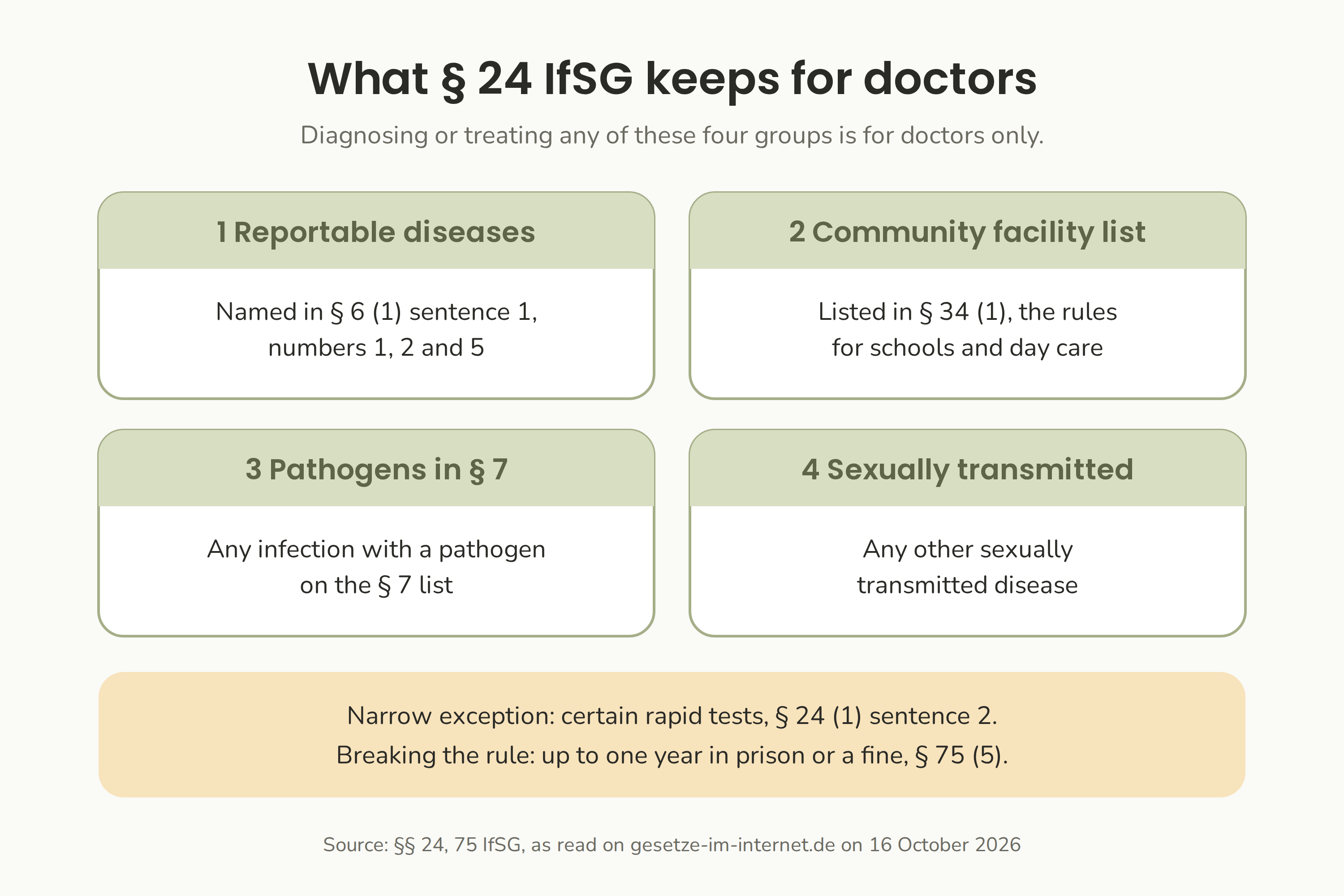
The four groups in plain words
The first group covers diseases named in § 6 (1) sentence 1, numbers 1, 2 and 5 (§ 6 IfSG). The second covers the diseases in § 34 (1), the list that keeps sick people out of schools and day care (§ 34 IfSG).
The third group is the widest. It covers an infection with any pathogen on the § 7 list, even when the disease is not named in § 6 (§ 7 IfSG). The fourth covers all other sexually transmitted diseases.
The narrow exception for rapid tests
There is one small opening. Anyone may use certain point-of-care tests, quick tests that give a result on the spot, whatever their profession (§ 24 (1) sentence 2 IfSG). Today the law names tests for HIV, hepatitis C, SARS-CoV-2 and Treponema pallidum.
The exception covers the test only. A positive result does not open the door to treatment, which stays with the doctor. The federal health ministry may widen the list of tests by regulation (§ 24 (2) IfSG).
What happens if you treat anyway
Treating a person against § 24 is a criminal offence. The penalty is up to one year in prison or a fine (§ 75 (5) IfSG).
In practice, your role ends at noticing. When you suspect an infection from the four groups, you stop, report where the law asks you to, and send the patient to a doctor.
What changed on 2 July 2026
The law changed this summer. The Apothekenversorgung-Weiterentwicklungsgesetz (ApoVWG), a pharmacy reform act, came into force on 2 July 2026 (BGBl. 2026 I Nr. 195, Article 7, via buzer.de). The table shows what changed for your practice.
| Topic | Before 2 July 2026 | Since 2 July 2026 |
|---|---|---|
| COVID-19 in § 6 | Report by name | Removed from the list |
| SARS-CoV-2 in § 7 | Diagnosis and treatment for doctors only | Unchanged, still for doctors only |
| Rapid tests in § 24 | Anyone may use certain tests | Same, plus pharmacists and nursing staff for five more pathogens, in their own pharmacy or care home |
| Doctors-only rule in § 24 | In force | Unchanged in substance |
COVID-19 is no longer a disease you report by name (§ 6 IfSG). SARS-CoV-2 stays on the pathogen list, so it still falls into group three (§ 7 IfSG).
Some training material online says § 24 was left unchanged. That is not correct. The section was restructured, even though its core rule stayed the same (comparison of old and new § 24 on buzer.de).
When must a Heilpraktiker report to the health office?
A Heilpraktiker must report every case listed in § 6 (1) sentence 1 to the health office by name (§ 8 (1) no. 8 IfSG). For the named diseases, a suspicion is already enough. The report must reach the office no later than 24 hours after you learned of the case.
This reporting duty, the Meldepflicht, is easy to underestimate. It covers all of § 6 (1) sentence 1, not only the groups from the treatment ban. And unlike some other health professions, your duty does not fall away just because a doctor was also involved (§ 8 (2) IfSG).
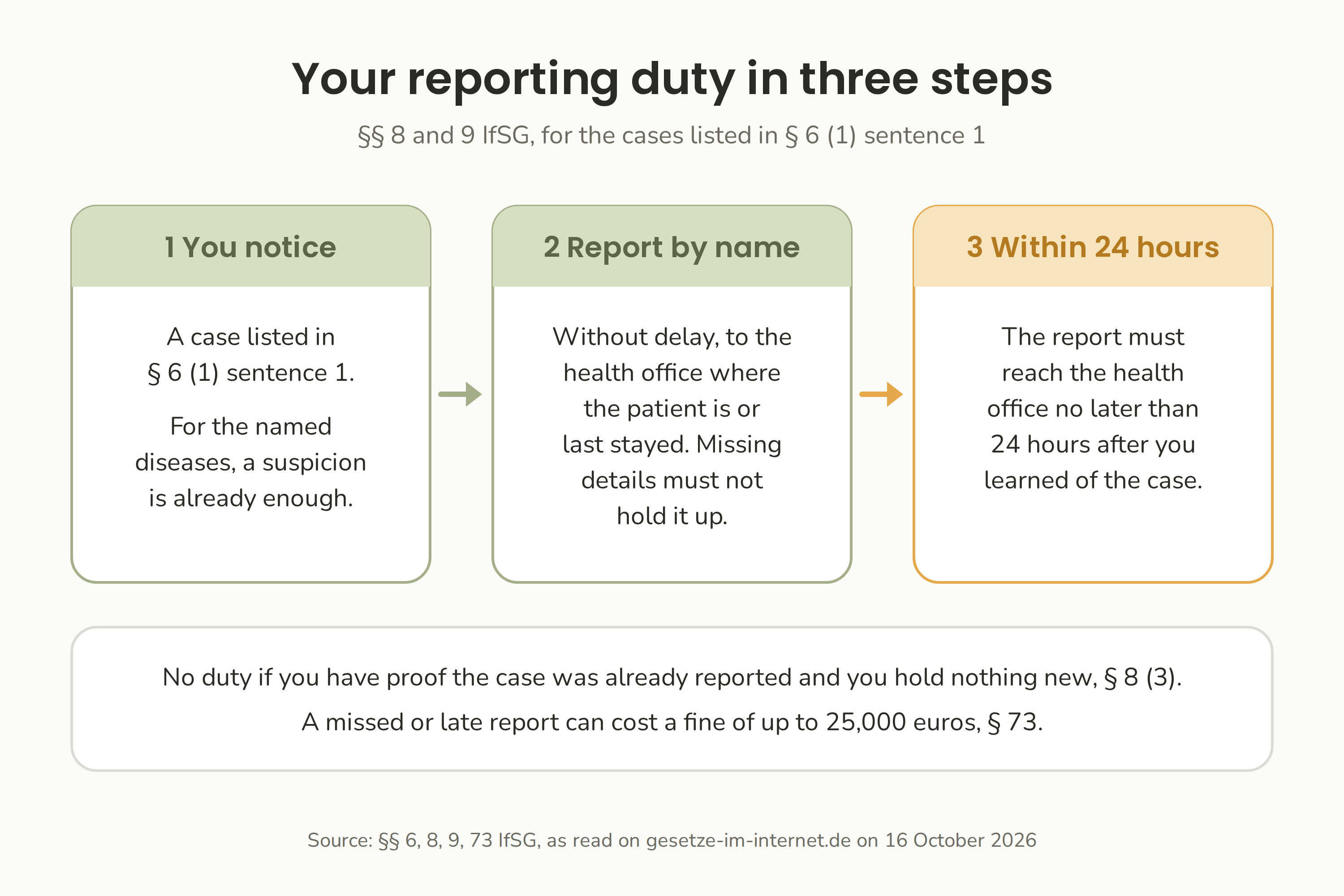
Deadline and the right office
The report must be made without delay. It must reach the competent health office no later than 24 hours after you learned of the case (§ 9 (3) IfSG). Missing details must not hold it up; you can send them afterwards.
The right office is the one for the place where the patient is staying, or last stayed (§ 9 (4) IfSG). For most patients that is their home district. Keep the phone and fax number of your local health office, the Gesundheitsamt, somewhere you can find in a hurry.
What goes into the report
The report contains what you know at that moment (§ 9 (1) IfSG). Most health offices provide a form for it.
- The patient's name, sex, date of birth, address and contact details
- The suspected or confirmed diagnosis and the relevant dates
- The likely place and route of infection, if you know them
- Your own name, address and contact details as the person reporting
When you do not have to report
You do not have to report if you have proof that the case was already reported and you have nothing new (§ 8 (3) IfSG). A patient telling you "my doctor has reported it" is not proof. A copy of the report or a note from the health office is.
A missed, wrong or late report is an administrative offence. It can cost a fine of up to 25,000 euros (§ 73 (1a) no. 2 and (2) IfSG).
Does a Heilpraktiker need the § 43 Belehrung?
In most cases, no. The § 43 Belehrung, a health office briefing on infection risks, is a food-work rule. It covers commercial work with the foods listed in § 42, or in kitchens that cook for others (§ 42 IfSG, § 43 IfSG).
The Robert Koch Institute titles its official briefing sheet "for people working in the food sector" (RKI briefing sheet). The foods include meat, milk, fish, egg products, baby food, ice cream, filled pastries, salads, sauces and sprouts. Treating patients is not on the list, so the law ties no § 43 duty to your practice.
How the § 43 Belehrung works
Before your first day of food work, you need a certificate from the health office or a doctor it commissions. That certificate must be no older than three months when you start (§ 43 (1) IfSG). You also confirm in writing that you know of no reason that bars you from the work.
After that, the employer repeats the briefing every two years and documents it (§ 43 (4) IfSG). The certificate and the latest record are kept at the workplace, and a self-employed person carries these duties alone (§ 43 (5) and (6) IfSG). Letting someone start without the certificate can cost a fine of up to 25,000 euros (§ 73 (1a) no. 20 and (2) IfSG).
When it does concern your practice
The briefing becomes your topic when your practice goes beyond treatment and into food. The table shows the common cases.
| Situation | § 43 briefing needed? |
|---|---|
| You treat patients and offer tea or water in the waiting room | No |
| You run a cooking course where you prepare listed foods for guests | Likely yes, check with your health office |
| You run a cafe or kitchen next to your practice | Yes, for everyone working with listed foods |
| You hire staff who prepare listed foods for others | Yes, and you must repeat the briefing every two years |
When in doubt, ask your health office. It can also tell you how it runs the first briefing and what it costs.
Who checks hygiene in a Heilpraktiker practice?
Your local health office can inspect your practice for infection hygiene. § 36 (2) IfSG lets it supervise any facility where blood could pass on pathogens through work on people (§ 36 IfSG). Health offices apply this to Heilpraktiker who work invasively, for example with injections (Giessen district guidance, August 2025).
The IfSG itself only allows inspection here; it does not require a hygiene plan from every practice. The detailed duties come from your federal state. Under § 23, each state may require a hygiene plan from practices of other health professions that do invasive work (§ 23 (5) IfSG).
An example from Hesse
Hesse shows how far a state can go. There, a Heilpraktiker who works invasively needs a 40-hour hygiene course. Under the state's infection hygiene regulation, a written hygiene plan with cleaning and disinfection steps is required too (Giessen district guidance, August 2025). Invasive work must also be reported to the health office before it starts (VUH, 2018).
Other states set their own rules, and they differ. Ask your health office which regulation applies in your state. Your professional association can usually send you a hygiene plan template that fits it.
A short IfSG checklist for your practice
Run through these seven questions once a year, or whenever you add a new method to your practice. They cover the four duties above: the treatment ban, the 24-hour report, the hygiene rules of your state and the rare case for the § 43 briefing. Each "no" shows you where to act.
- Do you know which four groups of infections § 24 keeps for doctors, including SARS-CoV-2 through § 7? (§ 24 IfSG)
- Do you have a routine for sending a patient to a doctor when you suspect one of them?
- Do you have the contact details and report form of your health office at hand? (§ 9 IfSG)
- Could you get a report to the health office within 24 hours, even on a Friday evening?
- Have you checked the latest § 6 list since the change on 2 July 2026? (§ 6 IfSG)
- If you work invasively, do you have the hygiene plan and training your state asks for? (§ 23 IfSG)
- Does any part of your practice involve preparing listed foods for others? Only then does § 43 come in. (§ 43 IfSG)
If you belong to a professional association, check its own guidance as well. Several associations publish their own summaries of the IfSG for members.
This article is general information, not legal advice. Talk to a lawyer or your health office for your own case.
Frequently asked
Does a Heilpraktiker need the § 43 Belehrung?
Usually not. The § 43 briefing is for people who work commercially with the foods listed in § 42 IfSG, or in kitchens that cook for others. It only concerns your practice if you or your staff prepare those foods for others, for example in a cooking course or a cafe.
Which infections may a Heilpraktiker not treat?
§ 24 IfSG keeps four groups for doctors: the reportable diseases in § 6 (1) sentence 1, numbers 1, 2 and 5; the diseases listed in § 34 (1); any infection with a pathogen listed in § 7; and any other sexually transmitted disease. Diagnosing them is also reserved for doctors.
How fast must a Heilpraktiker report a case to the health office?
Without delay. The report must reach the competent health office no later than 24 hours after you learned of the case (§ 9 (3) IfSG). Missing details must not hold it up; you send them afterwards.
Do Heilpraktiker still have to report COVID-19?
Not by name under § 6 any more. The pharmacy reform act ApoVWG removed COVID-19 from the § 6 list on 2 July 2026. SARS-CoV-2 is still listed in § 7, so diagnosing and treating it remains for doctors.
Sources
- § 1 IfSG - purpose
- § 6 IfSG - reportable diseases
- § 7 IfSG - reportable pathogens
- § 8 IfSG - who must report
- § 9 IfSG - content and deadline of a report
- § 23 IfSG - hygiene in medical facilities
- § 24 IfSG - treatment reserved for doctors
- § 34 IfSG - community facilities
- § 36 IfSG - infection hygiene supervision
- § 42 IfSG - food work
- § 43 IfSG - briefing and certificate
- § 73 IfSG - fines
- § 75 IfSG - criminal offences
- ApoVWG of 26 June 2026, Article 7 (buzer.de)
- Old and new § 24 IfSG compared (buzer.de)
- Robert Koch Institute, § 43 briefing sheet for the food sector
- Giessen district, hygiene rules for Heilpraktiker practices in Hesse, August 2025
- VUH, Hesse: invasive work must be reported, 2018
Written by
Vitalmyn Team
Editorial team
We are building the ordering service for practitioner recommendations. Here we write down what we learn about recommending, practice finances and advertising law, so you do not have to dig it up yourself.