A new patient asks what a session costs and whether her insurer will pay it back. You open a fee list that was last priced in 1985. As a Heilpraktiker, a state-licensed non-medical practitioner, you are free to set your own fee, and the GebüH is a list of what practices usually charged, not a law. This guide explains what it is, what it means for your prices, what Beihilfe and private insurers refund, and what your invoice must show.
Every section links to the source it rests on, so you can read the original wording yourself.
What is the GebüH and is it binding?
The GebüH is the Gebührenverzeichnis für Heilpraktiker, a list of average fees for Heilpraktiker services. Most people call it the Gebührenordnung für Heilpraktiker, but that name promises more than it is. It is not a fee schedule with the force of law. It is a guide to what practices usually charged, and insurers use it to decide what they refund (BDH, Gebührenverzeichnis).
Doctors in Germany bill under the GOÄ, a fee schedule set by federal regulation. Heilpraktiker have nothing like it. The Bund Deutscher Heilpraktiker (BDH) states that there is no fee schedule binding under state or federal law, and that the GebüH is an orientation aid for insurers and other cost bearers (BDH).
The numbers come from a statistical survey among Heilpraktiker in 1985. Six professional associations published the result: BDH, FDH, FH, FVDH, UDH and VDH. The amounts were converted to euros with a small adjustment, and the version dated 1 January 2002 is still the one in use (BDH). The BDH itself calls the list outdated, because it was never adjusted to today's costs.
So the GebüH does three jobs in your practice. It gives you a structure of numbered services, called Ziffern. It gives you a range per service that patients and insurers recognise. And it gives insurers a reference point for refunds. What it does not do is set your price.
How do you set your fee under German law?
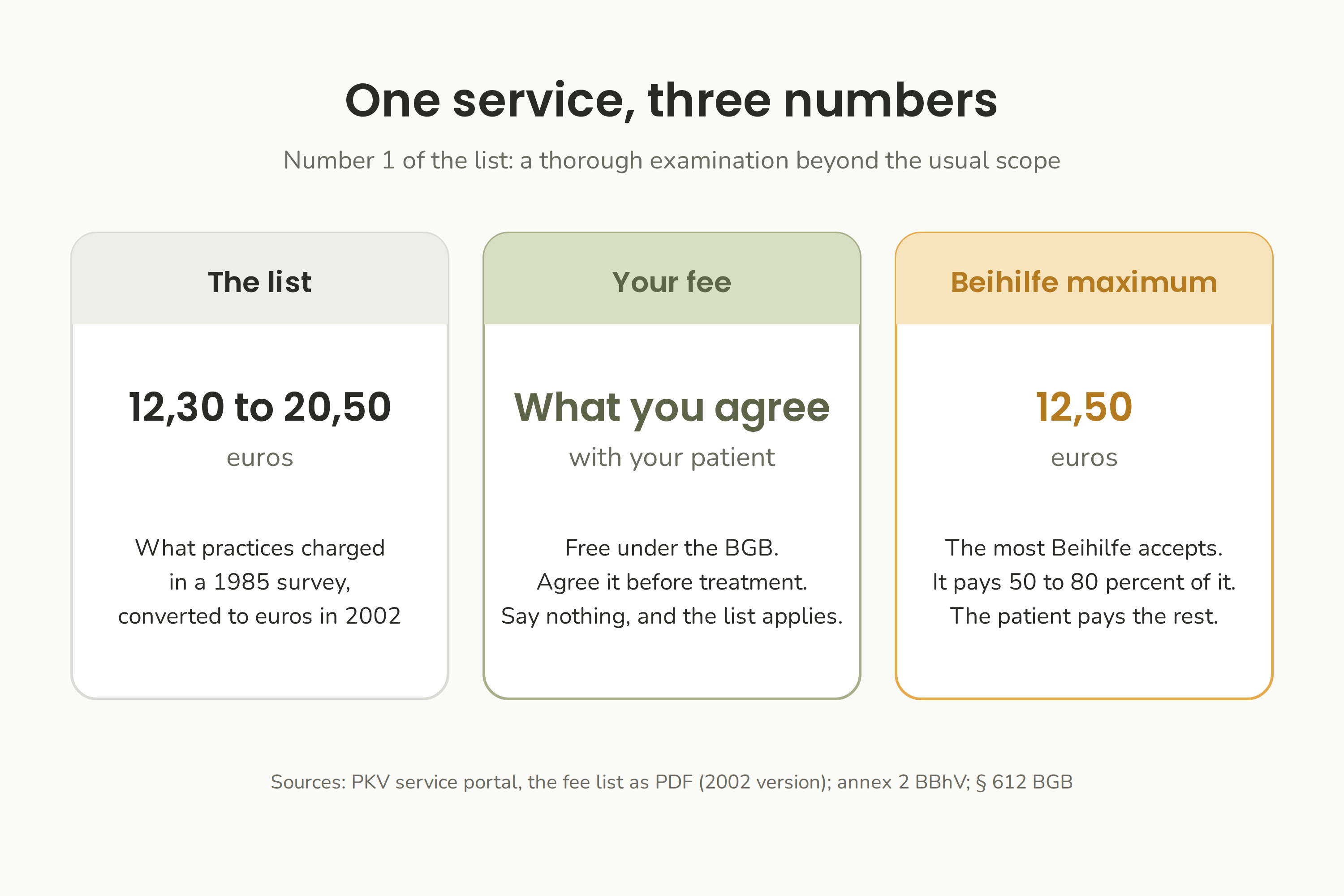
Your fee is whatever you and your patient agree. The treatment contract is a service contract under the German Civil Code (BGB), and the patient owes the agreed fee (§ 630a BGB). If you never named an amount, the law fills the gap. Where no official tariff exists, the usual fee counts as agreed (§ 612 BGB).
That usual fee, the übliche Vergütung in the law, is where the GebüH comes in. The Fachverband Deutscher Heilpraktiker (FDH) explains it this way: the fee is set by fair judgement under § 315 BGB, and a patient who was told nothing in advance may assume the fee falls inside the GebüH range (FDH, § 315 BGB). In plain words, if you say nothing, the old list becomes your price.
The way out is to agree the fee before the first session. Three habits keep that clean.
- Name your price per service or per time unit before treatment starts, in writing where you can. A signed fee agreement is the strongest form.
- Tell the patient which GebüH number you will put on the invoice. Insurers read the number, not your description.
- Say clearly that refunds depend on the patient's own insurance contract. You cannot promise what an insurer will pay.
A fee above the GebüH range is lawful when it was agreed. Billing software vendors describe a multiple of two to two and a half times the range as common practice when it was announced in advance, and warn that insurers cut unannounced higher fees back to the list (Patientify, 2026). That is a market observation, not a rule. The rule is simpler. Agreed in advance holds. Surprised on the invoice does not.
What do the GebüH numbers look like?
The GebüH groups services into numbered items, each with a range in euros. The first eight numbers cover general services such as examination and consultation. Later chapters cover written reports, lab work, injections, acupuncture, chiropractic and osteopathic treatment, baths and physical therapy. The full list is public, for example as a PDF on the PKV service portal (PKV-Serviceportal, GebüH as PDF).
The numbers you will use most are the ones for examination and consultation. These are the ranges in the 2002 version, with the Beihilfe maximum from the next section beside them.
| Number | Service, in short | GebüH range (2002) | Beihilfe maximum (BBhV) |
|---|---|---|---|
| 1 | Thorough examination beyond the usual scope | 12,30 to 20,50 euros | 12,50 euros |
| 2 | Full case history, homeopathic | 15,40 to 41,00 euros | 35,00 euros (2b), 80,00 euros for a first case history of at least one hour (2a) |
| 3 | Short information or repeat prescription | 4,50 euros | 3,00 euros |
| 4 | Thorough consultation of at least 10 to 15 minutes | 16,20 to 22,00 euros | 18,50 euros |
| 5 | Consultation, also by phone, with a short examination if needed | 8,20 to 20,50 euros | 9,00 euros |
| 9.1 | Home visit by day, including consultation | 21,50 to 29,50 euros | 24,00 euros |
| 21.1 | Acupuncture including pulse diagnosis | 10,30 to 26,00 euros | 23,00 euros |
GebüH ranges from the PKV service portal PDF and the Patientify guide; Beihilfe maxima from annex 2 of the federal Beihilfe regulation (BBhV). The annex was last amended in October 2025.
Two things stand out. The ranges are low, because they are 1985 prices with a euro conversion on top. And the Beihilfe maximum usually sits inside the range, close to the lower end. A practice that bills at the top of the range is already above what Beihilfe accepts for most numbers.
To look up any number and add up an invoice, use our free GebüH calculator. It has all 147 items of the list with their ranges, and you can copy or print the total.
How much do Beihilfe and private insurers refund?
Beihilfe refunds a share of a fixed maximum per GebüH number. Private insurers refund whatever the patient's tariff says. In both cases the money goes to the patient, not to you. Your claim is against the patient, and the patient's claim is against the insurer.
Beihilfe: a maximum per number, then a percentage
Civil servants and their families get Beihilfe, a state contribution to medical costs. For Heilpraktiker services, the federal rules accept a fee only up to the maximum amount listed in annex 2 of the BBhV (annex 2 BBhV, § 6 BBhV). Anything above that maximum is not refundable, however well it was agreed.
Beihilfe then pays its share of that maximum. The share is the personal rate, usually 50, 70 or 80 percent depending on the person's situation (§ 46 BBhV). For a number with a maximum of 18,50 euros and a rate of 50 percent, Beihilfe pays 9,25 euros. The patient covers the rest, often through a supplementary private tariff.
The federal rules apply to federal civil servants. Each state has its own Beihilfe regulation with its own table. North Rhine-Westphalia uses a separate list of maximum amounts, and Bavaria lists its amounts in annex 1 of its own regulation (Beihilfe NRW, Heilpraktiker, BayBhV, annex 1). Ask a patient with Beihilfe which authority pays, and check that table.
Private insurers: it depends on the tariff
A private health insurer refunds Heilpraktiker services only if the patient's tariff includes them. Some full tariffs cover a large share of the GebüH range. Supplementary tariffs often cap the yearly amount, for example at 500 or 1.000 euros (Patientify, 2026). Some tariffs refund nothing for Heilpraktiker at all.
Many tariffs also limit refunds to methods listed in the Hufeland directory, a catalogue of naturopathic therapies kept by the Hufelandgesellschaft (Hufelandgesellschaft). The GebüH says what a service is worth. The Hufeland directory says whether the method counts as a recognised one. A patient with a private tariff may need both to match.
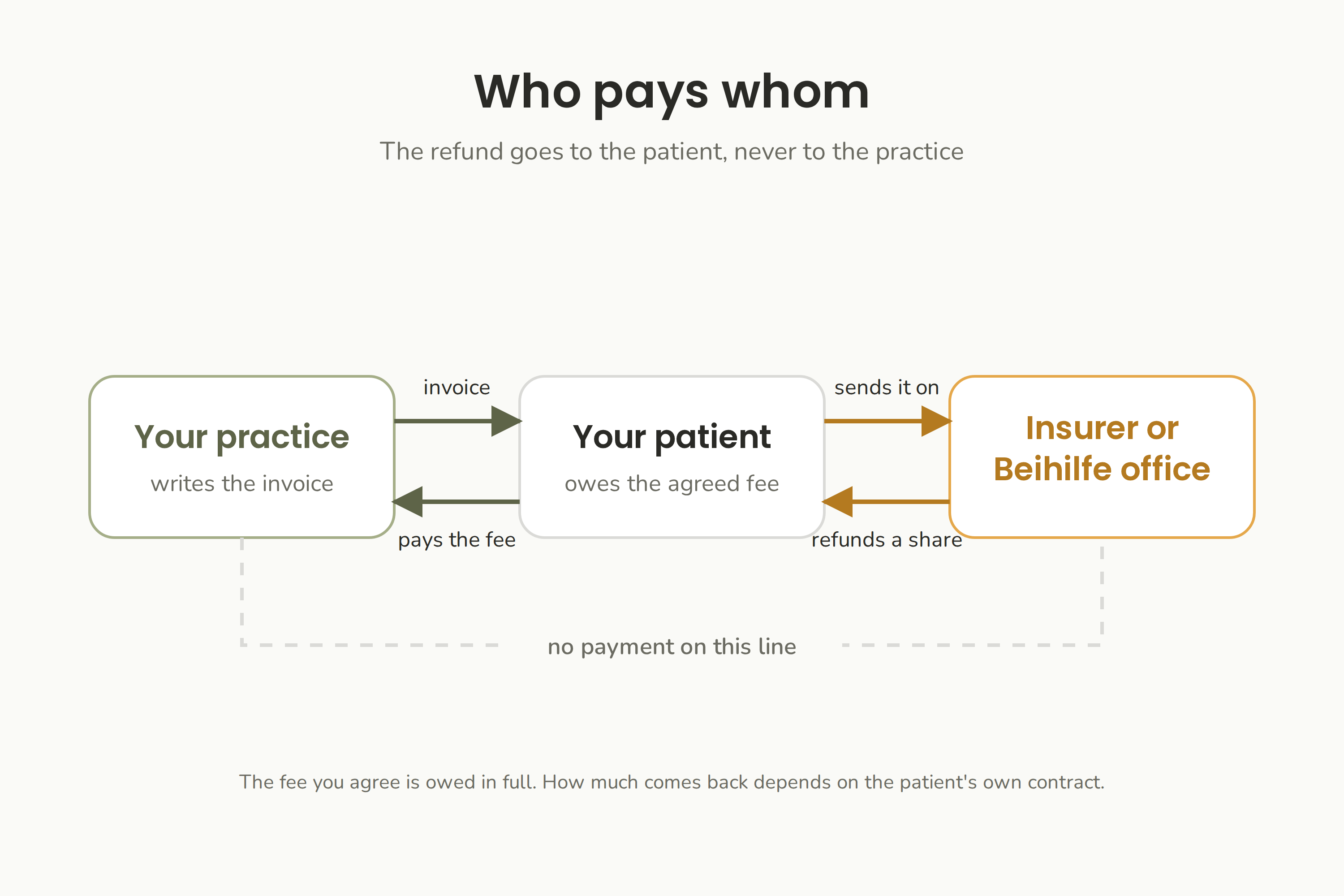
The practical consequence is one sentence on your price list and on your website: the patient pays the invoice, and the refund depends on their own contract.
What must a Heilpraktiker invoice show?
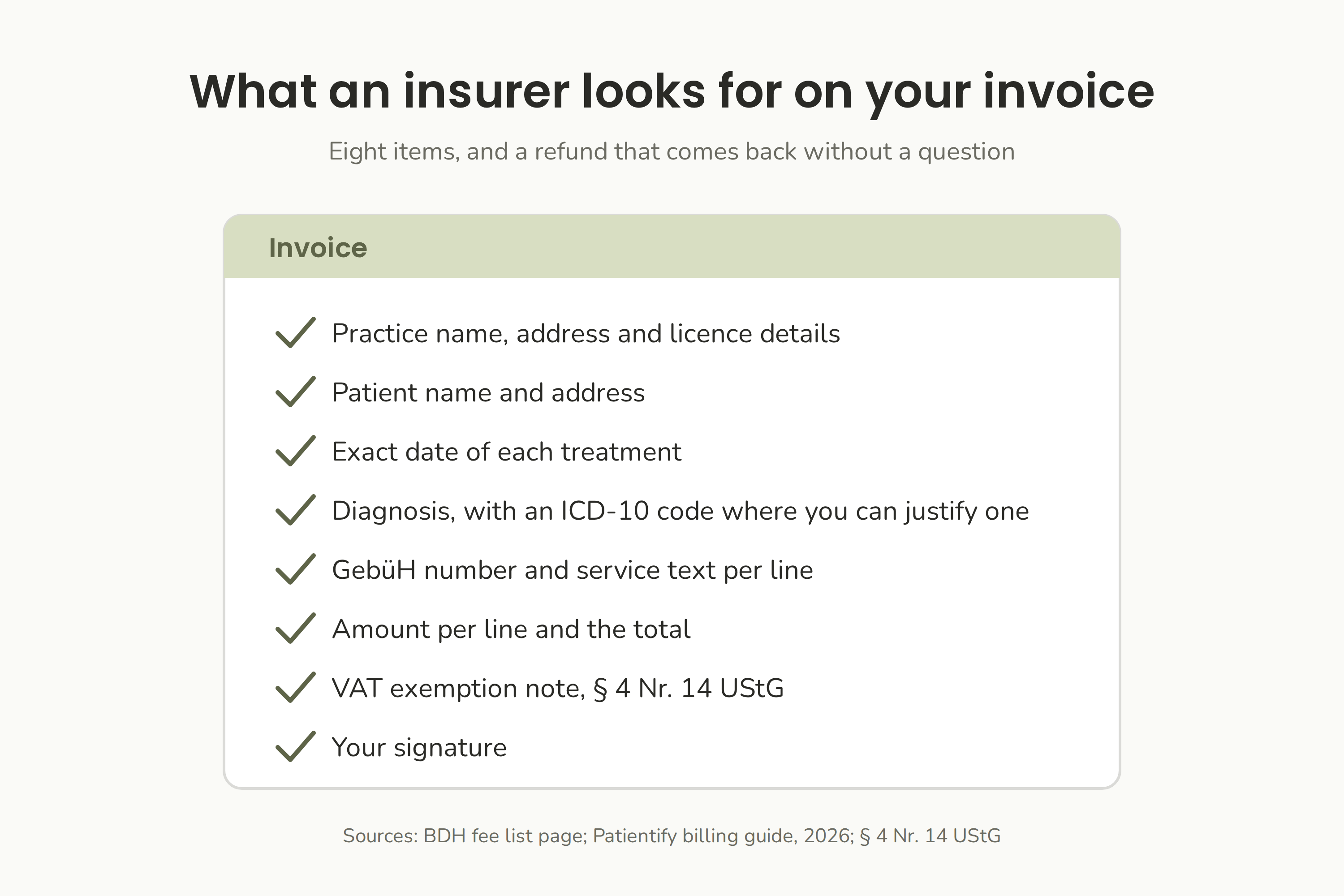
An invoice that an insurer or Beihilfe office can process names the practice, the patient, the date of each treatment, a diagnosis, and every service with its GebüH number and amount. It states the VAT exemption and carries your signature. Miss one of these and the refund comes back with a question.
There is no single law that lists these items for Heilpraktiker invoices. They come from what insurers and Beihilfe offices ask for in practice, and billing guides for the profession agree on the list (Patientify, 2026). The BDH adds that the reviewer at the insurer must be able to see a coherent treatment concept that fits the stated diagnosis (BDH).
A few of these need a word of explanation.
- The diagnosis. Insurers increasingly want an ICD-10 code next to the free text. Write the code you can justify from your records.
- The date. Each treatment day on its own line, with the exact day. A month alone is not enough.
- The number. One GebüH number per service, with the short service text from the list. If you charge above the range, the agreed fee goes on the line, not the range.
- The VAT note. Treatment as a Heilpraktiker is exempt from VAT under § 4 Nr. 14 UStG, and the invoice says so (§ 4 UStG). Work that is not treatment, such as a lecture or a product sale, is taxed and belongs on a separate invoice.
An invoice number and a payment deadline are not required for the refund, but they make your own bookkeeping easier and are required if you issue invoices for taxable work.
Is there a GebüH 2026?
No. There is no 2026 edition of the GebüH. The version dated 1 January 2002 is the current one, and it still rests on the 1985 survey. The BDH describes it as essentially outdated and names no planned update (BDH).
What does change is the Beihilfe side. The federal maximum amounts in annex 2 of the BBhV are set by regulation and were last amended in October 2025 (annex 2 BBhV). When a patient with Beihilfe asks why her refund looks different from last year, that table is the first place to look.
For your own prices, a search for a current year version leads nowhere. What you can update every year is your fee agreement.
Does the GebüH cover psychotherapy, osteopathy and physiotherapy?
The GebüH has numbers for manual and physical treatments, but it was written for a general naturopathic practice in 1985. A Heilpraktiker limited to psychotherapy or to physiotherapy finds few items that fit, and prices those services by time in a fee agreement.
The Beihilfe table shows which chapters exist. Chiropractic treatment sits under number 34, osteopathic treatment of individual joints under number 35, massage and physical therapy under number 20, and baths and electrotherapy under numbers 36 to 39 (annex 2 BBhV). A full osteopathic session as practised today does not match the single-joint items of 1985, which is why many practices agree a session fee and name the closest number on the invoice.
For psychotherapy, check your patient's tariff before the first session. Many private tariffs and Beihilfe rules treat psychotherapy by a Heilpraktiker differently from physical treatment, and some exclude it. The fee you agree stays valid either way. The refund does not.
A quick check before you send the next invoice
- Did you agree the fee before treatment, in writing where possible? (§ 612 BGB)
- Does each line carry a GebüH number, the service text and the amount? The GebüH calculator gives you all three.
- Does each line carry the exact treatment date?
- Is there a diagnosis the insurer can read, with an ICD-10 code where you can justify one?
- Does the invoice state the VAT exemption under § 4 Nr. 14 UStG? (§ 4 UStG)
- Is it signed?
- For a patient with Beihilfe: do you know which state's table applies, and did you tell her that amounts above the maximum are hers to pay? (annex 2 BBhV)
- For a privately insured patient: did you say that the refund depends on her tariff?
If you belong to a professional association, use its billing guide as well. The BDH and the FDH both publish one for members.
This article is general information, not tax or legal advice. Talk to your tax adviser or a lawyer for your own case. All law texts were read on gesetze-im-internet.de on 17 October 2026.
About this blog
This blog is written by the team at Vitalmyn. We build an ordering service for practitioner recommendations, and we write guides on the business side of running a Heilpraktiker practice in Germany.
Frequently asked
Is the GebüH binding for Heilpraktiker?
No. The GebüH is a list of average fees published by six professional associations after a 1985 survey. There is no fee schedule for Heilpraktiker with the force of law. Your fee is what you agree with your patient under the German Civil Code.
Can a Heilpraktiker charge more than the GebüH?
Yes, if the fee was agreed before treatment, ideally in writing. Without an agreement the usual fee applies, and courts and insurers read the GebüH range as the usual fee. Insurers and Beihilfe still refund only what the patient's tariff or the Beihilfe table allows.
What does Beihilfe pay for Heilpraktiker services?
Beihilfe accepts a fee only up to the maximum per GebüH number in annex 2 of the federal Beihilfe regulation, and then pays its personal rate of that maximum, usually 50, 70 or 80 percent. Each state has its own table and rate.
Is there a new GebüH for 2026?
No. The current GebüH is the version dated 1 January 2002, which still rests on the 1985 survey. What changes are the Beihilfe maximum amounts, which were last amended in October 2025.
Sources
- BDH: the fee list for Heilpraktiker (German)
- FDH: the fee list for Heilpraktiker (German)
- PKV service portal: the GebüH as PDF
- § 612 BGB - the usual fee
- § 630a BGB - the treatment contract
- § 315 BGB - fair judgement
- Annex 2 BBhV - maximum amounts for Heilpraktiker services
- § 6 BBhV - refundable expenses
- § 46 BBhV - the personal rate
- § 4 UStG - VAT exemption for treatment
- Beihilfe North Rhine-Westphalia: Heilpraktiker services
- Bavaria: annex 1 BayBhV
- Hufelandgesellschaft: the Hufeland directory
- Patientify: GebüH billing guide, 2 October 2026
Written by
Vitalmyn Team
Editorial team
We are building the ordering service for practitioner recommendations. Here we write down what we learn about recommending, practice finances and advertising law, so you do not have to dig it up yourself.