Your lab or software provider may already send invoices as data files. As a Heilpraktiker, a state-licensed non-medical practitioner, you must be able to receive these e-invoices since 1 January 2025. Patient invoices stay as they are. Sending e-invoices only matters for taxable work you bill to another business, from 2027 or 2028.
Most of your invoices go to private patients. The e-invoice rules sit in the German VAT Act (UStG) and target trade between businesses. This guide sorts your invoices into the ones that change and the ones that do not, with every date and the law behind it.
What counts as an e-invoice?
An e-invoice is an invoice in a structured electronic format that is sent, received and processed by software. That is how § 14 (1) UStG defines it. A PDF sent by email is not an e-invoice. Neither is a scan or a paper invoice, which the law calls "other invoices".
The format must follow the European standard EN 16931. In Germany the two common formats are XRechnung, a pure data file, and ZUGFeRD from version 2.0.1, a PDF with the data file built in. The Federal Ministry of Finance lists both in its FAQ on e-invoicing. With ZUGFeRD you read the PDF as usual while your software reads the data.
| What you receive or send | Counts as an e-invoice? |
|---|---|
| XRechnung data file | Yes |
| ZUGFeRD 2.0.1 or later, except the MINIMUM and BASIC-WL profiles | Yes |
| PDF attached to an email | No |
| Paper invoice or scan | No |
Do Heilpraktiker have to send e-invoices to patients?
No. The duty to issue an e-invoice applies only when you bill another business in Germany for its business purposes (§ 14 (2) UStG). Your private patients are not businesses. Their invoices can stay on paper or go out as a PDF, exactly as today.
There is a second reason, and it also covers some invoices to companies. Treatments in human medicine by a Heilpraktiker are VAT-exempt under § 4 no. 14 UStG. The law lifts the duty to issue an invoice for supplies that are tax-exempt under § 4 nos. 8 to 29 (§ 14 (2) UStG). So a VAT-exempt treatment needs no e-invoice, even when a company pays for it.
The exemption covers treatments in human medicine (§ 4 no. 14 UStG). A talk, a course or coaching that is not such a treatment can be taxable. That is where the e-invoice rules can reach your practice.
When does your practice have to send an e-invoice?
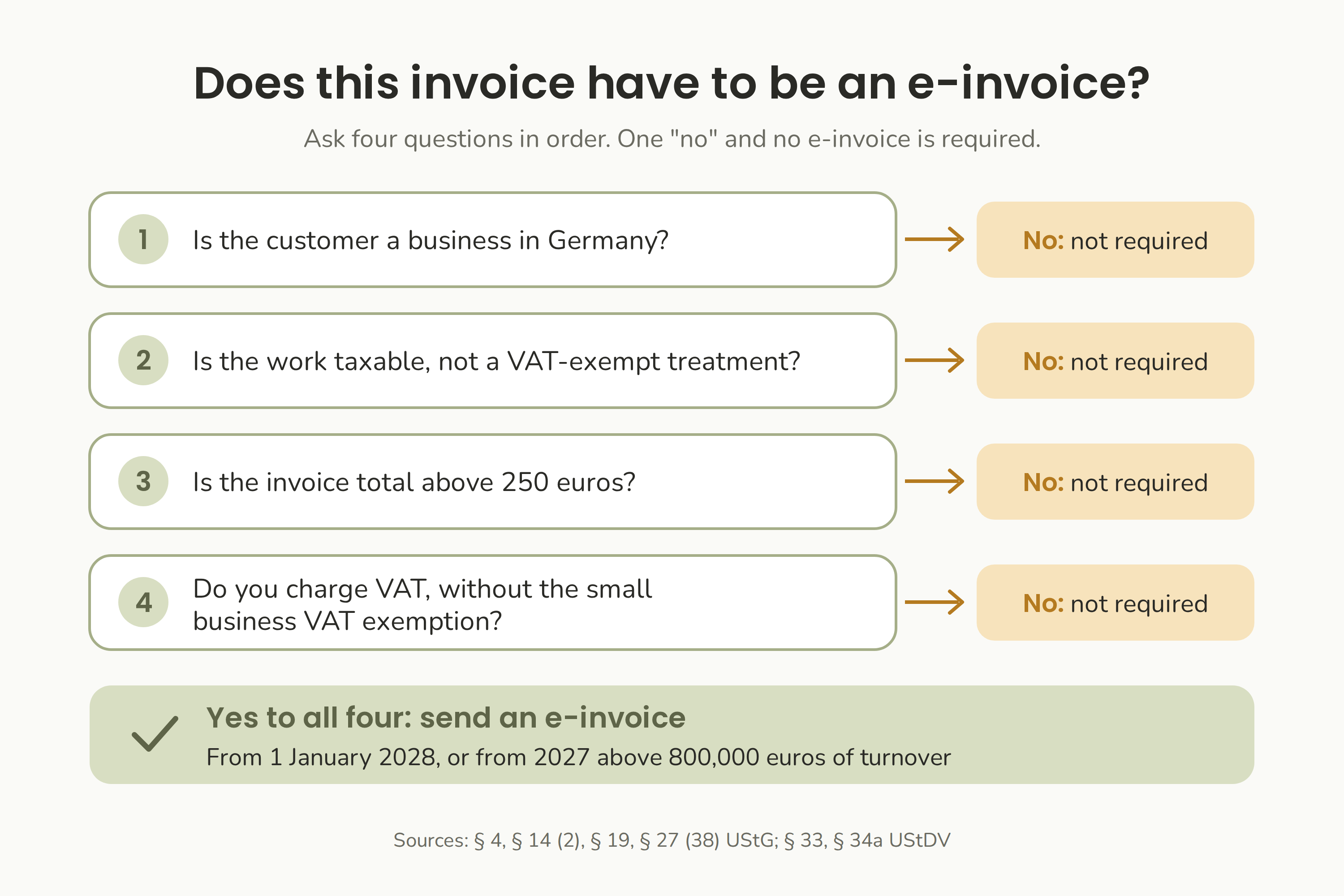
You have to send an e-invoice only when three things are true at once. You bill another business in Germany, the work is taxable, and no exemption applies. Even then, the duty starts in 2027 or 2028, depending on your turnover (§ 27 (38) UStG).
Typical cases in a practice, if the work is taxable:
- A paid talk or workshop for a company's staff
- A course you teach for another practice or a training provider
- An article you write for a publisher
The exemptions that cover most practices
Most of your invoices fall under at least one exemption. The table shows the common ones and the rule behind each.
| Situation | E-invoice needed? | Rule |
|---|---|---|
| Invoice to a private patient | No | § 14 (2) UStG |
| VAT-exempt treatment, even if a company pays | No | § 4 no. 14 UStG, § 14 (2) UStG |
| Invoice of 250 euros or less in total (limit as of 2026) | No. Paper, or a PDF if the customer agrees | § 33 UStDV |
| You use the small business VAT exemption | No. Paper, or a PDF if the customer agrees | § 34a UStDV |
| Taxable work for a business in Germany | Yes, from 2027 or 2028 | § 27 (38) UStG |
The small business VAT exemption
Under § 19 UStG you charge no VAT if your total turnover stayed at or below 25,000 euros last year. It must also stay at or below 100,000 euros this year (thresholds as of 2025). VAT-exempt treatments under § 4 nos. 11 to 29 do not count toward that total (§ 19 (2) UStG).
If you use this exemption, you may always send paper invoices, or a PDF if the customer agrees (§ 34a UStDV). You never have to send an e-invoice. The duty to receive them still applies to you.
Which deadlines apply: 2025, 2027 or 2028?
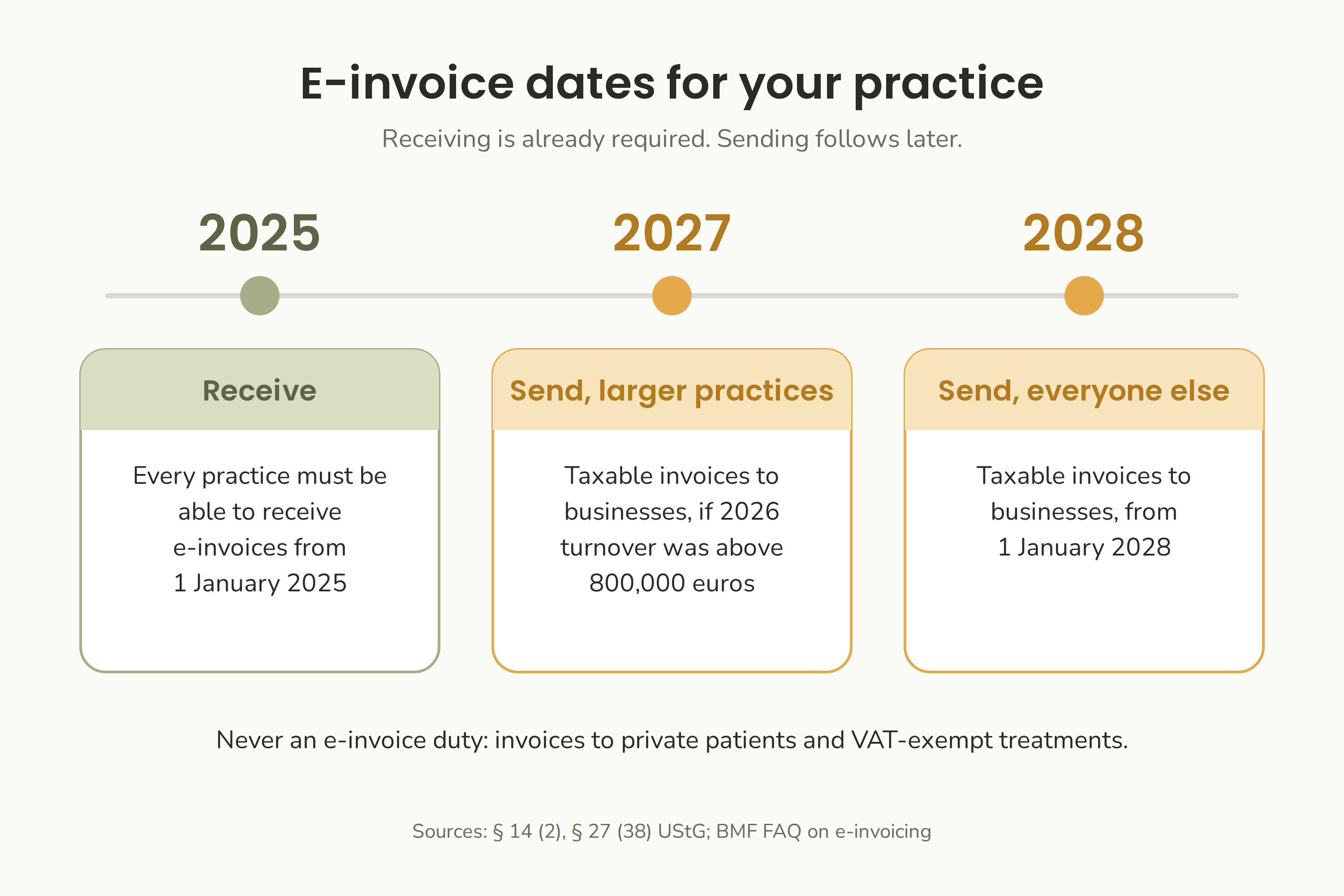
Receiving has been required since 1 January 2025. Sending starts in 2027 for businesses with more than 800,000 euros of total turnover in the previous year. Everyone else follows in 2028 (§ 27 (38) UStG). For most practices, the sending date that matters is 1 January 2028.
| Date | What changes for your practice |
|---|---|
| 1 January 2025 | You must be able to receive e-invoices. You may still send paper, or a PDF if the customer agrees. |
| 1 January 2027 | Above 800,000 euros of total turnover in 2026, taxable invoices to businesses must be e-invoices. |
| 1 January 2028 | Everyone else: taxable invoices to businesses must be e-invoices. |
The 800,000 euro line uses the same total turnover as the small business exemption. VAT-exempt treatments do not count toward it (§ 27 (38) UStG, § 19 (2) UStG).
How do you receive e-invoices in your practice?
Every business in Germany must be able to receive e-invoices since 1 January 2025. That includes businesses with only VAT-exempt turnover and those using the small business exemption (BMF FAQ on e-invoicing). When a supplier has to send you an e-invoice, it does not need your consent. An email inbox is enough to receive them.
The harder part is reading them. A ZUGFeRD invoice opens like any PDF. An XRechnung is a data file, so you need a viewer or accounting software that shows it as a readable invoice. Your lab, your software provider, your accountant or a supplier of practice materials may send you either.
Storing e-invoices
Keep every invoice you send or receive for eight years (§ 14b UStG). For an e-invoice, keep the structured data file in its original form, not only a printout or an image of it (BMF FAQ on e-invoicing). Check that your archive or accounting software stores the data file itself.
A short checklist for your practice
Work through these steps once, then check them again each January, when last year's turnover is known.
- Choose one email address for incoming invoices and give it to every supplier.
- Make sure you can open an XRechnung, with a viewer or your accounting software.
- Store each e-invoice as its original data file for eight years.
- List every invoice you send to a business, not a patient.
- For each one, ask your tax adviser whether the work is VAT-exempt or taxable.
- If you use the small business VAT exemption, note that you never have to send e-invoices.
- If you have taxable work for businesses, set up invoicing software that writes XRechnung or ZUGFeRD before 1 January 2028, or 2027 above 800,000 euros of turnover.
This article is general information, not tax or legal advice. Talk to your tax adviser for your own case. All law texts were read on gesetze-im-internet.de on 13 October 2026.
Frequently asked
Do Heilpraktiker have to send e-invoices to patients?
No. The duty only covers invoices to other businesses in Germany. Invoices to private patients can stay on paper or go out as a PDF.
Who does not have to send e-invoices?
Businesses using the small business VAT exemption, invoices of 250 euros or less, and VAT-exempt supplies under § 4 nos. 8 to 29 UStG, which include treatments by a Heilpraktiker.
Does a Heilpraktiker have to be able to receive e-invoices?
Yes, since 1 January 2025. This also applies to practices with only VAT-exempt turnover. An email inbox is enough to receive them.
Sources
- § 4 UStG - tax exemptions (no. 14: treatments in human medicine)
- § 14 UStG - issuing invoices, definition of the e-invoice
- § 14b UStG - storing invoices
- § 19 UStG - small business VAT exemption
- § 27 (38) UStG - transition rules for e-invoices
- § 33 UStDV - invoices of 250 euros or less
- § 34a UStDV - invoices under the small business VAT exemption
- Federal Ministry of Finance (BMF), FAQ on e-invoicing
Written by
Vitalmyn Team
Editorial team
We are building the ordering service for practitioner recommendations. Here we write down what we learn about recommending, practice finances and advertising law, so you do not have to dig it up yourself.