As a Heilpraktiker, a state-licensed non-medical practitioner, your treatments are VAT-exempt under § 4 no. 14 UStG when they have a therapeutic aim. Talks, wellness offers, reports and product sales are not covered. Those sales count toward the small business line of 25,000 euros a year (as of 2026). Your treatment fees do not.
A patient asks to buy the supplement you recommended, so you keep a few packs in the cupboard. A year later your tax adviser asks how much you sold. This guide shows which parts of a practice pay VAT, where the small business line sits in 2026, and what product sales change.
Which treatments are VAT-exempt under § 4 no. 14 UStG?
Treatments in human medicine that you carry out as a Heilpraktiker are VAT-exempt. The German VAT Act (UStG) names the Heilpraktiker next to doctors, dentists, physiotherapists and midwives in § 4 no. 14 (a) UStG. The test is the aim of the work: diagnosing, treating or preventing an illness.
The tax administration spells out that test in its VAT guidance, the VAT application decree (UStAE), section 4.14.1. Healthcare services are exempt only when a therapeutic aim comes first. So the exemption needs your qualification as a Heilpraktiker and a therapeutic purpose for each service.
You charge no VAT on treatments. In return, you cannot reclaim the VAT you pay on costs that serve them, such as a treatment couch or practice software (§ 15 (2) no. 1 UStG). A purely treating practice books the VAT on its costs as a plain expense.
What in your practice is taxable?
Anything without a therapeutic aim falls outside the exemption, and so does any sale of goods. In a typical practice that means reports for insurers, beauty offers, general health courses, talks and teaching, and products a patient takes home. The table sorts the common cases, based on section 4.14.1 of the VAT application decree.
| What your practice does | VAT-exempt? | Why |
|---|---|---|
| Diagnosis and treatment of a patient | Yes | Therapeutic aim, § 4 no. 14 (a) UStG |
| A remedy you use up during the session | Yes, as part of the treatment | It serves the treatment and is no separate sale |
| Supplements, books or aids a patient takes home | No | A sale of goods, not a treatment |
| Reports for an insurer, an authority or an employer | No | No therapeutic aim, listed in section 4.14.1 (5) UStAE |
| Beauty treatments without a medical reason | No | No therapeutic aim, listed in section 4.14.1 (5) UStAE |
| Prevention courses with no direct link to an illness | No | Listed in section 4.14.1 (5) UStAE |
| Talks, seminars, articles | Usually no | Not a treatment; some teaching has its own exemption |
Taxable does not mean you charge VAT straight away. It means these sales count toward the small business line in the next section. Many practices with a few product sales a year stay below it.
How does the small business exemption work for Heilpraktiker?
Since 1 January 2025, § 19 UStG has two limits. A business charges no VAT if its total turnover was at most 25,000 euros last year and stays at most 100,000 euros this year. The two figures are unchanged for 2026. For a Heilpraktiker, the key question is which turnover counts.
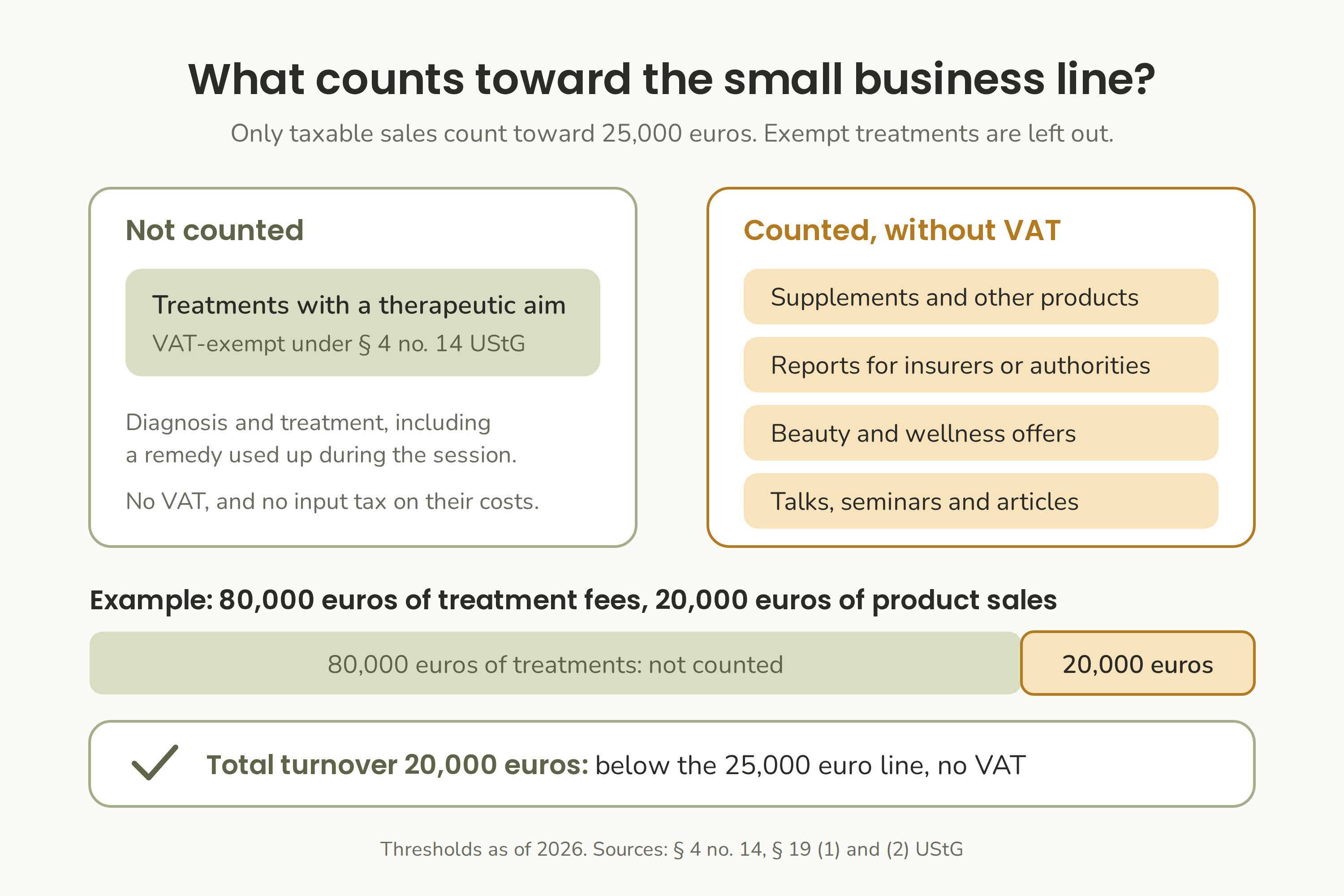
Your treatment fees do not count
The law takes sales that are exempt under § 4 nos. 11 to 29 out of the total turnover (§ 19 (2) UStG). Exempt treatments under § 4 no. 14 fall inside that range. So for your practice, total turnover means only the taxable part: product sales, talks, wellness and reports.
A practice with 80,000 euros of treatment fees and 20,000 euros of product sales has a total turnover of 20,000 euros. It stays below the line. The amounts are counted without VAT, as the Federal Ministry of Finance confirms in its letter of 18 March 2025.
What happens when you cross the line
There are two lines, and they work differently. Last year's total decides whether you start the year with the exemption. This year's total can end it during the year.
- Last year above 25,000 euros: no small business exemption this year. You charge VAT on taxable sales from 1 January.
- This year above 100,000 euros: the exemption ends with the very sale that crosses the line. That sale already carries VAT (BMF letter of 18 March 2025).
While the exemption applies, you show no VAT and file no VAT returns. You also reclaim no input tax, which is the VAT on your own purchases (§ 19 (1) UStG, § 15 (2) UStG).
Opting out of the exemption
You can give up the small business exemption and charge VAT on purpose. The choice binds you for at least five calendar years (§ 19 (3) UStG). It can pay off when the taxable part of the practice has large costs with VAT on them. Ask your tax adviser before you file it.
What happens to VAT when your practice sells supplements?
Product sales are taxable sales of goods. As long as all your taxable sales stay within the small business line, you still charge no VAT on them. Once they pass 25,000 euros in a year, you charge VAT on product sales from the next 1 January. Your treatments stay exempt the whole time.
The table shows three invented practices. All figures are net, without VAT, and only illustrate the rule.
| Practice | Treatment fees 2025 | Taxable sales 2025 | What applies in 2026 |
|---|---|---|---|
| A | 60,000 euros | 8,000 euros | Small business exemption, no VAT on products |
| B | 45,000 euros | 27,000 euros | VAT on product sales from 1 January 2026, treatments stay exempt |
| C | 30,000 euros | 22,000 euros | Exemption at the start of the year; taxable sales pass 100,000 euros in November, so VAT applies from that sale on |
Which VAT rate applies to supplements?
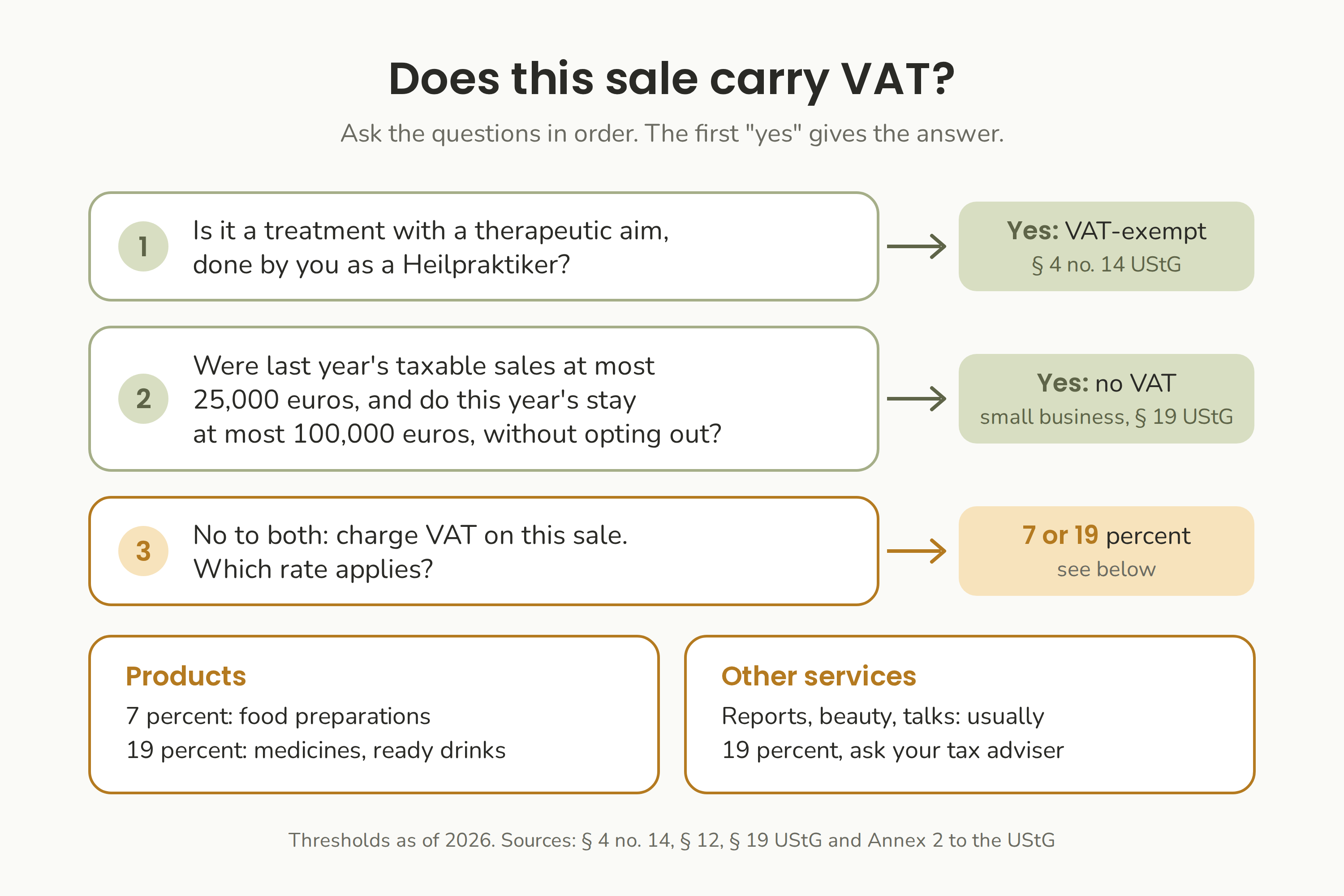
Supplements are taxed at 7 or 19 percent, depending on how the product is classified in the customs tariff. Food preparations under tariff heading 2106 are on the list of reduced-rate goods in Annex 2 to the UStG, so they carry 7 percent. Products classified as medicines are not on that list and carry 19 percent.
The Federal Fiscal Court (BFH) has confirmed that only the customs rules decide whether the reduced rate applies (VII R 9/17). Ready-to-drink products can count as beverages and then carry 19 percent. The rate your supplier charges you on the invoice is a good first guide. Check it with your tax adviser before you set your own prices.
Input tax once you charge VAT
Once you charge VAT on product sales, you can reclaim the VAT on purchases for them, such as stock (§ 15 (1) UStG). Costs that serve only your exempt treatments stay excluded. Costs that serve both, such as accounting software, are split by a fair key (§ 15 (4) UStG).
VAT returns
Charging VAT also means filing advance VAT returns through ELSTER, the tax office's online portal. The standard period is the calendar quarter. You file monthly if last year's VAT was above 9,000 euros. The tax office can release you from these returns if it was 2,000 euros or less (§ 18 (2) UStG, figures as of 2026). An annual VAT return follows each year.
A note on trade tax
Product sales can touch a second tax. Treatment income counts as a liberal profession, and § 18 (1) no. 1 EStG names the Heilpraktiker there. Selling goods is a trade, so the tax office may treat your product sales as a separate business for trade tax.
For a sole practitioner, trade profit up to 24,500 euros a year (as of 2026) is free of trade tax (§ 11 (1) GewStG). In a partnership, trade income can make the whole practice a trade (§ 15 (3) no. 1 EStG). The BFH accepts a small share without that effect (judgment of 27 August 2014, VIII R 6/12). The limit is 3 percent of net turnover and at most 24,500 euros a year.
What must your invoices say about VAT?
For an exempt treatment, the VAT Act does not oblige you to issue an invoice to a private patient. If you issue one, it must state that the treatment is VAT-exempt (§ 14 (4) no. 8 UStG). Name the rule as well: § 4 no. 14 UStG.
| What is on the invoice | What the invoice must show | Rule |
|---|---|---|
| Exempt treatment only | A note that the treatment is VAT-exempt | § 14 (4) no. 8 UStG |
| Products under the small business exemption | One total and a note that the small business exemption applies | § 34a UStDV |
| Products with VAT | Net amount, VAT rate and VAT amount for each rate | § 14 (4) UStG |
| Treatment and products together | Separate lines, the exemption note on the treatment, VAT on the products | § 14 (4) UStG |
An invoice of up to 250 euros may use a shorter form, but it still needs the VAT rate or the exemption note (§ 33 UStDV). For the fee items on your treatment lines, see our guide to the GebüH fee schedule. Taxable invoices to other businesses must become e-invoices by 2028, unless you use the small business exemption, as our guide to e-invoicing for Heilpraktiker explains.
A year-end VAT check for your practice
Run through these steps each January, once last year's figures are known. They tell you whether you charge VAT this year, at which rate, and what your invoices must show. The work is easier when your books keep treatment fees and product sales apart from the start.
- Split last year's income into exempt treatments and taxable sales: products, talks, wellness, reports.
- Add up the taxable sales without VAT. That is your total turnover under § 19 UStG.
- At 25,000 euros or less, the small business exemption applies this year. Above it, you charge VAT on taxable sales from 1 January.
- If you charge VAT on products, check the rate for each product, 7 or 19 percent.
- Keep treatment lines and product lines apart on every invoice.
- Watch this year's taxable sales during the year. The exemption ends the moment they pass 100,000 euros.
This article is general information, not tax or legal advice. Talk to your tax adviser for your own case. All law texts were read on gesetze-im-internet.de on 20 October 2026.
About this blog
This blog is written by the team at Vitalmyn. We build an ordering service for practitioner recommendations, and we write guides on the business side of running a Heilpraktiker practice in Germany.
Frequently asked
Do Heilpraktiker have to charge VAT?
Not on treatments. Treatments in human medicine with a therapeutic aim are VAT-exempt under § 4 no. 14 UStG. VAT can apply to other work in the practice, such as product sales, reports, beauty offers or talks, once those sales pass the small business line of 25,000 euros a year.
Do treatment fees count toward the small business line?
No. § 19 (2) UStG takes sales that are exempt under § 4 nos. 11 to 29 out of the total turnover, and exempt treatments fall under § 4 no. 14. Only the taxable part of the practice counts, measured without VAT.
Can a Heilpraktiker reclaim input tax?
Only for costs tied to taxable sales on which the practice charges VAT, such as stock for product sales. Costs that serve exempt treatments stay excluded under § 15 (2) UStG, and mixed costs are split. Under the small business exemption there is no input tax at all.
What VAT rate applies to supplements sold in a practice?
7 or 19 percent, depending on the customs classification of the product. Food preparations under tariff heading 2106 carry 7 percent under Annex 2 to the UStG. Products classified as medicines, and ready-to-drink products classified as beverages, carry 19 percent.
Sources
- § 4 UStG, tax exemptions (no. 14: treatments in human medicine)
- § 19 UStG, small business exemption
- § 15 UStG, input tax
- § 14 UStG, issuing invoices
- § 18 UStG, VAT returns
- Annex 2 to the UStG, goods taxed at the reduced rate
- § 33 and § 34a UStDV, small and small business invoices
- Federal Ministry of Finance, VAT application decree (UStAE), section 4.14.1
- Federal Ministry of Finance, letter of 18 March 2025 on the small business exemption
- § 18 EStG, income from liberal professions
- § 11 GewStG, trade tax allowance
- § 15 EStG, trade income of partnerships
Written by
Vitalmyn Team
Editorial team
We are building the ordering service for practitioner recommendations. Here we write down what we learn about recommending, practice finances and advertising law, so you do not have to dig it up yourself.