
A patient hands your invoice to her insurer and it comes back with a question. As a Heilpraktiker, a state-licensed non-medical practitioner, you write invoices under two sets of rules. The VAT Act (UStG) says what every invoice must contain, and insurers add what they need for a refund. This guide walks through both, with a sample invoice line by line.
Most of your invoices go to private patients for VAT-exempt treatment. That makes the tax side short. The body of the invoice decides whether the refund goes through. It needs the date of each treatment, a diagnosis the reviewer can read, and one GebüH number per service.
Does a Heilpraktiker have to issue an invoice?
VAT law does not force you to invoice a private patient for an exempt treatment. The duty in § 14 (2) UStG covers work for businesses and legal persons. It skips supplies that are exempt under § 4 nos. 8 to 29, and treatment by a Heilpraktiker is exempt under § 4 no. 14 (§ 4 UStG).
In practice you issue one anyway, every time. Three reasons:
- Your patient can demand a receipt for every payment (§ 368 BGB).
- No insurer and no Beihilfe office refunds a single euro without an invoice that shows what was done and when.
- Your tax office expects a record of every sale, and a numbered invoice is the simplest one.
When you bill a business for taxable work, for example a talk for a company, the duty does apply. Then the invoice must go out within six months of the service (§ 14 (2) UStG).
What belongs on every Heilpraktiker invoice?
An invoice that satisfies the tax office carries the ten items in § 14 (4) UStG. For a VAT-exempt treatment, two of them change shape: there is no tax amount, and in its place the invoice names the exemption. The table shows the list, read for a Heilpraktiker practice.
| Item in § 14 (4) UStG | On your invoice |
|---|---|
| Full name and address of supplier and recipient | Your practice name and address, and your patient's name and address |
| Tax number or VAT ID | The tax number your tax office gave you |
| Date of issue | The invoice date |
| Consecutive invoice number | A unique number, assigned once, in a sequence you can show |
| Scope and type of service | One line per service, with the GebüH number and a short service text |
| Date of the service | The exact day of each treatment |
| Fee, broken down by tax rate and exemption | The fee per line and the total |
| Tax rate and tax amount, or a note on the exemption | A note that the service is exempt from VAT under § 4 no. 14 UStG |
| Note on the recipient's storage duty | Only for work on a building, so never for treatment |
| The self-billing label | Only when the customer writes the invoice, so never for treatment |
Two details catch practices out. The invoice number must be consecutive and unique. A new sequence each year is fine as long as the year is part of the number. And the tax number stays on the invoice even though you charge no VAT. The law lists it without an exception (§ 14 (4) UStG).
Add your professional title next to your name. A lawyer who specialises in Heilpraktiker law advises writing "Heilpraktiker" on every invoice. When your licence is limited to psychotherapy or physiotherapy, write the restricted title in full (Sasse, invoicing and practice name, 2020). A practice name that sounds like a medical practice can read as a claim to a licence you do not hold. So can a general GebüH number on a restricted licence.
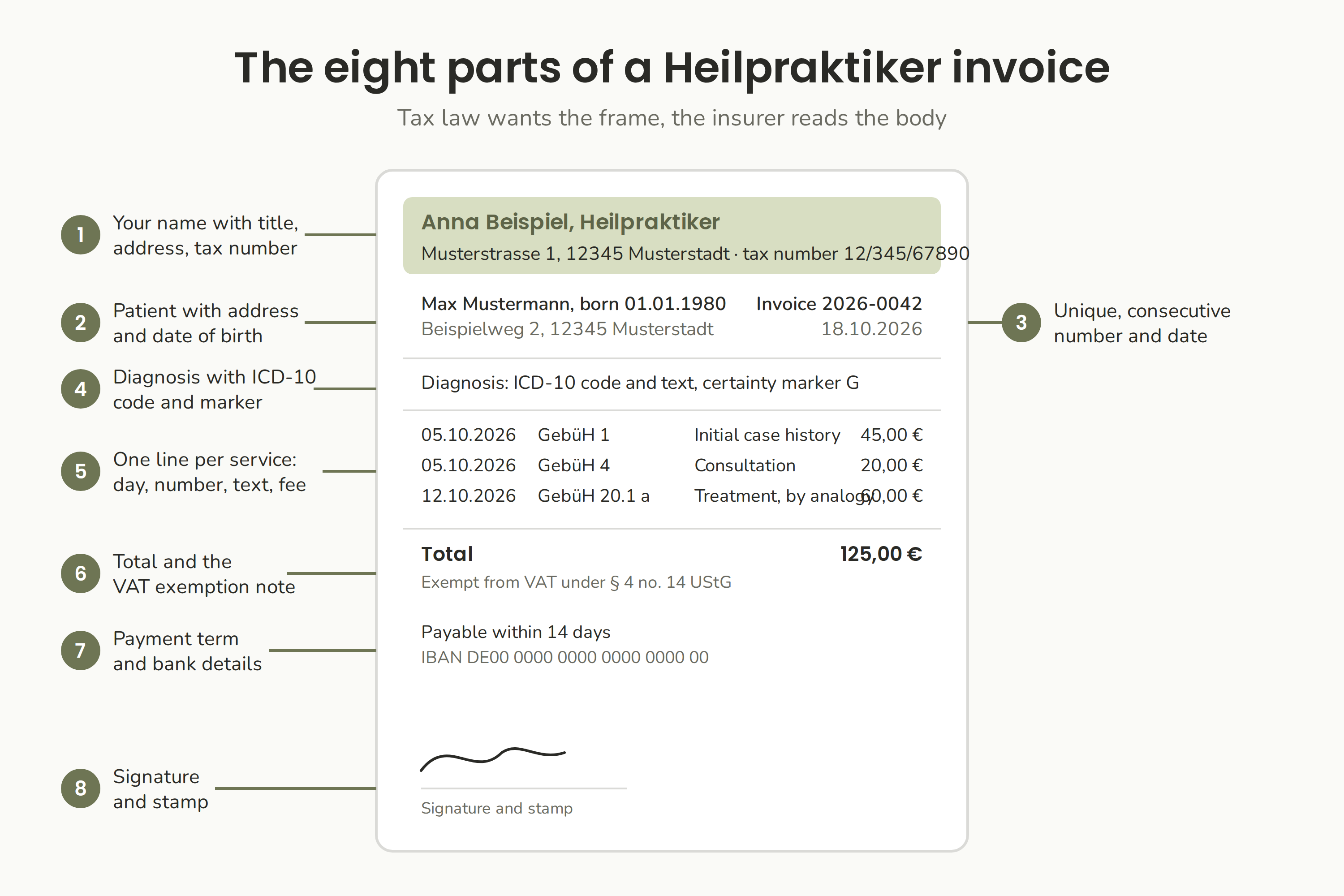
A sample Heilpraktiker invoice, line by line
A sample invoice for one patient and three visits looks like this. The names, the fees and the number are examples, and the diagnosis is a placeholder for the code and text from your own records.
| Part of the invoice | Example |
|---|---|
| Practice header | Anna Beispiel, Heilpraktiker, Musterstrasse 1, 12345 Musterstadt, tax number 12/345/67890 |
| Patient | Max Mustermann, born 01.01.1980, Beispielweg 2, 12345 Musterstadt |
| Invoice number and date | 2026-0042, 18.10.2026 |
| Diagnosis | ICD-10 code and text from your records, with the certainty marker |
| Line 1 | 05.10.2026, GebüH 1, detailed initial case history and examination, 45,00 euros |
| Line 2 | 05.10.2026, GebüH 4, consultation, 20,00 euros |
| Line 3 | 12.10.2026, GebüH 20.1 a, treatment billed by analogy, 60,00 euros |
| Total | 125,00 euros, exempt from VAT under § 4 no. 14 UStG |
| Payment | Within 14 days to IBAN DE00 0000 0000 0000 0000 00 |
| Signature | Signed, with the practice stamp |
Each part has a reason behind it.
The treatment date on every line. Insurers refund per visit, so a period such as "October 2026" is not enough. The exact day on each line also matches your records if an insurer ever asks (Paracelsus Magazin, correct invoicing, 2022).
One GebüH number per service, with its text. The number is what the reviewer reads. Where no number fits, bill by analogy to the closest one and mark the line with an "a" (sevdesk, invoicing as a Heilpraktiker). More on this in the next section.
The diagnosis. Private insurers and Beihilfe offices want a diagnosis they can match to the services. Billing guides for the profession recommend an ICD-10 code next to the text, plus a marker for how certain it is. G stands for confirmed, V for suspected, A for ruled out and Z for a symptom-free state after a diagnosis (Paracelsus, 2022). Only write a code you can back up from your records.
The patient's date of birth. Not required by tax law, but insurers use it to find the policy. Leave it out and the refund waits for a letter.
The VAT note. Treatment is exempt, and the invoice says so in one sentence that names § 4 no. 14 UStG. Never write a tax rate of zero percent, because that is a different thing in VAT law.
Signature and stamp. No tax rule asks for them, but many insurers still expect a signed original. It costs you nothing.
How to bill with the GebüH and analogue numbers
The GebüH is a list of usual fees for Heilpraktiker services, not a law. You may agree any fee with your patient, and the GebüH number on the invoice tells the insurer which service the fee is for. Where a service has no number, you bill by analogy to the closest one.
The list dates from a survey of practices in 1985, with a euro conversion in 2002, and the professional associations themselves call it outdated. Because it carries no force of law, your fee rests on the agreement with your patient, as with any service contract (§ 611 BGB). Three rules keep the invoice clean.
| Rule | What it means on the invoice | Source |
|---|---|---|
| Agree the fee before the first treatment | When a third party may not cover the full cost, inform the patient of the expected cost in text form before treatment starts. A fee above the GebüH range is lawful when agreed this way. Announced on the invoice for the first time, it gets cut back | § 630c (3) BGB |
| Write the agreed fee on the line, not the range | The invoice shows what the patient owes. The range is background for the insurer | § 611 BGB |
| Bill by analogy with care | Mark the line with an "a" behind the number and pick a service that is similar in kind and effort. A chain of analogue numbers with no visible treatment concept invites questions | Paracelsus, 2022 |
Do not bill under the doctors' fee schedule, the GOÄ. You may name a GOÄ item to explain a service. But an invoice written under the GOÄ is reviewed as if a doctor had issued it, and you are not one (Paracelsus, 2022).
Invoices for psychotherapy under a restricted licence
A Heilpraktiker limited to psychotherapy writes the restricted title in full on the invoice and finds few GebüH numbers that fit. Most practices agree a fee per session in a written fee agreement, bill by time, and name the closest number on the line (Sasse, 2020). Check the patient's tariff before the first session, because many private tariffs treat psychotherapy by a Heilpraktiker differently from physical treatment.
What private insurers and Beihilfe need to see
Private insurers refund what the patient's tariff allows. Beihilfe offices refund a share of a fixed maximum per GebüH number. In both cases your invoice goes to the patient, the patient pays you, and the patient claims the refund. Your invoice has to give the reviewer everything in one read.
For federal civil servants, Beihilfe accepts a Heilpraktiker fee only up to a maximum per number. The table is annex 2 of the federal Beihilfe regulation (§ 6 (5) BBhV, annex 2 BBhV). Anything above the maximum stays with the patient, however well you agreed it. Each state has its own table for its own civil servants, so ask a patient with Beihilfe which office pays.
A private tariff can cover a large share of the GebüH range, a yearly cap, or nothing for Heilpraktiker at all. You cannot see the tariff, so say the one honest sentence before treatment. The refund depends on her policy, and the invoice is hers to pay either way. The cost information in text form under § 630c (3) BGB is the place for it.
The items reviewers ask for most, beyond the tax list:
| Reviewers look for | Why |
|---|---|
| Diagnosis with ICD-10 code and certainty marker | To match the services to a medical reason |
| Date of birth of the patient | To find the policy |
| Exact day per treatment | Refunds are per visit |
| GebüH number and text per line | The number is what the tariff refers to |
| Your title as licensed | Restricted licences are refunded differently |
| Signature | Many offices still ask for a signed original |
VAT, the small business exemption and invoices under 250 euros
Treatment by a Heilpraktiker is exempt from VAT, so your invoice shows no tax and names the exemption instead. Work that is not treatment, such as a lecture or a course, is taxable. It belongs on a separate invoice with VAT shown, unless you use the small business VAT exemption.
The exemption in § 4 no. 14 UStG covers treatment in human medicine. Prevention classes, wellness offers and talks can fall outside it. Keep the two kinds of work on separate invoices and in separate records. Then your tax adviser sees at a glance which turnover was exempt.
The small business VAT exemption. If your taxable turnover stays under the limits in § 19 UStG, you charge no VAT on taxable work either. Such an invoice needs fewer items, but it must carry a note that the small business exemption under § 19 UStG applies (§ 34a UStDV). Exempt treatments do not count toward the limit.
Invoices up to 250 euros. An invoice whose total does not exceed 250 euros may leave out the recipient's name, the invoice number and the service date (§ 33 UStDV). Do not use this shortcut for patients. The insurer wants the full invoice, and the date of each treatment is the first thing the reviewer looks for.
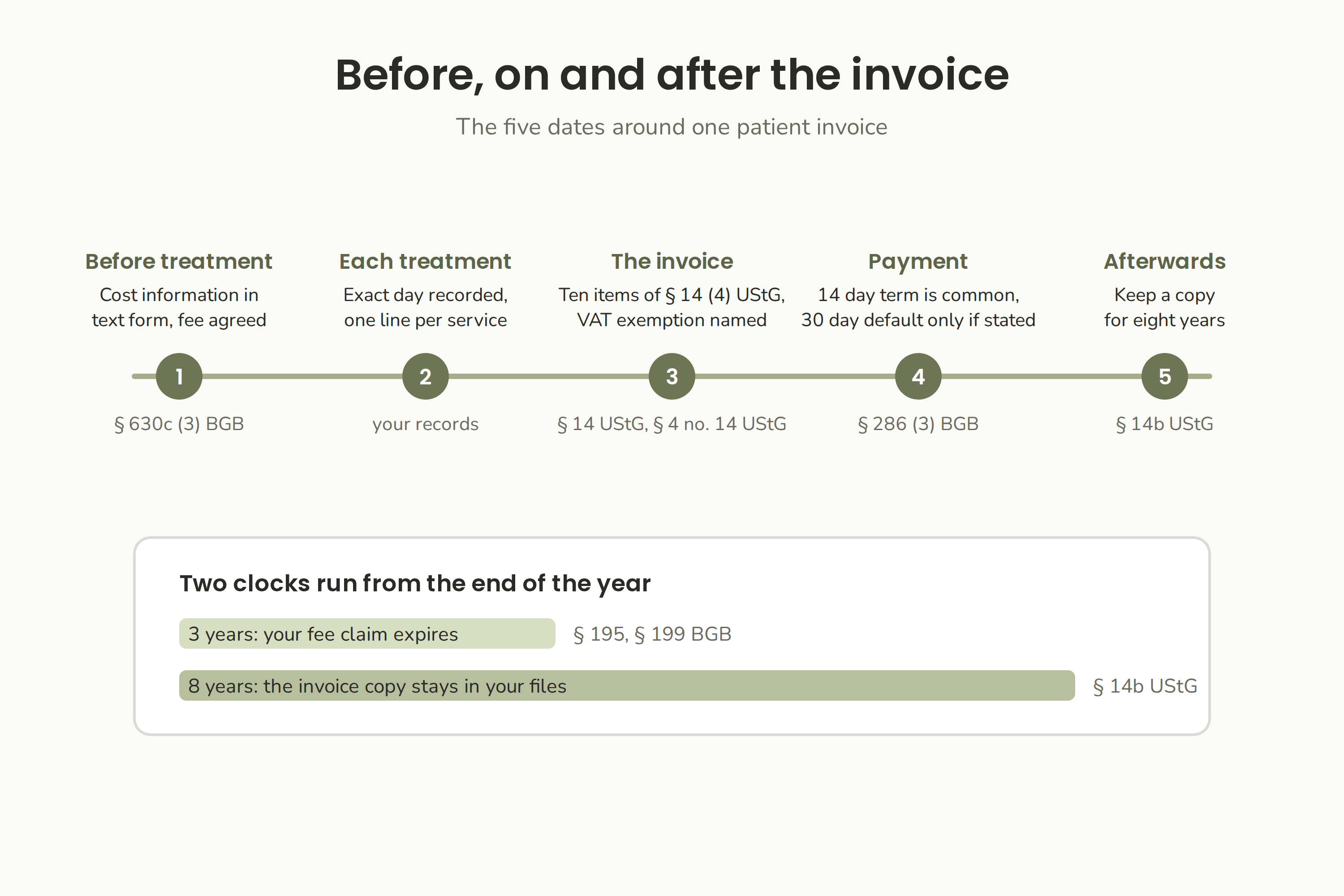
Before and after the invoice: cost information, payment and storage
The invoice is one step in a short chain. Before it comes the cost information in text form. After it come the payment term, the storage period and the point where an unpaid fee expires.
Before treatment. Sometimes you know, or have reason to suspect, that a third party will not cover the full cost. Then you inform the patient in text form about the expected cost before treatment begins (§ 630c (3) BGB). An email counts as text form. Many practices put the fee agreement and this information on one page and have the patient sign it at the first visit.
Payment term. No law sets one for treatment, and fourteen days is common. A private patient is in default automatically 30 days after she received the invoice only if the invoice says so. A consumer has to be told on the invoice itself (§ 286 (3) BGB). A plain line such as "payable within 14 days" plus a reminder works for most practices.
Storage. Keep a copy of every invoice you issue for eight years. The period starts at the end of the year in which you issued it (§ 14b UStG). The period was ten years until the end of 2024. Store the invoice as you issued it, on paper or as the PDF, and keep the numbering unbroken.
Limitation. Your claim for the fee expires three years after the end of the treatment year (§ 195 BGB, § 199 BGB). An invoice you forgot to send in 2026 can still go out in 2029, but a reminder in 2030 comes too late.
A short checklist before you send the invoice
- Your name with the title "Heilpraktiker", or the restricted title in full, plus address and tax number
- The patient's name, address and date of birth
- A unique, consecutive invoice number and the invoice date
- A diagnosis with ICD-10 code and certainty marker, taken from your records
- One line per service with the exact treatment date, the GebüH number, a short text and the agreed fee
- The total, with a note that it is exempt from VAT under § 4 no. 14 UStG
- A payment term and your bank details
- Your signature and stamp
- A copy in your files, kept for eight years
This article is general information, not tax or legal advice. Talk to your tax adviser or a lawyer for your own case. All law texts were read on gesetze-im-internet.de on 18 October 2026.
About this blog
This blog is written by the team at Vitalmyn. We build an ordering service for practitioner recommendations, and we write guides on the business side of running a Heilpraktiker practice in Germany.
Frequently asked
Does a Heilpraktiker have to issue an invoice?
Not under VAT law for an exempt treatment to a private patient. In practice you issue one every time, because the patient can demand a receipt under § 368 BGB and no insurer refunds without an invoice. For taxable work billed to a business, the invoice is mandatory and due within six months.
Does a Heilpraktiker invoice show VAT?
No. Treatment by a Heilpraktiker is exempt under § 4 no. 14 UStG, so the invoice shows no tax amount and no tax rate. Instead it carries a note that the service is exempt. Work that is not treatment, such as a lecture or a product sale, is taxable and goes on a separate invoice.
What does an insurer need on a Heilpraktiker invoice?
The exact date of each treatment, a diagnosis with ICD-10 code and certainty marker, one GebüH number with its text and fee per service, the patient's date of birth, your title as licensed and a signature. Beihilfe offices refund only up to the maximum per number in annex 2 of the BBhV.
How long does a Heilpraktiker have to keep invoices?
Eight years, counted from the end of the year in which the invoice was issued, under § 14b UStG. Until the end of 2024 the period was ten years.
Sources
- § 14 UStG - issuing invoices and mandatory contents
- § 4 UStG - tax exemptions (no. 14: treatment in human medicine)
- § 14b UStG - storing invoices
- § 19 UStG - small business VAT exemption
- § 33 UStDV - invoices of 250 euros or less
- § 34a UStDV - invoices under the small business VAT exemption
- § 630c BGB - duty to inform the patient about costs
- § 368 BGB - right to a receipt
- § 286 BGB - default, 30 day rule for consumers
- § 195 and § 199 BGB - three year limitation period
- § 6 BBhV and annex 2 - Beihilfe maximum amounts for Heilpraktiker
- Paracelsus Magazin, Korrekte Rechnungsstellung in der Heilpraktikerpraxis, Teil 1 (2022)
- Rechtsanwalt Dr. René Sasse, invoicing and practice name (2020)
- sevdesk, Rechnung als Heilpraktiker schreiben
Written by
Vitalmyn Team
Editorial team
We are building the ordering service for practitioner recommendations. Here we write down what we learn about recommending, practice finances and advertising law, so you do not have to dig it up yourself.