
A self-employed Heilpraktiker does not have to pay into the German state pension in 2026, as long as the practice treats patients. The duty can already apply if you teach courses or work mainly for one client. A planned reform would add a pension duty for new self-employed people, but no bill exists yet.
As a Heilpraktiker, a state-licensed non-medical practitioner, you plan your own old age. Nobody pays pension contributions for you. Since summer 2026, the news has been full of a pension duty for the self-employed (Rentenpflicht). This guide sorts out what applies today, what is only planned, and what the state pension costs.
Do self-employed Heilpraktiker have to pay into the state pension?
Not for the practice itself. German pension law leaves most self-employed people free to arrange their own provision. § 2 SGB VI lists the self-employed groups that must pay, such as teachers, nursing carers, midwives and craftspeople. A practice that treats its own patients is not on that list.
The state pension is the statutory pension insurance, run by the German pension insurance (Deutsche Rentenversicherung, DRV). Employees pay into it automatically, and their employer pays half. A self-employed Heilpraktiker outside the list may join voluntarily (§ 7 SGB VI) and choose the amount within a floor and a ceiling.
Doctors, pharmacists and lawyers have their own professional pension funds (Versorgungswerke), which free them from the state pension (§ 6 (1) no. 1 SGB VI). Heilpraktiker have no chamber and no such fund. Whatever the state decides for self-employed people without a compulsory system will therefore reach Heilpraktiker directly.
When does today's law already make a Heilpraktiker pay?
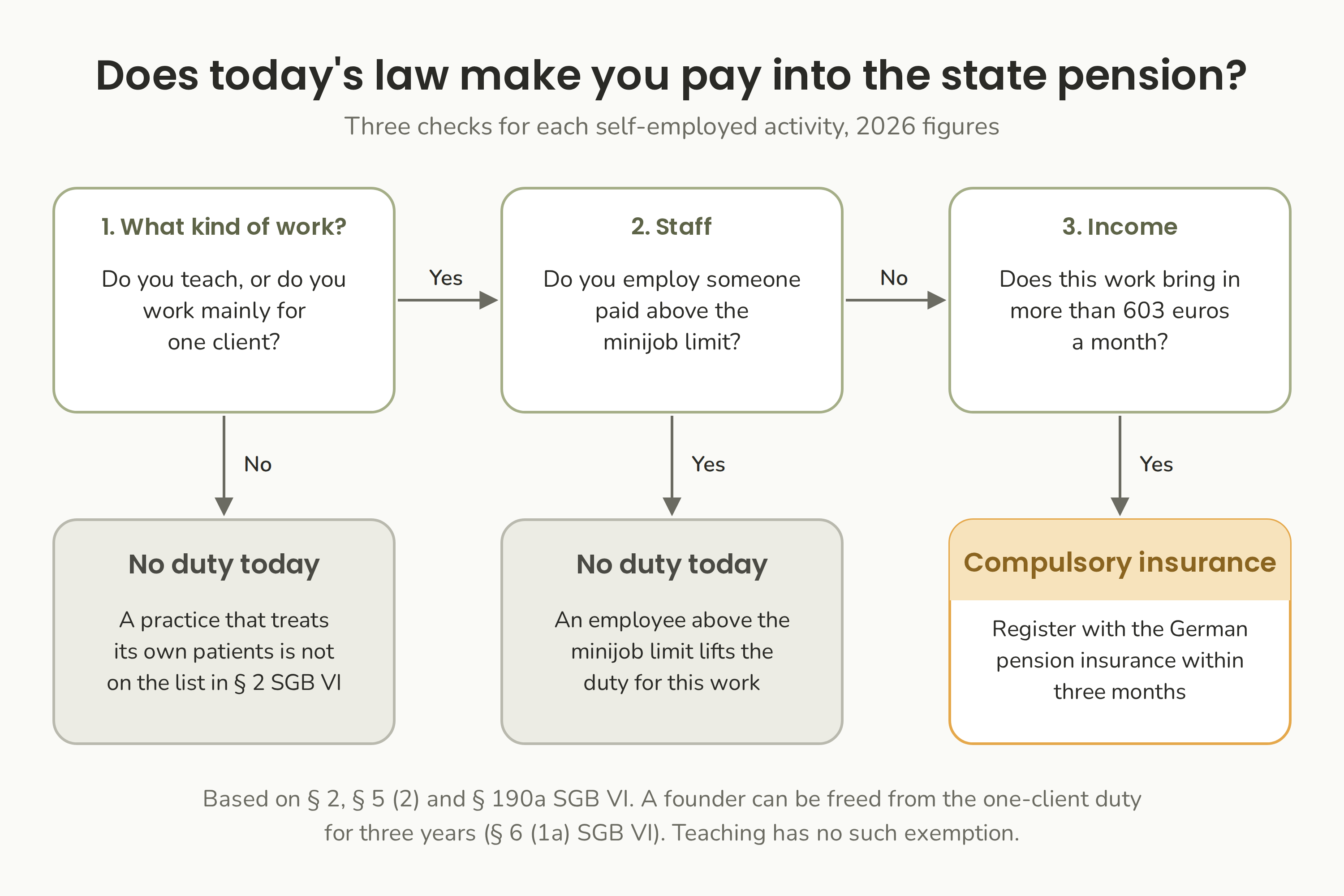
When part of your work falls into one of the listed groups. For a Heilpraktiker that usually means teaching, or working mostly for one client. In both cases the duty applies only if you employ nobody above the minijob limit. The work must also bring in more than 603 euros a month in 2026.
You teach courses or classes
Self-employed teachers must pay into the state pension if they regularly employ no employee who is compulsorily insured (§ 2 sentence 1 no. 1 SGB VI). The DRV reads teaching broadly. It names a lecturer at an adult education centre, a trainer of health or sports courses and a coach as examples (DRV on self-employed teachers).
For a Heilpraktiker, that can mean lecturing at a Heilpraktiker school, running a course at an adult education centre, or teaching relaxation classes. The duty covers the teaching, not the treatment. If you teach and treat side by side, ask the DRV which income it counts for the contribution.
You work mainly for one client
The second case is work for one main client. Under § 2 sentence 1 no. 9 SGB VI, you must pay if you have no compulsorily insured staff. You must also work long-term and essentially for one client.
A Heilpraktiker who works freelance only for one clinic, one spa or one doctor's practice can fall under this rule. There is a relief for founders. Anyone in this group can be freed from the duty for three years after first starting self-employed work (§ 6 (1a) SGB VI). Apply within three months, so the exemption counts from the start.
If you work like an employee, with fixed hours and someone else's instructions, the question is a different one. You may not be self-employed at all. A status check by the DRV (Statusfeststellungsverfahren, § 7a SGB IV) settles that before money is at stake.
Staff and the income limit
Two things lift the duty for teachers and one-client cases. The first is an employee who earns more than the minijob limit, because minijobbers do not count as employees here (§ 2 SGB VI). The second is low income, because work that earns no more than 603 euros a month in 2026 is exempt (§ 5 (2) SGB VI).
| Your situation | Pension duty today? | Rule |
|---|---|---|
| Practice that treats your own patients | No, voluntary membership possible | § 2 and § 7 SGB VI |
| Teaching courses or classes, no staff above the minijob limit | Yes, for the teaching | § 2 sentence 1 no. 1 SGB VI |
| Nearly all income from one client, no staff above the minijob limit | Yes, founders can be exempt for three years | § 2 sentence 1 no. 9 and § 6 (1a) SGB VI |
| Teaching or one client, with an employee above the minijob limit | No | § 2 SGB VI |
| Work that earns 603 euros a month or less | No | § 5 (2) SGB VI |
What would the planned pension duty for the self-employed change?
It would bring self-employed people into the state pension as a group. The federal pension commission (Alterssicherungskommission) proposed this on 23 June 2026. On 2 July 2026, the coalition said it wants to adopt all 33 recommendations. As of 25 October 2026, no draft bill has been published.
The government aims to finish the legislative process by the end of 2026 (federal government FAQ, 2 July 2026). The commission's recommendation 22 sets out the details for the self-employed. The summary below follows the analysis of the founders' association VGSD (VGSD, 23 June 2026).
| Point | What the commission proposes | Still open |
|---|---|---|
| New self-employed | Everyone who starts after a cut-off date and has no compulsory system pays into the state pension, with no way out | The cut-off date |
| Existing self-employed | Covered as well, but may opt out without giving a reason | How and by when to opt out |
| Start phase | Three years at half the standard contribution, once per working life | Final amount and rules |
| Professional pension funds | Members stay in their own fund | Heilpraktiker have none |
For a practice that is already open, nothing changes today. The opt-out would let you keep your own provision, but the bill will decide how it works. For a Heilpraktiker who opens a practice after the cut-off date, the state pension would become compulsory.
Some websites already write that the duty starts in 2027. That date is a political target and has no legal force yet. Plan with the rules in force, and check again once the federal labour ministry publishes its draft.
How much does the state pension cost a self-employed person in 2026?
You pay 18.6 percent of the income your contribution is based on, all of it yourself. Without proof of income, that is the standard contribution of 735.63 euros a month in 2026. With your income tax assessment, you can pay on your real profit instead, between 112.16 and 1,571.70 euros a month.
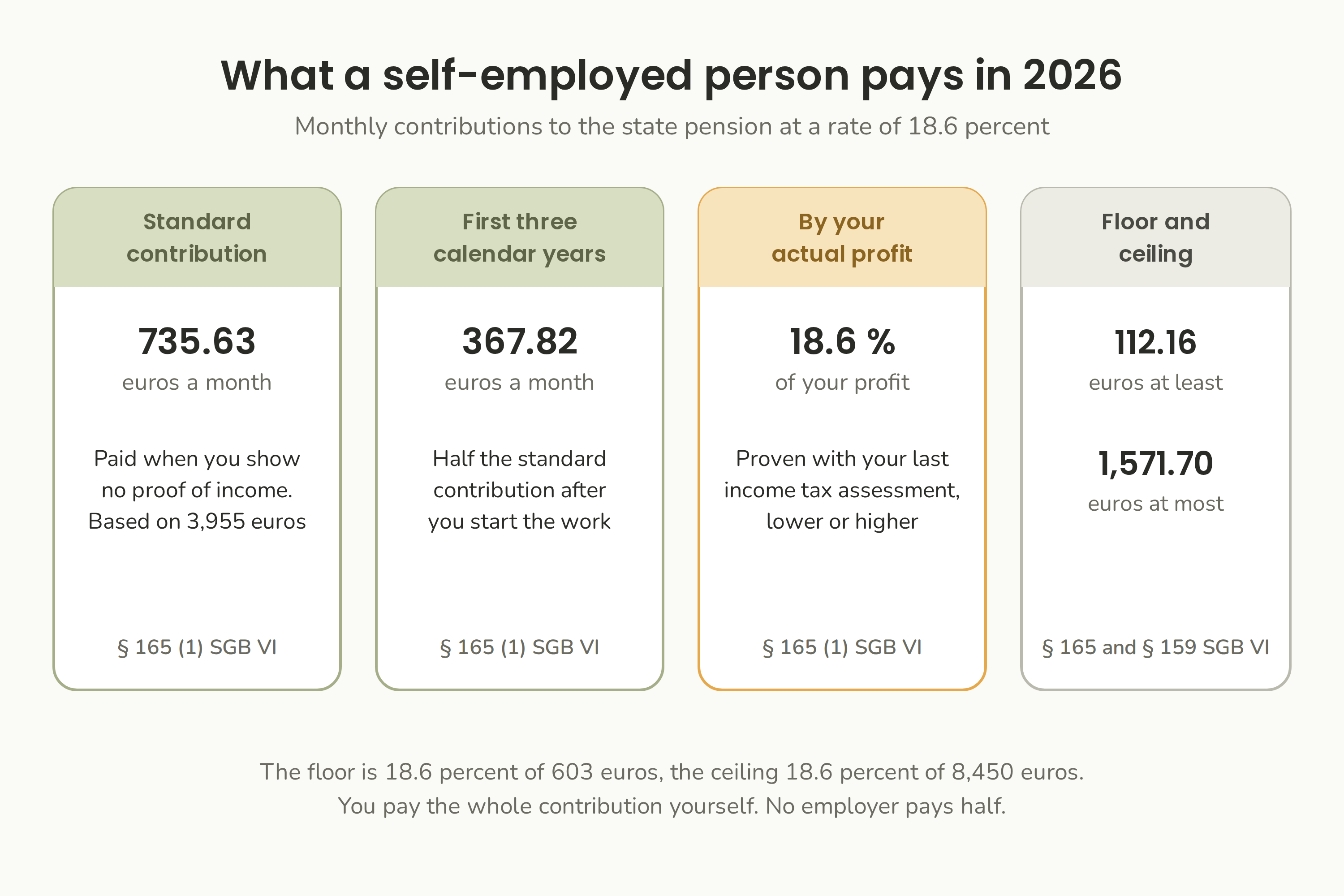
The rules sit in § 165 (1) SGB VI, and the DRV publishes the figures each year (DRV, 2026 figures). The standard contribution assumes an income equal to the reference amount of 3,955 euros a month. In the first three calendar years after you start, half that amount applies, which is 367.82 euros a month.
If your profit is lower or higher, send the DRV your latest income tax assessment within two months of receiving it. The contribution then follows that profit. It never falls below 18.6 percent of 603 euros, and it stops at the ceiling of 8,450 euros a month (§ 159 SGB VI).
In return, you build pension rights and cover if illness stops you from working (DRV, self-employed). Your contributions also count as pension expenses for income tax within a yearly cap (§ 10 EStG). Teaching income can follow its own VAT rules as well, and our guide to VAT rules for Heilpraktiker explains the medical exemption and its limits.
What should you do now?
Check each paid activity against the three questions, register any duty within three months, and watch for the draft bill. The DRV can claim back contributions for four years after the year they fell due (§ 25 SGB IV). If they were withheld on purpose, the limit is thirty years.
- List every paid activity: treatment, courses, teaching posts, and freelance work for a clinic or another practice.
- For each teaching or one-client activity, check your staff and the 603-euro limit for 2026.
- If the duty applies, register with the DRV within three months of starting the work (§ 190a SGB VI).
- If you work for one client in your first three years of self-employment, apply for the founder exemption within three months.
- If a deadline has passed, contact the DRV to settle it.
- If a contract makes you unsure whether you are self-employed at all, ask for a status check.
- Follow the reform through the federal labour ministry and your professional association, and note the cut-off date once it is set.
- Book the free advice of the DRV, and plan the amounts with your tax adviser.
This article is general information, not tax or legal advice. Talk to your tax adviser, the DRV or a lawyer for your own case. All law texts were read on gesetze-im-internet.de on 25 October 2026.
About this blog
This blog is written by the team at Vitalmyn. We build an ordering service for practitioner recommendations, and we write guides on the business side of running a Heilpraktiker practice in Germany.
Frequently asked
Do self-employed Heilpraktiker have to pay into the state pension?
Not for a practice that treats its own patients. § 2 SGB VI lists the self-employed groups that must pay, and Heilpraktiker are not among them. The duty can apply to teaching or to work done mainly for one client. It falls away if you employ someone above the minijob limit or the work earns 603 euros a month or less in 2026.
Is there a pension duty for all self-employed people from 2027?
Not yet. The federal pension commission recommended it on 23 June 2026, and the coalition wants to adopt the recommendations. As of 25 October 2026 no draft bill and no cut-off date have been published.
Does teaching at a Heilpraktiker school make me pay pension contributions?
It can. Self-employed teachers are compulsorily insured under § 2 sentence 1 no. 1 SGB VI if they employ nobody above the minijob limit. The teaching must also earn more than 603 euros a month in 2026. The duty covers the teaching, not your practice.
How much does the state pension cost a self-employed person in 2026?
The standard contribution is 735.63 euros a month, and 367.82 euros in the first three calendar years. With an income tax assessment you can pay 18.6 percent of your real profit instead, at least 112.16 and at most 1,571.70 euros a month.
Can a Heilpraktiker join the state pension voluntarily?
Yes. Anyone who is not compulsorily insured can pay voluntary contributions under § 7 SGB VI and choose the amount between the floor and the ceiling.
Sources
- § 2 SGB VI, self-employed people who must be insured
- § 5 SGB VI, exemption for minor self-employed work
- § 6 SGB VI, exemptions for professional pension funds and founders
- § 7 SGB VI, voluntary insurance
- § 159 SGB VI, contribution ceiling
- § 165 SGB VI, contributions of the self-employed
- § 190a SGB VI, duty to register within three months
- § 7a SGB IV, status check
- § 25 SGB IV, time limits for back contributions
- Federal government, FAQ on the pension commission report, 2 July 2026
- VGSD, what the pension commission's recommendations mean for the self-employed, 23 June 2026
- German pension insurance, self-employed teachers
- German pension insurance, self-employed people
- German pension insurance, 2026 figures for the self-employed
Written by
Vitalmyn Team
Editorial team
We are building the ordering service for practitioner recommendations. Here we write down what we learn about recommending, practice finances and advertising law, so you do not have to dig it up yourself.