
The appointment book looks full on Friday, yet the bank account at the end of the quarter tells a smaller story. As a Heilpraktiker, a state-licensed non-medical practitioner, you have no salary. You have turnover, and a long list of things that come off it before anything reaches you.
The best data on Heilpraktiker salary comes from a survey for the Federal Ministry of Health. Self-employed practices turned over about 59.479 euros a year on average between 2017 and 2022. This guide shows where that figure comes from, what comes off it, and where practices lose money they have already earned.
What does a Heilpraktiker earn?
The most reliable answer is a turnover figure. A survey for the Federal Ministry of Health (BMG) asked practices about their gross turnover. Self-employed Heilpraktiker practices reported 59.479 euros a year on average from 2017 to 2022. Practices run by employed Heilpraktiker reported 35.099 euros (BMG empirical report, table 100).
The ministry commissioned the study because reliable data on the profession was missing. The research firm in vivo GmbH ran it from May 2023 to November 2024 and asked about the years 2017 to 2022. Between 552 and 793 self-employed practices answered the turnover question each year.
| What the survey measured | Self-employed practices, average 2017 to 2022 |
|---|---|
| Gross turnover per year, including VAT | 59.479 euros |
| Lowest and highest year | 57.082 euros (2021) to 63.513 euros (2019) |
| Turnover per treatment | 101 euros, rising from 83 euros (2017) to 119 euros (2022) |
| Patients per year | 619 on average, down from 704 (2017) to 566 (2022) |
| Mainly self-employed | 96 percent of respondents |
| Main occupation, not a side job | 72 percent |
| Mainly part time | 40 percent, at about 21 hours a week |
Source: BMG empirical report on the Heilpraktiker profession, tables 53 to 56 and 100 to 102, survey years 2017 to 2022.
These are averages across full-time and part-time practices. A full-time practice sits above them, and a side practice below. They are also figures before costs, tax and insurance, which the rest of this guide covers.
Holders of a limited licence for psychotherapy report less. Their self-employed practices turned over 25.286 euros a year on average in the same period (BMG report, table 170).
Why salary tables miss most Heilpraktiker
Salary sites quote monthly gross pay for Heilpraktiker, often between 3.000 and 4.000 euros in October 2026 (Azubi.de, StepStone). Those figures describe employees. Yet 96 percent of Heilpraktiker in the BMG survey work mainly self-employed, so the tables describe a small minority.
The official salary tool of the Federal Employment Agency, the Entgeltatlas, is built from the reports employers send to social insurance. It shows full-time employees only (Federal Employment Agency, help on the Entgeltatlas). A self-employed practitioner sends no such report and never appears in it.
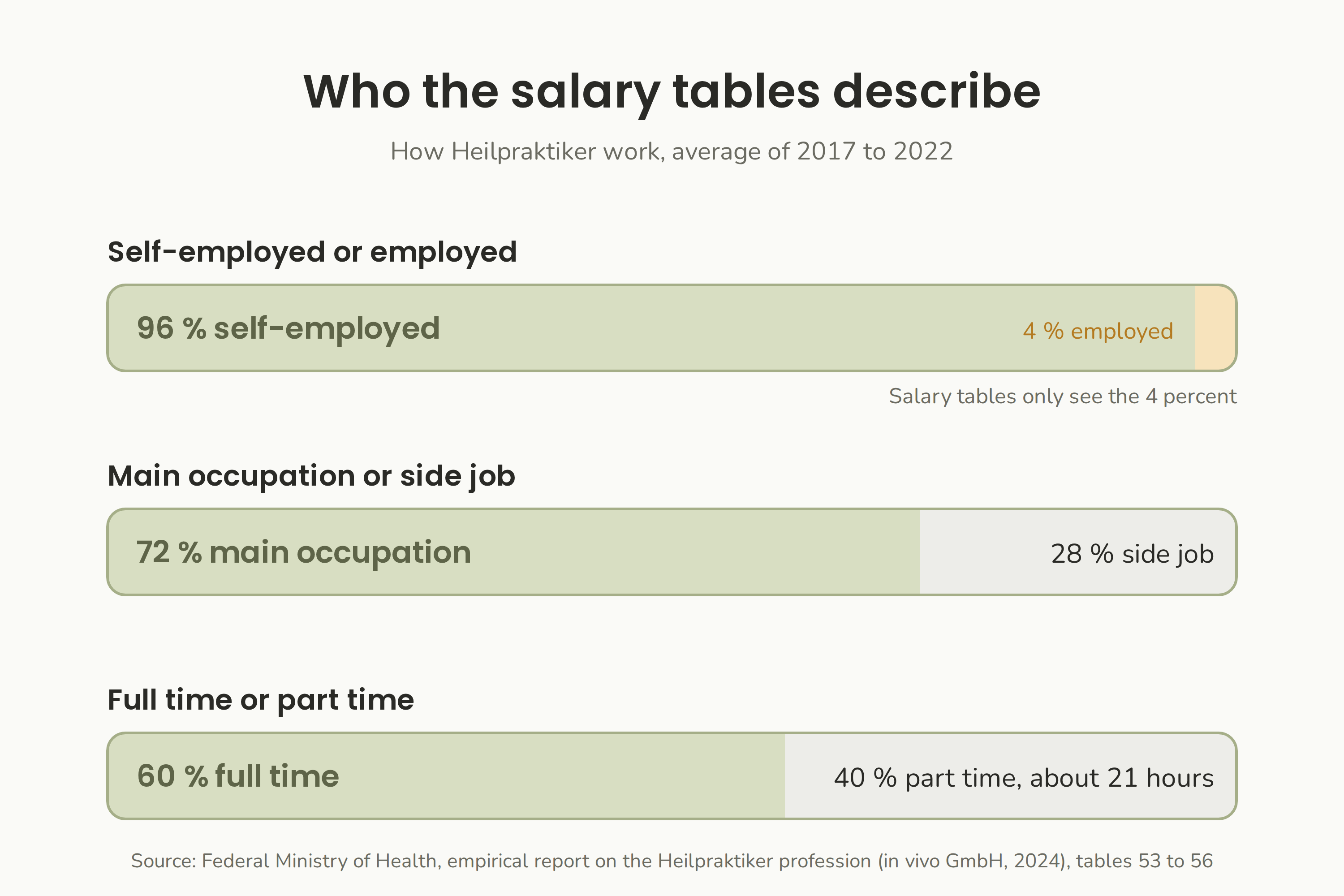
For a self-employed practice, "salary" means profit after costs, minus tax and social insurance. The BMG survey reports turnover, and costs differ widely between a room at home and a rented practice in a city centre. So what Heilpraktiker take home depends on their own costs, which the next section walks through.
What comes off turnover before you are paid?
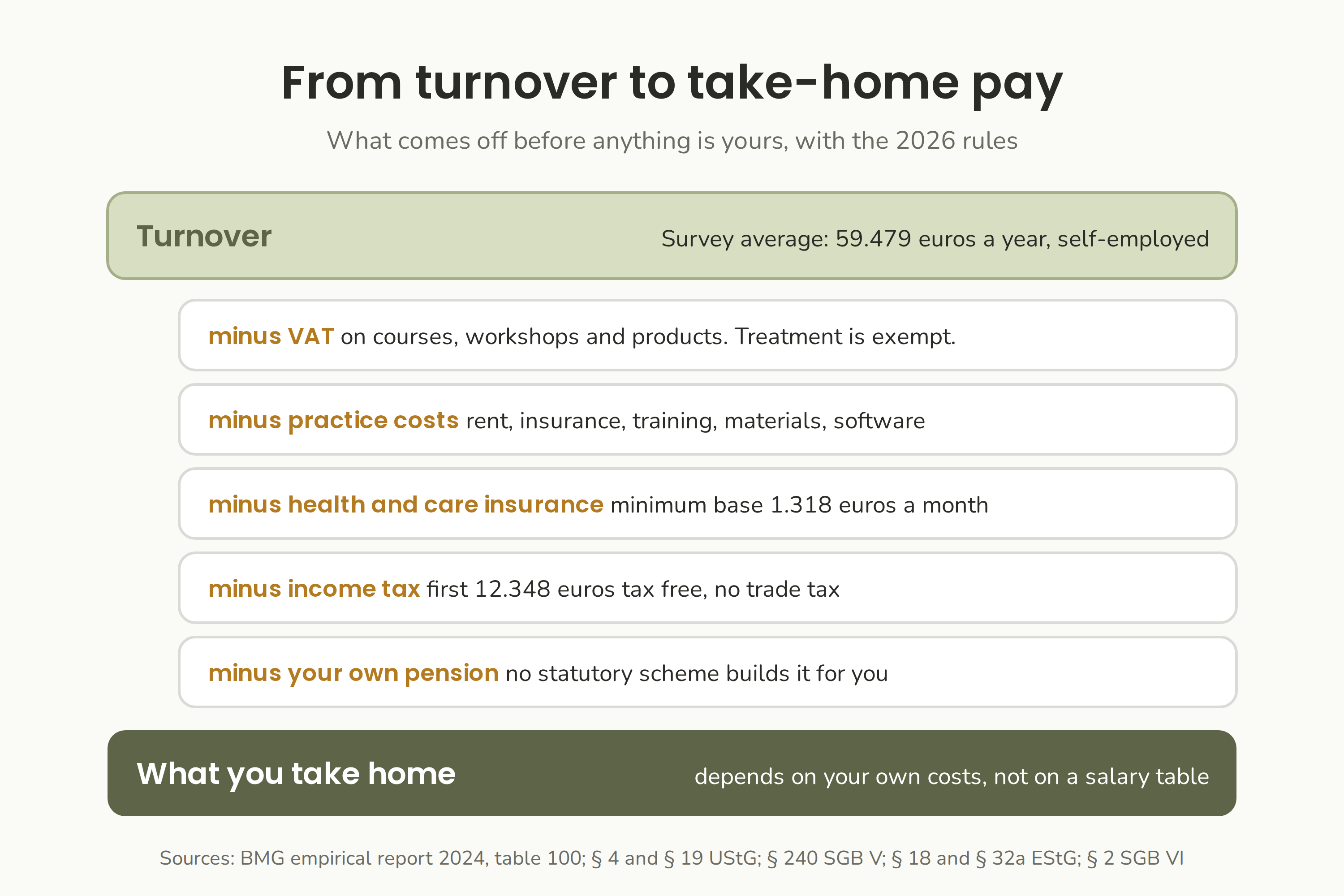
Four things come off your turnover first. They are VAT on anything that is not treatment, your practice costs, health and care insurance, and income tax. On top of that you fund your own pension. None of these shows up in a salary table, yet together they decide what you take home.
VAT: treatment is exempt, other income is not
Treatment by a Heilpraktiker is exempt from VAT under the VAT Act (§ 4 Nr. 14 UStG). Courses, prevention workshops, wellness offers and products are not treatment, so VAT can apply to them. Since 2025, the small-business rule frees you from charging VAT on them. It holds while your total turnover stayed under 25.000 euros last year and stays under 100.000 euros this year (§ 19 UStG).
Our guide to VAT rules for Heilpraktiker explains the exemption and its limits in detail.
Practice costs
Your costs are the biggest variable, and no public survey reports them for Heilpraktiker. The usual lines are rent or a share of your home, professional liability insurance, training, materials, software, a website, a phone line and an accountant. The BMG survey gives one benchmark: professional liability insurance cost about 230 euros a year on average in 2017 to 2022 (BMG report, table 74).
Your own bookkeeping is the only reliable number here. Your annual profit statement, the simple cash-basis account most small practices file with the tax office, shows it in one line.
Health and care insurance
As a self-employed person you pay the full contribution yourself, with no employer share. In statutory health insurance the contribution follows your income, with a minimum base (§ 240 of the Social Code, book V). In 2026 that minimum is 1.318,33 euros a month. It is one third of the 2026 reference value of 3.955 euros (TK, reference values 2026).
So even a small practice pays at least the contribution on that base each month. Care insurance is charged on the same income on top. If your health insurance comes through a main job, ask your insurer how the practice income counts.
Income tax, and no trade tax
The income tax law names Heilpraktiker as a liberal profession, the tax term for freelance professions (§ 18 EStG). Your treatment profit is therefore taxed as income from independent work, and you pay no trade tax on it. Trade tax is the local business tax that shops and trades pay. In 2026 the first 12.348 euros of taxable income stay tax free, and above that the rate rises in steps (§ 32a EStG).
Your own pension
Heilpraktiker are not among the self-employed groups that must pay into the statutory pension scheme (§ 2 of the Social Code, book VI). That keeps money in your account today, but no one builds your pension for you. Whatever you set aside for retirement comes out of your profit. If your work sits close to nursing or physiotherapy, ask the German pension insurance (Deutsche Rentenversicherung) whether other rules apply.
Where does the money leak?
Practices often lose money in six places, listed in the table below. Some hours go unpaid, prices follow an old fee list, and fees are never agreed in writing. Missed appointments, unpaid invoices and VAT on non-treatment income do the rest. Each leak is small on its own.
| Leak | What happens | What helps |
|---|---|---|
| Unbilled hours | Notes, phone calls, invoices and admin take time no patient pays for | Price your session so it covers the time around it |
| An old fee list | The GebüH, the fee list for Heilpraktiker, holds 1985 prices converted to euros in 2002 | Set your own fee and agree it in advance |
| No fee agreement | Without one, the usual fee applies, and the old list becomes your price | A written fee agreement before the first session |
| Missed appointments | A no-show leaves a paid slot empty | A cancellation rule agreed in writing |
| Unpaid invoices | Claims expire after three years | Invoice promptly and follow up every month |
| VAT on other income | Courses or products can trigger VAT the price never included | Check the VAT status of each offer before you price it |
Hours nobody pays for
Hourly billing is one of the two common fee models. In the BMG survey it made up 45 percent of billing on average. Many practices mix it with the fee list (BMG report, table 99).
An hourly fee pays for the hour with the patient. It does not pay for the case notes afterwards, the call with a relative, the invoice or the tax return. If a 60-minute session takes 90 minutes of your week, your real hourly rate is a third lower than your listed one.
Prices that follow a 1985 list
The other common model is the GebüH, with an average share of 62 percent of billing in the same survey (BMG report, table 99). The list rests on a 1985 survey and was converted to euros in 2002. It is a guide with no force of law, and you may agree higher fees. Our guide to the GebüH explains the list, its sources and how to agree your own fee.
Fees that were never agreed
If you name no price, the German Civil Code fills the gap with the usual fee (§ 612 BGB). Professional associations read the usual fee for Heilpraktiker as the GebüH range, as our GebüH guide shows with sources. A written fee agreement before the first session keeps the old list from becoming your price by default.
Missed appointments
When a patient does not come, you can claim the fee only in narrow cases. The law lets you keep the fee when the other side fails to accept a service at the agreed time (§ 615 BGB). Courts still look at the individual agreement. A clear cancellation rule, agreed in writing and applied the same way every time, is what holds up.
Invoices that go unpaid
Your claim is against the patient. The patient pays you and claims a refund from their insurance or the Beihilfe office, the state contribution for civil servants. A fee claim expires after three years, counted from the end of the year it arose (§ 195 BGB, § 199 BGB).
VAT on income that is not treatment
Workshops, prevention courses and products fall outside the treatment exemption. Once your turnover passes the small-business limit, VAT is due on them whether or not your price included it. Product income can also count as trade income, with trade tax and its own registration rules (§ 15 EStG). Check before you price a new offer.
How do you work out your own hourly rate?
Work backwards from the year. Add what you want to take home, your practice costs, and what you will pay in tax, insurance and pension. Divide the total by the hours a patient actually pays for. The result is the hourly rate your practice needs to cover all of it.
The step most practices skip is counting billable hours honestly. Holidays, training days, sick days and admin come off the calendar before a single session is booked.
| Step | What you count | Your number |
|---|---|---|
| 1 | What you want to take home in a year | |
| 2 | Plus practice costs from last year's profit statement | |
| 3 | Plus health and care insurance, pension savings and income tax | |
| 4 | This is the turnover your practice needs | |
| 5 | Weeks you actually work: 52 minus holidays, training and sick days | |
| 6 | Times sessions per week that patients pay for | |
| 7 | This is your billable hours per year | |
| 8 | Step 4 divided by step 7 is your hourly rate |
Take a practice that bills 20 hours a week for 42 weeks. It has 840 billable hours a year. Every 10.000 euros it needs, for costs, tax or pay, adds about 12 euros to the hourly rate. At 15 hours a week the same practice has 630 hours, and the same 10.000 euros adds about 16 euros.
Once you know your number, compare it with the fee you charge and the GebüH range. If the gap is large, the fee agreement is where you close it.
A quick check before the next quarter
Eight questions cover the leaks in this guide. Answer them once a quarter, with last year's profit statement and your open invoices in front of you. Any "no" points to the section above that explains the fix.
- Do you know last year's turnover and last year's profit, as two separate numbers?
- Does your hourly fee cover the time around each session, not just the session?
- Did every patient agree your fee in writing before the first appointment? (§ 612 BGB)
- Is your cancellation rule written down, and do you apply it the same way every time?
- Are any invoices older than 30 days still open?
- Do you know which of your offers are exempt from VAT and which are not? (§ 4 UStG)
- Do you know your 2026 minimum health insurance contribution? (§ 240 SGB V)
- Is money for your pension set aside every month?
This article is general information, not tax or legal advice. Talk to your tax adviser or a lawyer for your own case. Survey figures are averages for 2017 to 2022, not a forecast for any practice. All law texts were read on gesetze-im-internet.de on 24 October 2026.
About this blog
This blog is written by the team at Vitalmyn. We build an ordering service for practitioner recommendations, and we write guides on the business side of running a Heilpraktiker practice in Germany.
Frequently asked
How much does a Heilpraktiker earn in Germany?
There is no salary statistic for the self-employed. The best data is a survey for the Federal Ministry of Health: self-employed practices reported an average gross turnover of 59.479 euros a year from 2017 to 2022. Profit and take-home pay are lower, because costs, insurance and tax come off first.
Why do salary websites show different numbers?
Salary sites quote figures for employees, and the Federal Employment Agency's Entgeltatlas covers full-time employees only. Most Heilpraktiker are self-employed, so they do not appear in that data at all.
Do Heilpraktiker pay VAT and trade tax?
Treatment by a Heilpraktiker is exempt from VAT under section 4 no. 14 UStG. Courses, workshops and products are not. Heilpraktiker are a liberal profession under section 18 EStG, so treatment income is not subject to trade tax.
What hourly rate should a Heilpraktiker charge?
Add what you want to take home, your practice costs, and your tax, insurance and pension, then divide by the hours patients actually pay for in a year. At 840 billable hours a year, every 10.000 euros you need adds about 12 euros to the hourly rate.
Sources
- Federal Ministry of Health: empirical report on the Heilpraktiker profession (in vivo GmbH, 2024)
- Federal Employment Agency: help on the Entgeltatlas
- Azubi.de: Heilpraktiker pay (employees)
- StepStone: Heilpraktiker pay (employees)
- § 4 UStG - VAT exemption for treatment
- § 19 UStG - the small-business rule
- § 18 EStG - liberal professions
- § 32a EStG - income tax rates from 2026
- § 15 EStG - trade income
- § 240 SGB V - contributions of voluntary members
- TK: social insurance reference values 2026
- § 2 SGB VI - self-employed people in the pension scheme
- § 612 BGB - the usual fee
- § 615 BGB - fee when a service is not accepted
- § 195 BGB - the three-year limitation period
- § 199 BGB - when the limitation period starts
Written by
Vitalmyn Team
Editorial team
We are building the ordering service for practitioner recommendations. Here we write down what we learn about recommending, practice finances and advertising law, so you do not have to dig it up yourself.