
German maternity protection law does not cover self-employed Heilpraktiker in 2026. No law pays you for the weeks around the birth, and no bill has been tabled yet. You can plan on maternity pay (Mutterschaftsgeld) if your health insurance includes sickness benefit. Add private daily sickness benefit, the parental allowance (Elterngeld) and pension credits.
As a Heilpraktiker, a state-licensed non-medical practitioner, you are your practice. When you stop working, the income stops, but the rent does not. This guide shows which payments a self-employed Heilpraktiker can expect today. It also covers which ones depend on choices made before the pregnancy, and how to plan the running costs.
Does maternity protection apply to self-employed Heilpraktiker?
No, the Maternity Protection Act (Mutterschutzgesetz, MuSchG) protects only women in employment. § 1 (2) MuSchG lists employees, trainees, home workers, students and a few similar groups. Self-employed women are not on the list. A Heilpraktiker with her own practice has no protection period, no ban on work and no employer top-up.
For employees, § 3 MuSchG sets the protection periods below. They matter to you as well, because insurers and the health insurance funds use the same weeks to decide when they pay.
| Protection period | Length for employees | Does it bind a self-employed Heilpraktiker? |
|---|---|---|
| Before the birth | 6 weeks, the employee may choose to keep working | No, you decide |
| After the birth | 8 weeks | No, you decide |
| After a premature or multiple birth, or a disability found within 8 weeks | 12 weeks | No, you decide |
| After a miscarriage from week 13 | 2, 6 or 8 weeks, by week of pregnancy | No, you decide |
You may keep treating patients until the birth and start again whenever you choose. That freedom has a cost, because every week off brings in no fees unless you arranged a payment in advance.
The Bund Deutscher Heilpraktiker (BDH), one of the professional associations, estimates that about 80 percent of Heilpraktiker are women (BDH, 12 October 2026). It joined the alliance campaigning for maternity protection for the self-employed in November 2025.
Where does the new law for self-employed women stand?
There is a political promise, but no law and no bill. The 2025 coalition agreement says the government wants maternity protection for the self-employed "in line with the protection periods for employees". It will "promptly examine" levy-based and other ways to pay for it (coalition agreement 2025).
As of 23 October 2026, the federal family ministry has not published a draft. The Bundestag debated two opposition motions on 15 October 2026 and sent both to the family committee (Bundestag, 15 October 2026).
| Proposal | Who | How it would be paid | Status |
|---|---|---|---|
| Maternity protection "in line with" employees | Coalition agreement 2025 | Levy or another model, still to be examined | No draft bill |
| Flat basic payment of 5,000 euros plus grants on application | Greens, motion 21/8401 | Federal budget | In committee |
| Extend the employer levy U2 to the self-employed | Left party, motion 21/8461 | Levy | In committee |
IfM Bonn is a research institute for small businesses. The BDH cites its estimate that a levy would cost each self-employed person about 6.40 to 7.50 euros a month. Neither the cost nor the design has been decided. If your baby is due in 2027, plan as if today's rules still apply. Anything a new law adds then improves a budget that already works.
Who pays Mutterschaftsgeld to a self-employed Heilpraktiker?
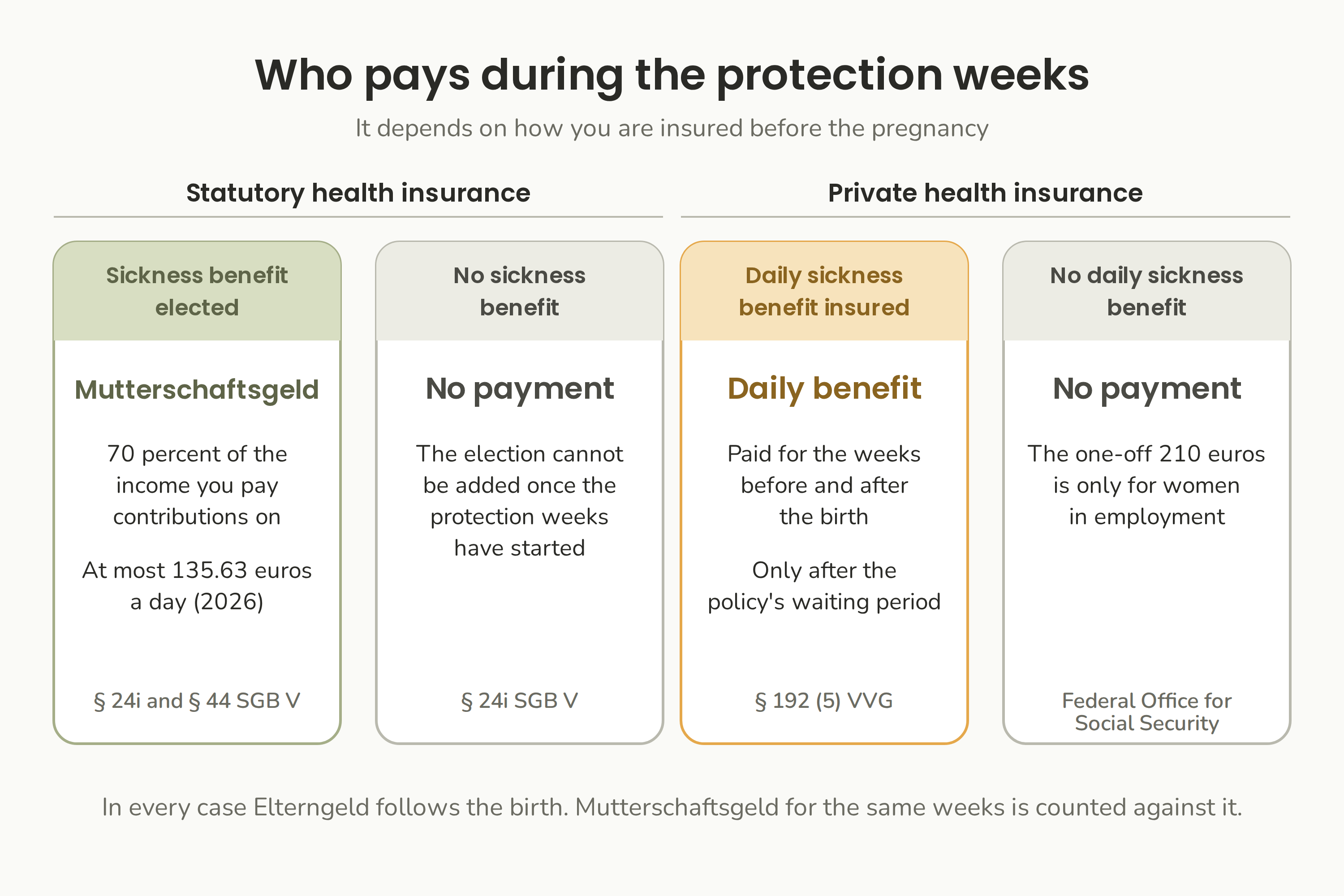
Your health insurance does, but only if your cover includes sickness benefit. Mutterschaftsgeld is the maternity pay the health insurance fund pays during the protection periods. For a self-employed member of a statutory fund, it equals the sickness benefit she would get (§ 24i SGB V). Without sickness benefit, there is no Mutterschaftsgeld.
If you are in statutory health insurance
As a full-time self-employed member, you have no sickness benefit by default. You get it only if you file an election with your fund under § 44 (2) no. 2 SGB V. You then pay the general contribution rate instead of the reduced one (§ 243 SGB V).
The election must be in force before the protection period starts, and it cannot be added afterwards (Barmer). The payment is 70 percent of the income your contributions are based on, capped at 135.63 euros a day in 2026 (family portal). Profit you earn during those weeks can reduce it.
If you have private health insurance
Private insurance pays no Mutterschaftsgeld, so private daily sickness benefit (Krankentagegeld) takes its place. The insurer must pay it in the protection periods and on the day of birth (§ 192 (5) VVG). The waiting period in your policy still applies, so take out the policy well before a pregnancy.
The one-off 210 euros
You may have read about a one-off Mutterschaftsgeld of up to 210 euros from the Federal Office for Social Security. It is only for women in employment who are not members of a statutory fund. A self-employed Heilpraktiker does not qualify (Federal Office for Social Security).
How is Elterngeld calculated for the self-employed?
Elterngeld, the federal parental allowance, replaces 65 to 67 percent of your lost income, between 300 and 1,800 euros a month. For the self-employed, it is based on the profit from your last completed tax year before the birth (§ 2b (2) BEEG). That one rule decides most of your planning.
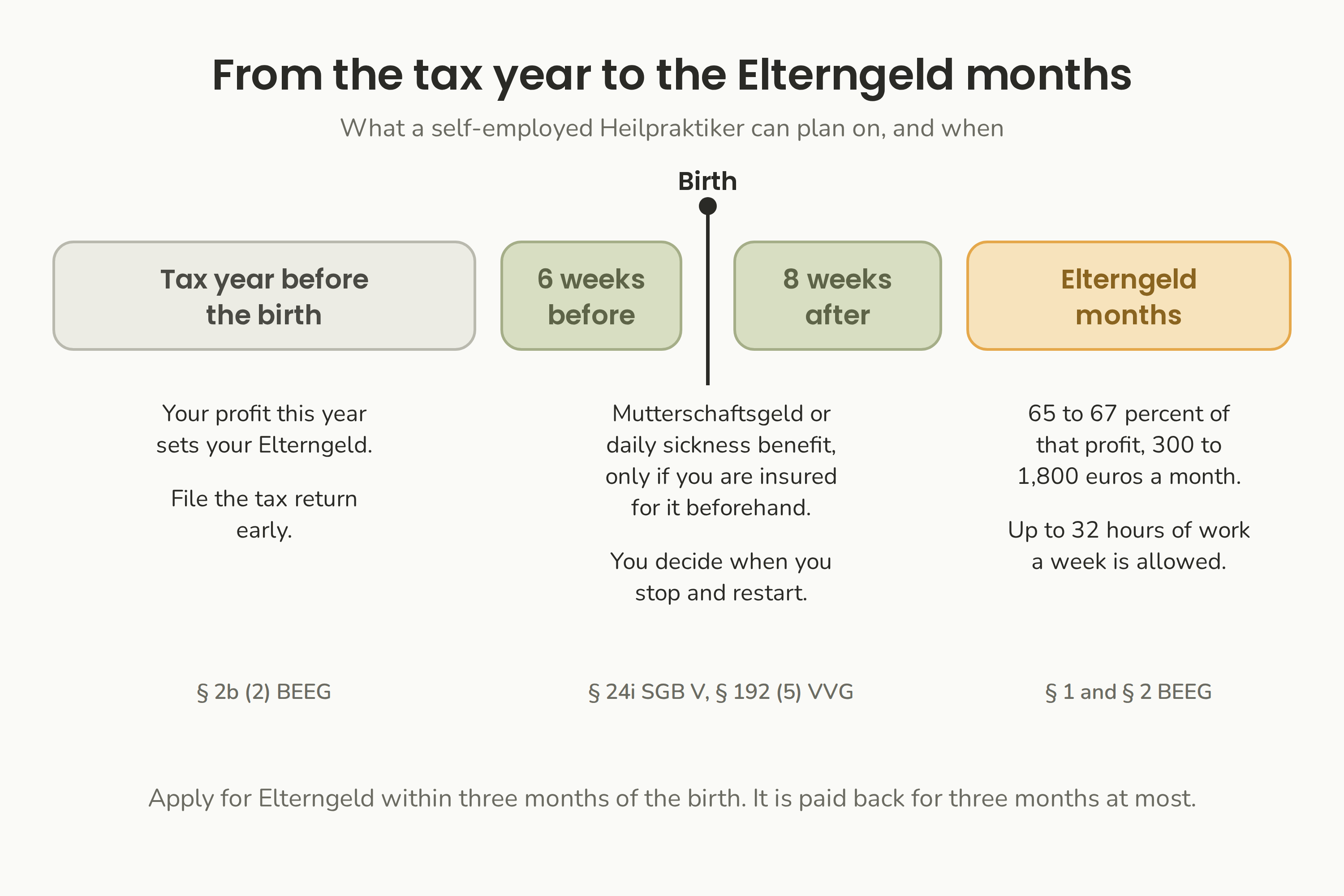
A baby due in spring 2027 is usually based on your profit for 2026. A weak year, for example because you cut your hours in the pregnancy, lowers your Elterngeld for the whole period. A strong year raises it. Keep that in mind when you plan the year before the birth.
| Rule | What it means for your practice | Source |
|---|---|---|
| Rate | 67 percent, falling to 65 percent above 1,200 euros net a month | § 2 BEEG |
| Range | At least 300, at most 1,800 euros a month | § 2 BEEG |
| Income limit | No Elterngeld above 175,000 euros taxable income | § 1 (8) BEEG |
| Working while you receive it | Up to 32 hours a week is allowed, but the profit reduces the payment | § 1 (6) BEEG |
| Mutterschaftsgeld | Counted against Elterngeld for the same weeks | § 3 BEEG |
| Applying late | Paid back for at most three months before the month you apply | § 7 BEEG |
The 32-hour rule is useful for a practice. You can see a few patients a week, for example to keep regular patients, and still receive a reduced Elterngeld. ElterngeldPlus stretches the payment over twice as many months at half the amount, which can suit a slow return (§ 4 BEEG).
A reform is under discussion. A July 2026 draft from the family ministry would change the length and the amounts from November 2027. The cabinet has not adopted it yet (beck-aktuell, 7 July 2026). Check the current rules with the Elterngeld office of your state before you apply.
What keeps running when the practice pauses?
Your fixed costs do. The BDH calls this the real gap, because insurance can replace part of your income while nothing covers the running costs of the practice (BDH). A practice that is closed for four months still pays rent, insurance and software.
| Cost | What you can do |
|---|---|
| Rent for the practice room | Ask the landlord early about a lower rent or a sublet to a colleague |
| Professional liability insurance | Ask your insurer whether the policy can be paused or reduced |
| Health insurance contributions | Mutterschaftsgeld and Elterngeld are free of contributions (§ 224 SGB V). Ask your fund whether you still owe a minimum contribution as a voluntary member |
| Software, phone, website | List every subscription and decide which can pause |
| Association fees | Ask whether your association offers a reduced fee during parental leave |
Can a colleague keep the practice running?
Yes, if the colleague holds her own licence. Anyone who practises healing without being a doctor needs the permit under § 1 HeilprG. An assistant without that licence may not treat your patients for you, even for a few weeks. Agree in writing how rooms, appointments and patient records are handled, and ask a lawyer to check the contract.
Does business interruption insurance help?
It usually does not pay for the pregnancy itself. Many policies that pay when the practice stands still exclude pregnancy, and some cover only complications. In November 2025, a regional court in Hanover held a pregnancy exclusion in such a policy to be discriminatory. The ruling is not final (LG Hannover, 6 O 103/24, reported by handwerk.com). Read your policy terms before you rely on it.
A planning checklist for the year before the birth
Most of what you can do happens before the pregnancy or early in it. The order below follows the deadlines. Work through it with your tax adviser and your health insurance fund, because both can check numbers this guide cannot.
- Check whether your health insurance includes sickness benefit. If not, file the election with your statutory fund or take out a private daily sickness benefit, and note its waiting period.
- Work out your monthly fixed costs and multiply them by the months you plan to pause. That is the reserve to build.
- Plan your profit for the tax year before the birth, because Elterngeld is based on it.
- File that year's tax return early, so the profit for Elterngeld is settled.
- Talk to your landlord, your insurers and a colleague with her own licence about the months you are away.
- Apply for Elterngeld within three months of the birth, so no month is lost.
- Apply to the pension insurance for child-raising periods with form V0800. Three years per child count toward a statutory pension, also for the self-employed (§ 56 SGB VI, German pension insurance).
This article is general information, not tax or legal advice. Talk to your tax adviser, your health insurance fund or a lawyer for your own case. All law texts were read on gesetze-im-internet.de on 23 October 2026.
About this blog
This blog is written by the team at Vitalmyn. We build an ordering service for practitioner recommendations, and we write guides on the business side of running a Heilpraktiker practice in Germany.
Frequently asked
Does maternity protection apply to self-employed women in Germany?
No. § 1 (2) MuSchG limits the Maternity Protection Act to employees and a few similar groups. A self-employed Heilpraktiker decides herself when to stop and restart work, and nobody pays her for the protection weeks unless she has insurance that does.
Do self-employed women get Mutterschaftsgeld?
Only from a statutory health insurance fund, and only if their cover includes sickness benefit. Full-time self-employed members must elect it under § 44 (2) no. 2 SGB V, and the election must be in force before the protection period starts. The payment then equals the sickness benefit, capped at 135.63 euros a day in 2026.
Does private daily sickness benefit pay during maternity leave?
Yes. § 192 (5) VVG requires the insurer to pay daily sickness benefit during the protection periods before and after the birth and on the day of birth. The waiting period in the policy still applies.
Which income counts for Elterngeld if I am self-employed?
The profit from your last completed tax year before the birth (§ 2b (2) BEEG). Elterngeld replaces 65 to 67 percent of it, with at least 300 and at most 1,800 euros a month.
When will there be a maternity protection law for the self-employed?
Nobody knows yet. The 2025 coalition agreement promises one, but the government had not published a draft by 23 October 2026. Two opposition motions from 15 October 2026 are in the Bundestag's family committee.
Sources
- § 1 MuSchG, scope of the Maternity Protection Act
- § 3 MuSchG, protection periods
- § 24i SGB V, Mutterschaftsgeld
- § 44 SGB V, sickness benefit and the election for the self-employed
- § 224 SGB V, contributions during Mutterschaftsgeld and Elterngeld
- § 243 SGB V, reduced contribution rate
- § 192 VVG, private daily sickness benefit
- § 1 BEEG, entitlement, 32 hours and income limit
- § 4 BEEG, ElterngeldPlus and the number of months
- § 2 BEEG, amount of Elterngeld
- § 2b BEEG, assessment period
- § 3 BEEG, other benefits counted against Elterngeld
- § 7 BEEG, applying for Elterngeld
- § 1 HeilprG, licence to practise
- § 56 SGB VI, child-raising periods
- Coalition agreement 2025
- Bundestag, debate of 15 October 2026 on maternity protection for the self-employed
- Bundestag printed paper 21/8401 (Greens motion)
- Bundestag printed paper 21/8461 (Left party motion)
- BDH, maternity protection for self-employed Heilpraktiker, 12 October 2026
- Family portal, benefits for self-employed mothers
- Barmer, maternity protection for the self-employed
- Federal Office for Social Security, Mutterschaftsgeld overview
- beck-aktuell, Elterngeld reform draft, 7 July 2026
- handwerk.com, LG Hannover on pregnancy exclusions in business interruption insurance
- German pension insurance, child-raising periods
Written by
Vitalmyn Team
Editorial team
We are building the ordering service for practitioner recommendations. Here we write down what we learn about recommending, practice finances and advertising law, so you do not have to dig it up yourself.