
No. Treatments by a Heilpraktiker are a liberal profession under § 18 EStG, so they need no Gewerbeanmeldung, the trade registration at the local trade office. You register with the tax office instead, and in some states with the health office. A trade registration only comes in for work outside your treatments, such as product sales.
As a Heilpraktiker, a state-licensed non-medical practitioner, you have your licence and a room. Now the forms start, and the advice online often mixes up three offices. This guide sorts out who you tell. It also covers product shelves, beauty offers and why partnerships need extra care.
Is a Heilpraktiker a freelancer or a trade?
A Heilpraktiker is a freelancer in the eyes of tax law. § 18 (1) no. 1 EStG lists the Heilpraktiker by name among the liberal professions, the so-called catalogue professions. Your treatment income is income from independent work, and the trade rules do not apply to it.
The Trade Regulation Act (GewO) says the same from its side. Under § 6 (1) GewO, the act applies to medical and other healing professions only where it says so expressly. It has no rule that asks a Heilpraktiker to register a trade for treatments.
Being freelance has real effects on your paperwork and your tax bill. The table shows the main ones.
| Question | Freelance treatments | Trade activity |
|---|---|---|
| Register at the trade office? | No | Yes, when you start (§ 14 GewO) |
| Trade tax? | No | Yes, above the allowance (§ 11 GewStG) |
| Chamber of commerce (IHK) member? | No | Yes, once assessed for trade tax (§ 2 IHKG) |
| Double-entry books required by tax law? | No | Only above set limits (§ 141 AO) |
| Tell the tax office? | Yes, within one month | Yes, the trade office passes it on |
What about a Heilpraktiker for psychotherapy?
A Heilpraktiker with a licence limited to psychotherapy is usually treated the same way. The federal start-up portal answers a related question and sees no legal reservation against sector-limited Heilpraktiker in this context (federal start-up portal). There is no court ruling on it that we could find, so confirm it with your tax office when you register.
What do you register instead when you open your practice?
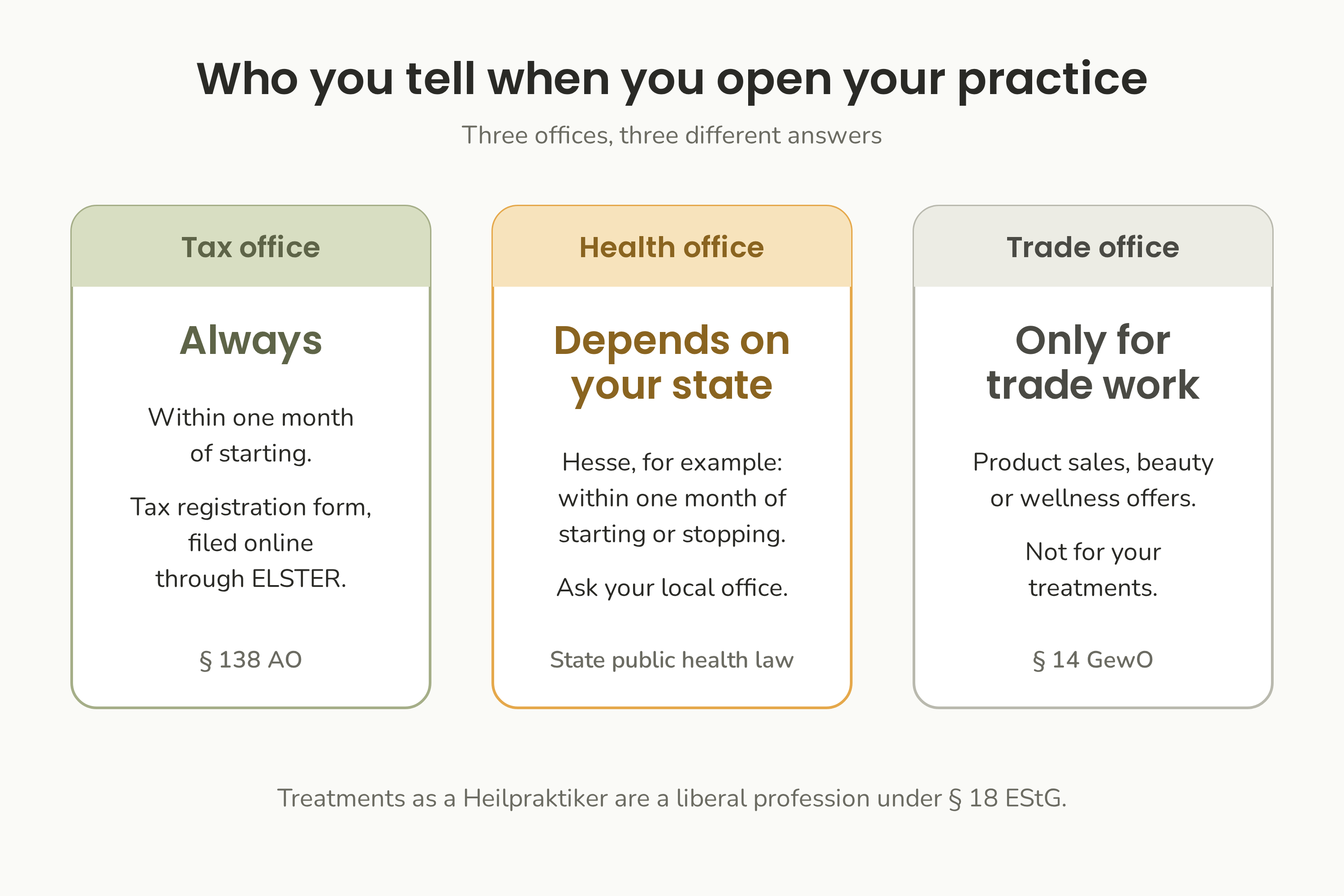
You tell the tax office within one month of starting, and in some states the health office as well. The trade office does not need to hear from you for your treatments. Each office has its own rule and its own deadline.
The tax office
Anyone who starts freelance work must tell the tax office within one month (§ 138 (1), (1b) and (4) AO). The details go in the tax registration form, which you file online through ELSTER, the tax office's online portal. Paper is allowed only in hardship cases.
The form asks for your expected income and profit for this year and next. It also asks whether you want the small business exemption for VAT. Your treatments with a therapeutic aim are VAT-exempt either way, so that question only matters if you plan other taxable work. Once the form is processed, you receive your tax number.
The health office
Some states ask Heilpraktiker to notify the local health office when they open or close a practice. There is no federal rule, so it depends on your state's public health law. In Hesse, for example, you report the start and end of your practice within one month. That is § 12 of the Hesse public health act (City of Wiesbaden).
A short phone call to your health office settles it. While you are in touch, ask about hygiene rules for your treatments. Our guide to the Infektionsschutzgesetz for Heilpraktiker covers what the health office checks.
When does a Heilpraktiker need a Gewerbeanmeldung?
You need a Gewerbeanmeldung as soon as your practice does work that is not the practice of healing. Selling goods is the most common case. Beauty and wellness offers without a therapeutic aim are another. A practice GmbH is a special case: it always pays trade tax because of its legal form, even on treatments.
The tax office looks at each activity on its own. The official income tax guidance lists vets who sell medicines as an example of trade activity next to a liberal profession (H 15.6 EStH 2025). The same logic applies to a practice.
| Activity in the practice | Tax status | Why |
|---|---|---|
| Treatments as a Heilpraktiker | Freelance | Listed in § 18 (1) no. 1 EStG |
| Courses and talks | Usually freelance | § 18 EStG also lists teaching work |
| Selling supplements, cosmetics, books or devices | Trade | Buying and reselling goods is a trade |
| Beauty treatments, wellness massage without a therapeutic aim | Usually trade | Not the practice of healing, so the catalogue profession does not cover it |
| Any work done by a practice GmbH | Trade for trade tax | A GmbH is a trade by its legal form (§ 2 (2) GewStG) |
How the trade registration works
Register at your town's trade office when you start the trade work (§ 14 (1) GewO). Most towns offer it online. The fee is set locally; Berlin, for example, charges 15 euros online and 26 euros on site, as of 2026 (service.berlin.de).
Describe only the trade part on the form, for example "sale of food supplements and cosmetics". Do not list your treatments there. The trade office passes your data on to the tax office, which then asks for the tax details of the new activity.
Chamber of commerce membership
Once you are assessed for trade tax, you become a member of your local chamber of commerce (IHK) by law. A sole trader outside the commercial register pays no contribution up to 5,200 euros of trade income a year (as of 2026, § 3 (3) IHKG). New founders get further relief in their first years.
What does trade tax cost a Heilpraktiker?
Your treatment income carries no trade tax at all. Trade tax only applies to the profit from your trade part. For a sole practitioner, the first 24,500 euros of trade profit a year are free of it (§ 11 (1) GewStG), as of 2026.
Above that allowance, trade tax is due at the local rate of your town. Most of it comes back through your income tax. § 35 EStG credits four times the trade tax base amount against your income tax, capped at the trade tax you actually paid.
In practice, a small product shelf in a sole practice rarely creates any trade tax. The bigger cost is the extra work: separate records, one more registration and, above the limit, a trade tax return.
Why does a partnership need extra care?
In a partnership, a small trade part can spill over and turn the whole practice into a trade. § 15 (3) no. 1 EStG treats all income of a partnership as trade income once part of it is trade income.
The Federal Fiscal Court (BFH) softened this rule with a small-share test (judgment of 27 August 2014, VIII R 6/12). The trade turnover may be at most 3 percent of total net turnover and at most 24,500 euros a year. Both limits must hold.
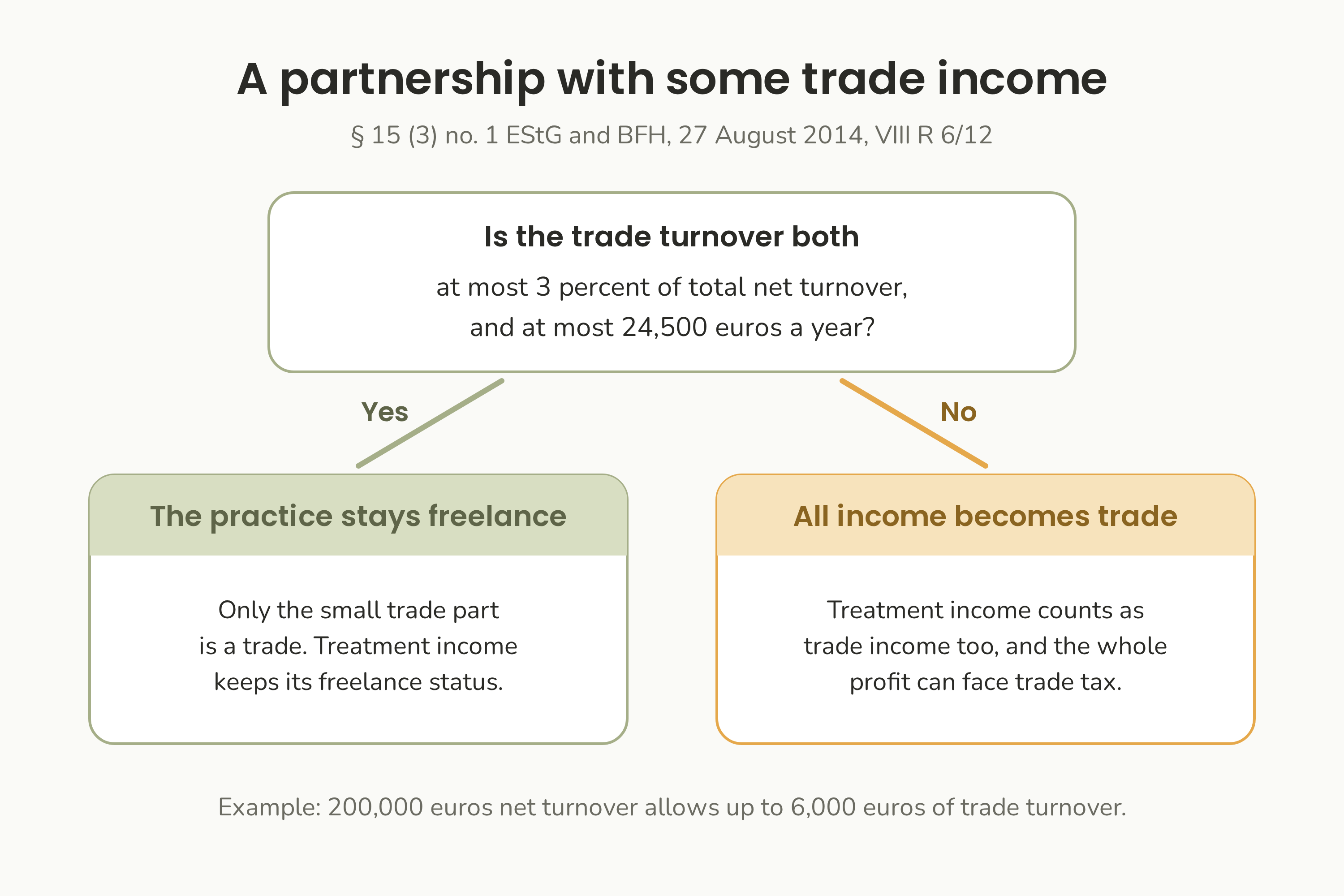
Take a shared practice with 200,000 euros net turnover. It may sell up to 6,000 euros of products a year before the whole practice turns into a trade. If it plans more, talk to a tax adviser before you start. A separate company for the trade part is a common answer.
How do you keep treatments and trade work apart?
If you are a sole practitioner, the tax office separates freelance and trade work wherever the two can be told apart (H 15.6 EStH 2025). Your treatments keep their freelance status. You make that separation easy by keeping the two apart from the first day.
- Keep separate income lists, or separate accounts in your bookkeeping, for treatments and for trade work.
- Put treatments and products on separate invoice lines. Our guide to the GebüH fee schedule helps with the treatment lines.
- Split shared costs, such as rent or a receptionist, by a fair key and write the key down.
- Check your website: product offers there also fall under advertising law, as our HWG guide explains.
A short checklist for opening your practice
Run through these six steps in the month you start. They cover the tax office, the health office and the trade office, plus the yearly check a partnership needs. Most Heilpraktiker are done with them in a few weeks.
- File the tax registration form through ELSTER within one month of starting.
- Ask your health office whether your state requires a notice, and file it if so.
- List everything your practice will offer besides treatments.
- If that list includes goods, beauty or wellness, register that part at the trade office when you start it.
- In a partnership, check the trade share against the 3 percent and 24,500 euro limits each year.
- Keep treatments and trade work apart in your books and on your invoices.
This article is general information, not tax or legal advice. Talk to your tax adviser or a lawyer for your own case. All law texts were read on gesetze-im-internet.de on 21 October 2026.
About this blog
This blog is written by the team at Vitalmyn. We build an ordering service for practitioner recommendations, and we write guides on the business side of running a Heilpraktiker practice in Germany.
Frequently asked
Do Heilpraktiker have to register a trade?
Not for treatments. § 18 (1) no. 1 EStG lists the Heilpraktiker among the liberal professions, so treatment work is freelance and needs no trade registration. A registration is only needed for trade work in the practice, such as selling products or beauty offers without a therapeutic aim.
Is a Heilpraktiker a freelancer or a trade?
A freelancer. The Heilpraktiker is one of the catalogue professions in § 18 EStG. Only activities outside the practice of healing, such as product sales, count as a trade, and the tax office separates them from the treatments where it can.
Which offices does a new Heilpraktiker practice have to notify?
The tax office, within one month of starting, through the online tax registration form in ELSTER (§ 138 AO). Depending on the state, the local health office as well. The trade office only for trade work.
Do Heilpraktiker pay trade tax?
Not on treatment income. Trade tax only applies to trade profit, for example from product sales. A sole practitioner has an allowance of 24,500 euros a year (§ 11 GewStG), and § 35 EStG credits much of any trade tax against income tax.
Can selling products make a whole partnership a trade?
Yes, under § 15 (3) no. 1 EStG. The Federal Fiscal Court allows a small share: trade turnover of at most 3 percent of total net turnover and at most 24,500 euros a year (VIII R 6/12). Above that, all partnership income counts as trade income.
Sources
- § 18 EStG, income from liberal professions
- § 6 GewO, scope of the Trade Regulation Act
- § 14 GewO, trade registration
- § 138 AO, notifying the start of a business or freelance work
- § 141 AO, bookkeeping duty for traders
- § 2 GewStG, what counts as a trade
- § 11 GewStG, trade tax allowance
- § 35 EStG, trade tax credit against income tax
- § 15 EStG, trade income of partnerships
- Federal Fiscal Court, judgment of 27 August 2014, VIII R 6/12
- Federal Ministry of Finance, income tax guidance H 15.6 EStH 2025 (mixed activity)
- § 2 and § 3 IHKG, chamber membership and contributions
- City of Wiesbaden, supervision of health professions (Hesse notice duty)
- Berlin service portal, trade registration and fees
Written by
Vitalmyn Team
Editorial team
We are building the ordering service for practitioner recommendations. Here we write down what we learn about recommending, practice finances and advertising law, so you do not have to dig it up yourself.