When a patient asks what your practice holds about them, you have one month to answer. As a Heilpraktiker, a state-licensed non-medical practitioner, you owe them the information Art. 15 DSGVO lists and a free first copy of their data. The patient file is part of that copy, and the patient does not have to say why they want it.
The request usually arrives without warning. A short email asks for "everything you have on me", sometimes after a disagreement about an invoice. This guide explains the two rights behind such a request, what your answer must contain, the deadline and the free copy. It ends with a step-by-step routine and what an ignored request can cost.
What does the right of access mean for your practice?
The right of access lets every patient find out whether you process their personal data. If you do, they get the data and key facts about it. It comes from Art. 15 of the DSGVO, the EU's data protection regulation. It applies to a solo practice exactly as it applies to a large company.
For a Heilpraktiker, a second right sits next to it. The treatment contract rules of the German civil code also cover Heilpraktiker. Under § 630g BGB, the patient may inspect the complete patient file. A patient can rely on either one, or on both at once.
The request needs no special form. It can come by email, by letter, through your contact form or in person at the desk. The patient does not have to name the law or use the word "access". "Please send me my file" is enough to start the clock.
The right covers far more than the treatment notes. Your appointment calendar, invoices, emails, the booking tool, lab reports you received and your own notes on the patient are all personal data. If a provider stores any of it for you, that data counts as well. Your data processing agreement (AVV) obliges the provider to help you answer, as our guide to AVV contracts explains.
What must your answer to an Art. 15 request contain?
Your answer has two parts. First, a written statement with the facts Art. 15 (1) DSGVO lists, such as the purposes, the recipients and how long you keep the data. Second, a copy of the personal data itself under Art. 15 (3). A letter that only says "we store your name and treatment notes" is not enough.
| What you must state | What it means in a practice | Rule |
|---|---|---|
| Confirmation | Yes, you process data about this patient | Art. 15 (1) |
| Purposes | Treatment, documentation, billing, appointment booking | Art. 15 (1) a |
| Categories of data | Contact details, health history, findings, invoices, correspondence | Art. 15 (1) b |
| Recipients | Practice software provider, booking tool, laboratory, tax adviser, collection service | Art. 15 (1) c |
| Storage period | For example ten years after the end of treatment for the patient file | Art. 15 (1) d |
| The patient's other rights | Correction, erasure, restriction and objection | Art. 15 (1) e |
| Right to complain | To the data protection authority of your federal state | Art. 15 (1) f |
| Source | Where data did not come from the patient, for example a referral letter or a lab | Art. 15 (1) g |
| Automated decisions | In a practice usually "none", but say so | Art. 15 (1) h |
Most of this text is the same for every patient. Write it once as a template and keep it with your record of processing activities. The privacy notice you hand out at the first appointment already contains most of the facts. For each request you then add only the patient's own data.
The ten-year storage period comes from the civil code. You must keep the patient file for ten years after the treatment ends, unless another law sets a different period (§ 630f (3) BGB). Name that period in your answer, so the patient knows when the file will be deleted.
Does the patient get a free copy of the whole file?
Yes, the first copy is free. The Court of Justice of the European Union decided this in October 2023, in a case about a German dentist (CJEU, C-307/22). The court also held that the patient does not have to give a reason. A patient who wants the file to prepare a claim against you still gets it free.
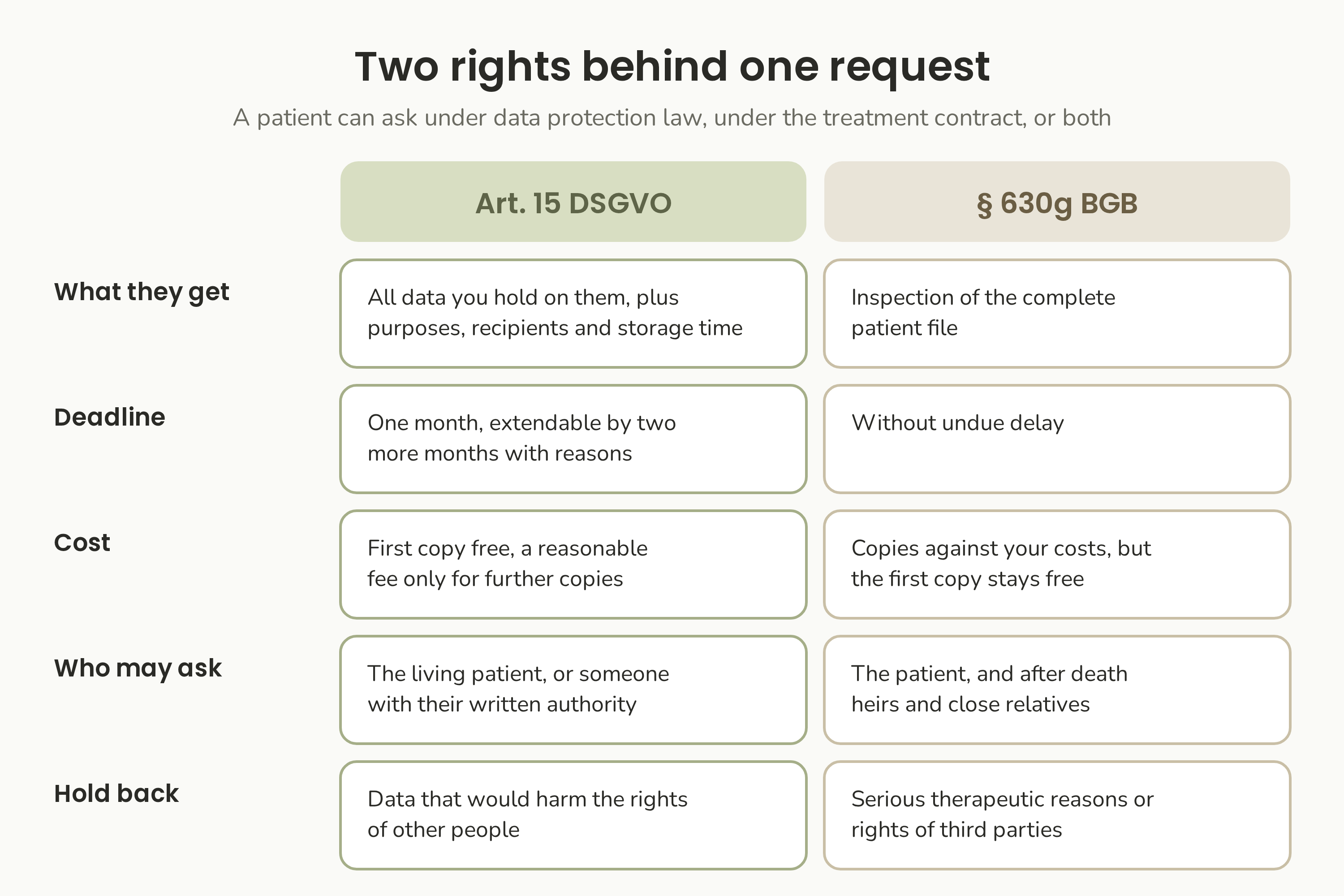
The ruling changed how § 630g BGB works in practice. The civil code still says the patient pays for copies of the file (§ 630g (2) BGB). For the first copy, the court ruled that this cost rule gives way to the DSGVO. You may charge a reasonable fee based on your costs only for further copies (Art. 15 (3) DSGVO).
What counts as a copy was also settled. It must be a faithful and understandable reproduction of all the data. In a patient file, that often means copies of whole documents, such as findings, diagnoses and records of what was done. A summary in your own words does not replace the copy.
Paper, PDF or email?
If the patient asks by email, answer in a common electronic form, such as a PDF (Art. 15 (3) DSGVO). Paper is only needed if they ask for it. Health data needs a secure route. Use encrypted email, a password-protected file with the password sent separately, registered post, or hand it over in person.
The patient can also choose to look at the original file in your practice under § 630g. That inspection takes place where the file is kept. It does not replace the free copy if the patient also asks for one.
How long do you have to answer?
You must answer without undue delay and within one month of receiving the request (Art. 12 (3) DSGVO). You may extend by two further months only for complex or numerous requests. Then you must tell the patient within the first month and give the reason.
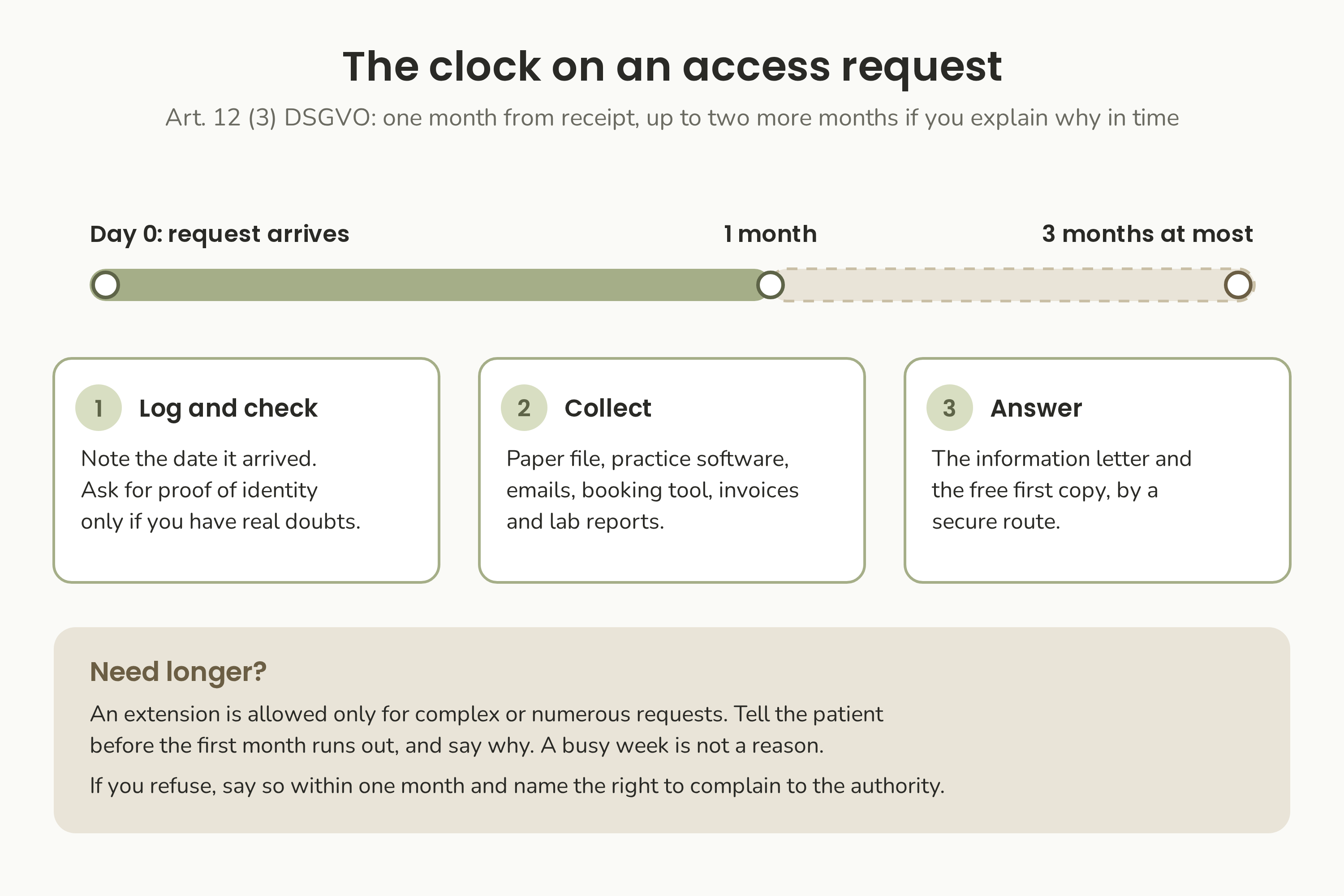
The month runs from the day the request reaches you, not from the day you read it. An email that arrives during your holiday still starts the clock. Set up an out-of-office note that names who handles urgent requests, or check your practice mailbox at least weekly.
A single patient file is rarely complex enough for an extension. Two years of treatment notes and a dozen emails are a normal request for a practice. Plan to answer within the first month and use the extension only when it is really needed.
The deadline under § 630g is stricter on paper. Inspection must be granted without undue delay, with no fixed number of days. In practice, answering promptly and well inside the month covers both rights at once.
When may you refuse or hold something back?
Only in a few narrow cases, and you carry the burden of proving that one applies. You may hold back data that would harm the rights of other people. You may charge a fee or refuse a manifestly unfounded or excessive request (Art. 12 (5) DSGVO). An example is the fifth identical request in a month.
| Situation | What you may do | Rule |
|---|---|---|
| You are not sure the request comes from the patient | Ask for proof of identity, but only with real doubts | Art. 12 (6) DSGVO |
| A relative or partner asks for the patient | Answer only with the patient's written authority | Art. 15 DSGVO |
| A parent asks for a child's file | Answer if the parent has custody, check the child's own wishes as the child grows older | § 1626 BGB |
| The file mentions other people, such as a family member | Black out their data, hand over the rest | Art. 15 (4) DSGVO, § 630g (1) BGB |
| The same patient repeats the request many times | Charge a reasonable fee or refuse, and record why | Art. 12 (5) DSGVO |
| The patient has died | The DSGVO does not apply; heirs (for property interests) and close relatives (for personal interests) may inspect, unless the patient's wishes speak against it | Recital 27 DSGVO, § 630g (3) BGB |
| Inspection could seriously harm the patient | § 630g allows a refusal for serious therapeutic reasons; whether this holds against Art. 15 is disputed | § 630g (1) BGB |
The last row needs care. § 630g allows you to refuse inspection where serious therapeutic reasons speak against it, and you must give your reason. Art. 15 DSGVO has no such exception in its text. Ask a lawyer before you hold anything back on these grounds, and never use it to hide a note you find awkward.
Your own notes are not exempt either. Impressions you wrote down about the patient, comments in the margin and internal emails about the case are personal data about them. If you would not want the patient to read a note, the time to think about its wording is when you write it.
If you refuse, you must still answer within one month. Say why, and tell the patient they can complain to the supervisory authority or go to court (Art. 12 (4) DSGVO). Silence is never an allowed answer.
How to answer an access request step by step
A fixed routine turns an access request into an hour of work instead of a week of worry. You log the request and check who sent it. Then you collect the data from every place it lives, write the letter and send the copy securely. Then you file a record that you did.
- Log the request. Write down the date it arrived and the deadline one month later. Confirm receipt to the patient in a short reply.
- Check identity only when in doubt. A known patient writing from their usual email address needs no ID check. A request from an unknown address or by phone may justify one.
- Collect the data. Go through the paper file, your practice software, the booking tool, your email, invoices and any lab reports. Ask your providers for anything you cannot export yourself.
- Check for other people's data. Black out names and details of third parties, such as family members mentioned in the history.
- Write the letter. Use your template with the Art. 15 (1) facts, and attach the copy of the data. Keep the wording plain, so a patient without legal training understands it.
- Send it securely. Use an encrypted route or registered post, or hand it over in person. Note how and when you sent it.
- Keep a record. File the request, your answer and the date. If the supervisory authority ever asks, this record shows you met the deadline.
Data protection authorities publish guidance and sample texts for answering access requests. The Datenschutzkonferenz, the joint body of German data protection authorities, explains the right of access in a short paper. The European Data Protection Board goes into more detail in its guidelines on the right of access.
What happens if you ignore a request?
Unanswered access requests are among the complaints data protection authorities see most often. The authority can order you to answer and can impose a fine. Breaches of data subject rights fall in the higher fine bracket (Art. 83 (5) b DSGVO). The cap is 20 million euros or four percent of worldwide annual turnover, whichever is higher.
For a solo practice, a fine of that size is unlikely. The realistic outcome is a letter from the authority with a short deadline and the request to explain yourself. The patient can also claim compensation for damage caused by the breach (Art. 82 DSGVO). Whether a late answer alone justifies compensation is disputed, and German courts have decided both ways.
There is a quieter cost too. A patient who asks for their file and hears nothing tends to assume the worst. A prompt, complete and friendly answer often ends a disagreement before it grows. Handled well, an access request shows the patient that your practice keeps its records in order.
This article is general information, not legal advice. Talk to a lawyer or your professional association for your own case.
About this blog
This blog is written by the team at Vitalmyn, who build an ordering service for practitioner recommendations. They read German health and data protection law closely because their own work depends on it. Articles here are general guides for practising Heilpraktiker.
Frequently asked
Does a Heilpraktiker have to give a patient a copy of the patient file?
Yes. Under Art. 15 (3) DSGVO the patient gets a copy of all personal data you hold, and the patient file is part of it. The Court of Justice of the EU ruled in case C-307/22 that the first copy is free and that the patient does not need to give a reason.
How long does a Heilpraktiker have to answer an access request?
One month from the day the request arrives (Art. 12 (3) DSGVO). For complex or numerous requests you may extend by two further months, but you must tell the patient within the first month and give the reason.
May a Heilpraktiker charge for copies of the patient file?
Not for the first copy. § 630g (2) BGB says the patient pays for copies, but the CJEU ruled that this gives way to the DSGVO for the first copy. A reasonable fee based on your costs is allowed only for further copies.
Can relatives ask for a patient's file?
While the patient is alive, only with the patient's written authority, or as a parent with custody of a child. After the patient's death the DSGVO no longer applies; heirs and close relatives may inspect the file under § 630g (3) BGB unless the patient's wishes speak against it.
Sources
- Regulation (EU) 2016/679 (DSGVO), Art. 12, 15, 82 and 83 and recital 27
- Court of Justice of the EU, judgment of 26 October 2023, C-307/22, press release
- § 630g BGB, inspection of the patient file
- § 630f BGB, documentation of the treatment
- § 1626 BGB, parental custody
- Datenschutzkonferenz, short paper 6: right of access, Art. 15 DSGVO
- European Data Protection Board, Guidelines 01/2022 on the right of access
Written by
Vitalmyn Team
Editorial team
We are building the ordering service for practitioner recommendations. Here we write down what we learn about recommending, practice finances and advertising law, so you do not have to dig it up yourself.