
The Heilpraktikergesetz lets you practise medicine without a medical degree, once the health authority has granted you a licence. As of November 2026 a full licence covers diagnosis and the choice of method across all fields. The limits come from other laws, which reserve some tasks, such as prescription-only medicines, dentistry and listed infectious diseases, for doctors.
If you work as a Heilpraktiker, a state-licensed non-medical practitioner, you already hold this licence. This guide sets out what the law says today and what your licence covers in daily practice. It also shows where the doctors' reserve begins and which duties come with it. Every rule links to its primary source.
What does the Heilpraktikergesetz say?
The Heilpraktikergesetz (HeilprG) is a short federal law from 17 February 1939. Its core is one sentence: anyone who wants to practise medicine without being licensed as a doctor needs a permit. The law was last amended in December 2016 and is still in force today (HeilprG).
Most people who search for the current version want to know which sections matter. There are only a few, and they fit in one table.
| Section | What it says in plain words |
|---|---|
| § 1 (1) HeilprG | Practising medicine without a medical licence needs a permit |
| § 1 (2) HeilprG | Defines practising medicine: any professional activity to find, cure or relieve illness, suffering or bodily harm in people, also when done for someone else |
| § 1 (3) HeilprG | A grandfather clause for people who practised before 1939; they also carry the title Heilpraktiker |
| § 3 HeilprG | The permit does not cover practising as a travelling healer |
| § 5 HeilprG | Practising medicine without a permit can lead to up to one year in prison or a fine |
| § 5a HeilprG | A permit holder who practises as a travelling healer commits an administrative offence, with a fine of up to 2,500 euros |
All sections come from the official text (HeilprG). § 4 has no text any more, because it clashed with the freedom to choose an occupation in the German constitution.
The implementing regulation
The details of granting and losing the permit sit in the first implementing regulation, the 1. DVO HeilprG. Its § 2 lists the reasons to refuse a permit. They include being under 25, unreliability, health reasons, and a knowledge check by the health office showing a danger to public health (1. DVO HeilprG, § 2).
For a practice that already runs, § 7 of the same regulation matters more. It is covered below under the duties that come with the licence.
What does the licence allow you to do?
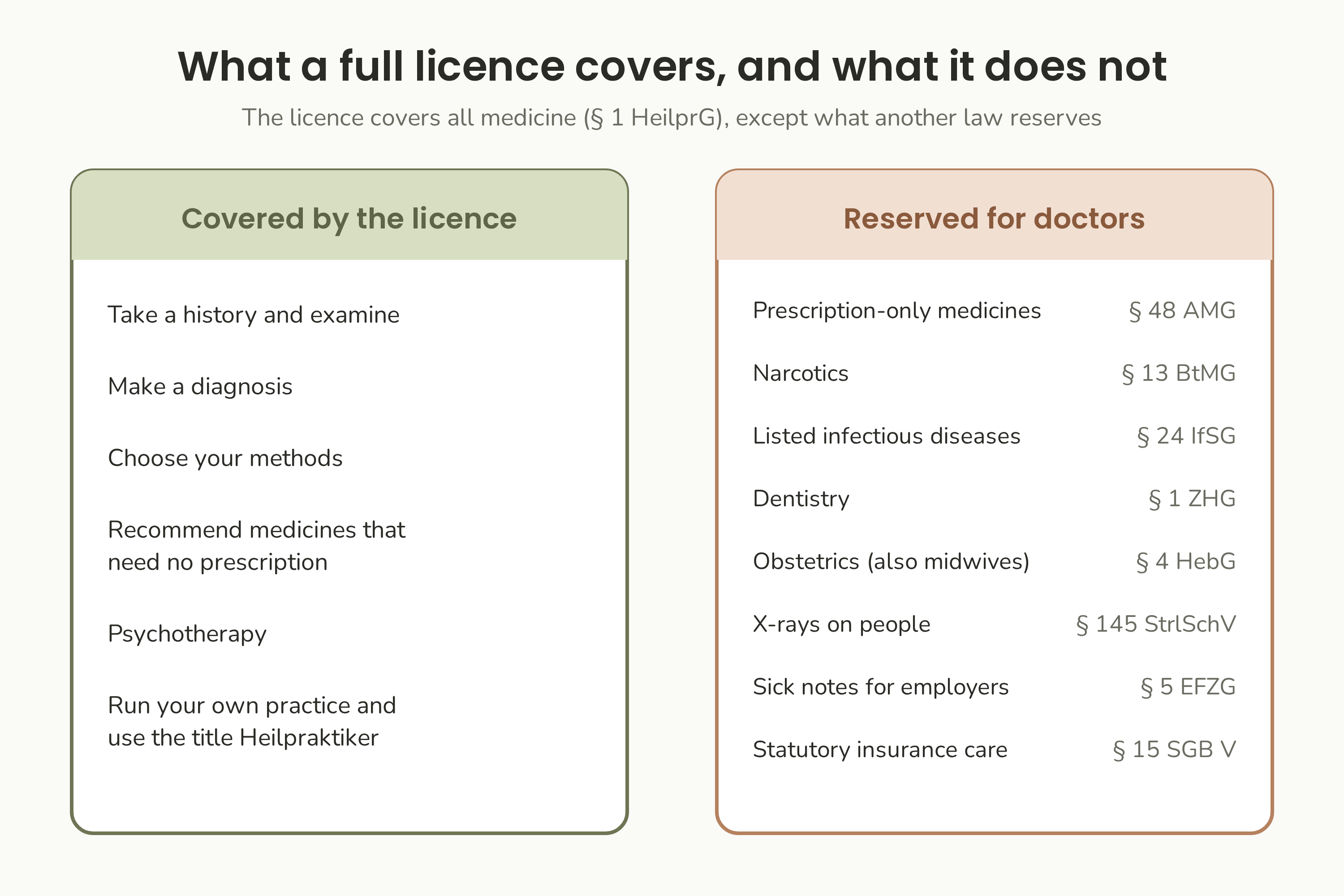
A full licence allows you to practise medicine on people in your own practice. That covers taking a history, examining, making a diagnosis and choosing your methods. The law sets no list of allowed methods. What you may not do is set by other laws that reserve certain tasks for doctors.
This is the key to reading the law. § 1 HeilprG grants a broad permit for all medicine. It does not name what you may do, so anything not reserved elsewhere is open to you (§ 1 HeilprG).
In daily work this means four things:
- Diagnosis. You may find out what is wrong with a patient, in your own words and with your own methods.
- Choice of method. No law tells you which approach to use. You carry the responsibility for that choice.
- Medicines without a prescription. You may recommend medicines that need no prescription, within the rules on advertising.
- Your title. With the permit you practise under the title Heilpraktiker in your own practice.
Your freedom to choose a method is not unlimited. The Federal Constitutional Court has said that a key risk in this field is indirect. A patient may skip medical care they need (BVerfG, 1 BvR 784/03). Keeping that risk low is part of your job, as the next sections show.
What is reserved for doctors?
Several federal laws reserve tasks for doctors, and sometimes for dentists or midwives. Your licence does not reach into these areas. The main ones for a practice are prescription-only medicines, narcotics, listed infectious diseases, dentistry, obstetrics, X-rays, sick notes for employers and statutory health insurance care.
Each limit sits in its own law. The table names the section, so you can check the exact wording yourself.
| Area | What the law reserves | Source |
|---|---|---|
| Prescription-only medicines | Only a doctor, dentist or vet may prescribe them | § 48 AMG |
| Narcotics | Only doctors, dentists and vets may prescribe them | § 13 BtMG |
| Infectious diseases | Diagnosing or treating listed infectious diseases and any sexually transmitted infection is for doctors only | § 24 IfSG |
| Dentistry | Needs a licence as a dentist | § 1 ZHG |
| Obstetrics | Only doctors and midwives may provide it, except in an emergency | § 4 HebG |
| X-rays and other radiation on people | Only doctors or dentists with the required expertise, or staff they supervise | § 145 StrlSchV |
| Sick notes for employers | An employee off sick for more than three calendar days needs a certificate from a doctor | § 5 EFZG |
| Statutory health insurance | Medical care in the statutory scheme is provided by doctors or dentists | § 15 SGB V |
The infectious disease rule causes the most questions in practice. It covers more than the obvious cases, and it has its own reporting duties. We explain it in detail in our guide to the Infektionsschutzgesetz for Heilpraktiker.
What the reserve means for your patient
When a case falls into one of these areas, your role changes. You may not take it on yourself, and the patient needs a doctor. Saying so clearly, and writing it down, protects both of you.
Full licence or sector licence: what is the difference?
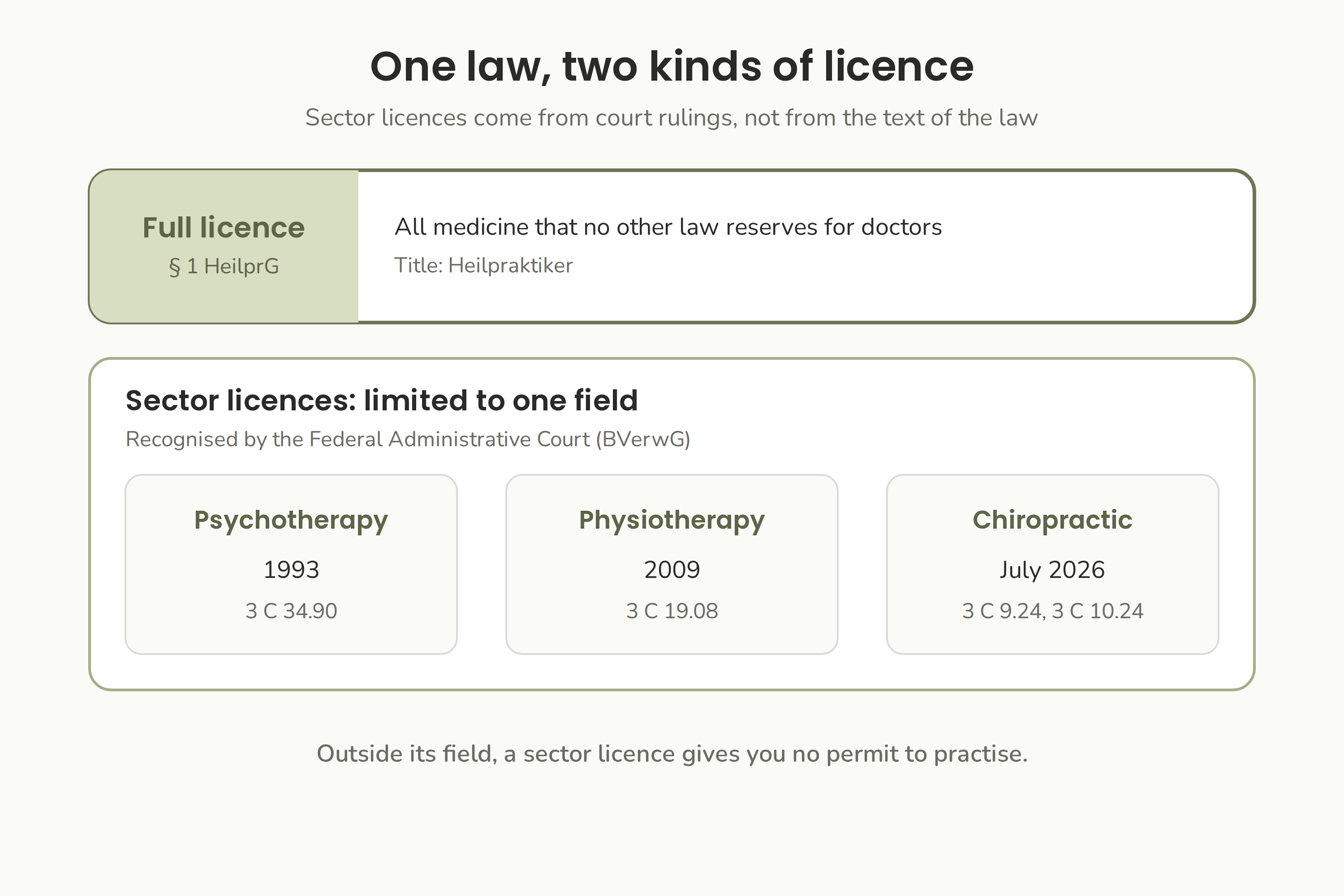
A full licence covers all medicine that no other law reserves for doctors. A sector licence covers only one field, such as psychotherapy, physiotherapy or, since July 2026, chiropractic. The text of the Heilpraktikergesetz does not mention sector licences. They come from rulings of the Federal Administrative Court.
The court first allowed a licence limited to psychotherapy in 1993 (BVerwG, 3 C 34.90). In 2009 it added physiotherapy and said that a trained physiotherapist must still pass a knowledge check limited to that field (BVerwG, 3 C 19.08).
The July 2026 chiropractic rulings
On 9 July 2026 the court decided two cases from two federal states (BVerwG, press release 56/2026). It ruled that a licence limited to chiropractic is possible, because the field can be clearly defined. The court relied on WHO guidelines from 2006, the professional associations and a German university curriculum.
Both claimants were physiotherapists who already held a physiotherapy licence. The court said neither gets the chiropractic licence without a knowledge check limited to chiropractic (beck-aktuell).
Why the type of licence matters every day
With a sector licence, your permit ends where your field ends. Outside it, you practise without a permit, and § 5 HeilprG applies. Check that the wording of your certificate matches what your website and your practice sign say you do.
Which duties come with the licence?
The licence comes with duties that run as long as you practise. You must stay reliable and fit to practise, or the authority must withdraw the permit. You must keep proper patient files. And you must not keep a patient away from medical care they need.
| Duty | What it means | Source |
|---|---|---|
| Keep the permit | The authority must withdraw it if you are no longer reliable or fit to practise | § 7 1. DVO HeilprG |
| Keep a patient file | Document the treatment and store the file for 10 years | § 630f BGB |
| Refer on | Send a patient to a doctor when a case goes beyond your licence | BVerfG, 1 BvR 784/03 |
| Advertise lawfully | Your website follows the rules on health advertising | HWG |
Keeping the permit
The higher administrative authority must withdraw your permit if facts arise or become known that would have justified a refusal. Typical cases are a loss of reliability or of health (1. DVO HeilprG, § 7). Before it decides, it must hear an expert committee.
The treatment contract and the patient file
The treatment contract rules in the German Civil Code (BGB, § 630a and following) apply to you as they do to a doctor. You must keep a patient file and store it for 10 years after the treatment ends, unless another law sets a different period (§ 630f BGB). Our guide on how long a Heilpraktiker must keep patient records covers the details.
Not standing between your patient and a doctor
The Federal Constitutional Court named the risk that patients skip necessary medical care as a reason the state may regulate this work (BVerfG, 1 BvR 784/03). In practice this means you refer a patient on when a case goes beyond your licence. Write the referral and the patient's answer in the file.
Advertising your practice
Your licence does not free your website from the rules on health advertising. The Heilmittelwerbegesetz applies to every Heilpraktiker practice. Our guide to the HWG for Heilpraktiker explains what your website may say.
Is the Heilpraktikergesetz about to change?
Not yet. As of November 2026 we found no federal draft bill to amend the Heilpraktikergesetz. The law you practise under today is the version last amended in 2016. Any change would need a new federal law, passed by the federal parliament.
There is movement around the law. A federation of Heilpraktiker associations has an entry in the federal lobby register on keeping the current rules. It states that it does not seek a change to the law at present (federal lobby register, RV0017711). In June 2026 an opposition motion in the federal parliament also asked to keep the profession (federal parliament press service, hib 473/2026).
What the federal reports found, and which reform directions are being discussed, is covered in our guide to the Heilpraktikergesetz reform.
What to check in your practice now
The law itself has not changed since 2016, so most practices need no new step. A short check once a year keeps you on the safe side. It covers four points: your certificate, the doctors' reserve, your patient files and your website.
- Your certificate. Is it a full licence or a sector licence? Does your website match its scope?
- The doctors' reserve. Do you know the eight areas in the table above, and how you refer a patient on?
- Your patient files. Are they complete, and kept for at least 10 years?
- Your website. Does it follow the rules on health advertising?
This article is general information, not legal advice. Talk to a lawyer or your professional association for your own case.
About this blog
This blog is written by the team at Vitalmyn, who build an ordering service for practitioner recommendations. They read German health law closely because their own work depends on it. Articles here are general guides for practising Heilpraktiker.
Frequently asked
What does the Heilpraktikergesetz allow?
It allows a person with a permit to practise medicine without a medical licence. The permit covers diagnosis and the choice of method. Tasks other laws reserve for doctors, such as prescribing prescription-only medicines or treating listed infectious diseases, are excluded.
May a Heilpraktiker prescribe medicines?
Not prescription-only medicines or narcotics. Under § 48 AMG and § 13 BtMG only doctors, dentists and vets may prescribe them. A Heilpraktiker may recommend medicines that need no prescription.
What is a sector Heilpraktiker licence?
A licence limited to one field, such as psychotherapy, physiotherapy or chiropractic. The Federal Administrative Court recognised these fields in 1993, 2009 and July 2026. Outside that field, the holder has no permit to practise.
Can a Heilpraktiker write a sick note for an employer?
No. Under § 5 EFZG an employee off sick for more than three calendar days needs a certificate from a doctor.
Sources
- Heilpraktikergesetz (HeilprG), §§ 1, 3, 5 and 5a
- First implementing regulation to the HeilprG, §§ 2 and 7
- § 48 AMG, prescription-only medicines
- § 13 BtMG, narcotics
- § 24 IfSG, infectious diseases reserved for doctors
- § 1 ZHG, dentistry
- § 4 HebG, obstetrics
- § 145 StrlSchV, radiation on people
- § 5 EFZG, certificate of incapacity for work
- § 15 SGB V, medical care in statutory health insurance
- § 630f BGB, patient file
- Federal Administrative Court, 3 C 19.08, 26 August 2009
- Federal Administrative Court, 3 C 9.24 and 3 C 10.24, press release, July 2026
- beck-aktuell on the chiropractic rulings, July 2026
- Federal Constitutional Court, 1 BvR 784/03, 2 March 2004
- Federal lobby register, RV0017711
- Federal parliament press service, hib 473/2026, June 2026
Written by
Vitalmyn Team
Editorial team
We are building the ordering service for practitioner recommendations. Here we write down what we learn about recommending, practice finances and advertising law, so you do not have to dig it up yourself.