
A Behandlungsvertrag is the treatment contract between a Heilpraktiker, a state-licensed non-medical practitioner, and a patient. Since the Patientenrechtegesetz of 2013 it is written into § 630a to § 630h BGB. Those eight paragraphs set your duties to inform, to obtain consent, to document and to open the file. They bind every Heilpraktiker, whether or not anything is signed.
The question usually comes up when a patient asks for a copy of the file or a private insurer refuses an invoice. This guide walks through the contract duty by duty and says which of them need a record. It ends with the clauses a written contract should contain.
What is the Behandlungsvertrag under the Patientenrechtegesetz?
The Patientenrechtegesetz is the act of 20 February 2013 that wrote the treatment contract into the civil code. Before that date the duties of a treating person came from court decisions. Since 26 February 2013 they stand in § 630a to § 630h BGB, one paragraph per duty, and apply to anyone who promises medical treatment.
That last point is the one that matters for your practice. § 630a (1) BGB names the treating person as whoever promises the medical treatment of a patient. The law does not say doctor.
A Heilpraktiker who takes on a patient is a treating person in the sense of the paragraph, and so are a physiotherapist or a midwife. The patient owes the agreed fee in return, unless a third party pays.
The eight paragraphs read as a sequence. One sets up the contract, one points at general service law, five describe a duty each, and the last one says how a court reads the file.
| Paragraph | What it covers | What it asks of you |
|---|---|---|
| § 630a BGB | The contract itself | Treat according to the recognised professional standard of your method, unless something else is agreed |
| § 630b BGB | Which general rules apply | The service contract rules of § 611 ff. BGB, so you owe careful work, not a result |
| § 630c BGB | Cooperation and information | Explain diagnosis, likely course and therapy in plain words, and warn about costs in text form |
| § 630d BGB | Consent | Obtain the patient's consent before every measure, after informing them |
| § 630e BGB | Informing before consent | Explain nature, scope, risks, chances and alternatives, orally and in good time |
| § 630f BGB | Documentation | Keep a file of every essential step, close in time, and keep it ten years |
| § 630g BGB | Inspection of the file | Let the patient read and copy the file on request, without delay |
| § 630h BGB | Burden of proof | What is not documented is presumed not done if a dispute reaches court |
The standard in § 630a (2) BGB is the standard of your own field. The paragraph speaks of the professional standards generally recognised at the time of treatment, and it lets the parties agree otherwise. For a Heilpraktiker that means two things. You are measured against a careful practitioner of the method you use. The contract is the place to name that method, so that both sides know what was agreed.
Does a Heilpraktiker need a written Behandlungsvertrag?
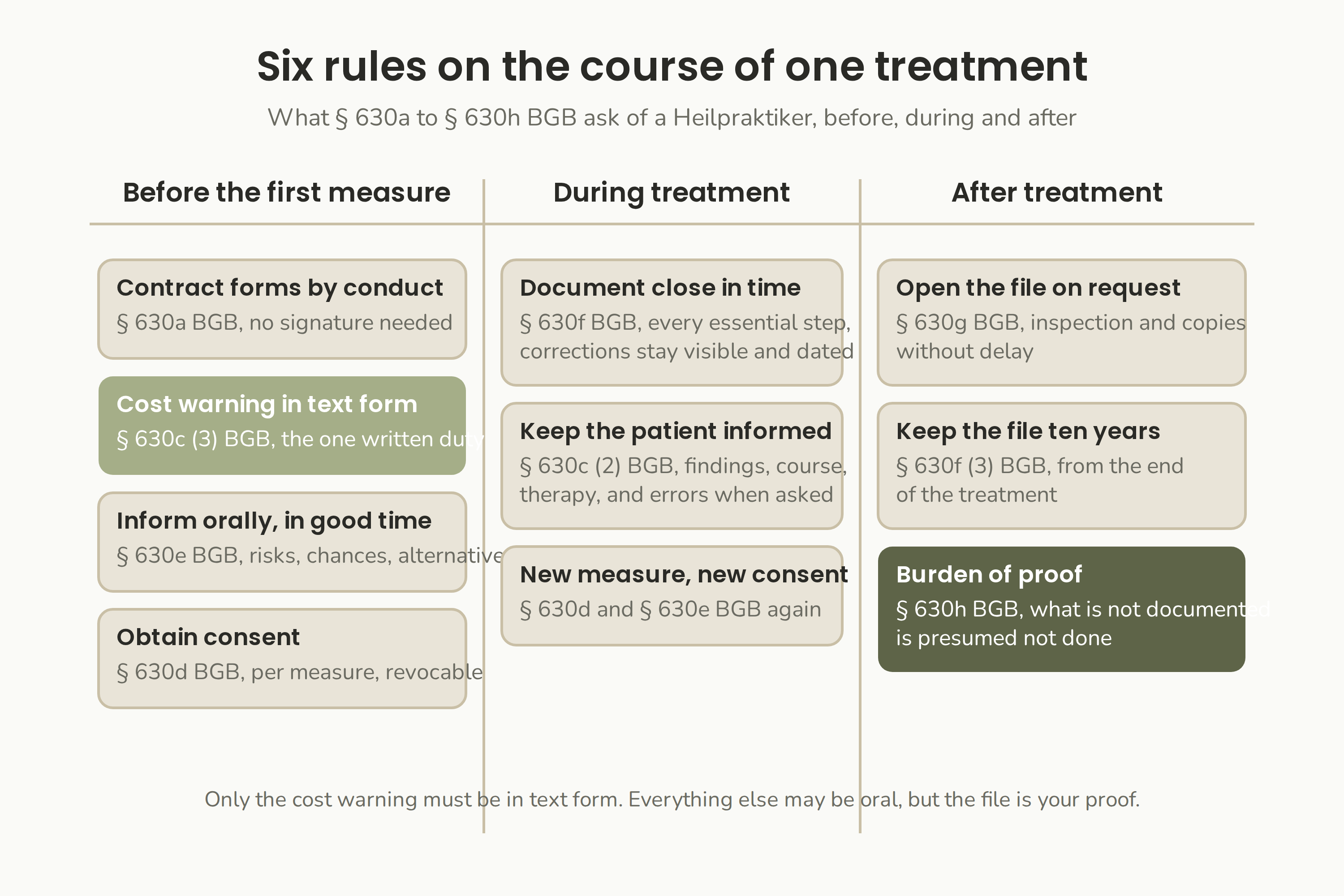
No law requires a signed treatment contract. The contract forms by conduct the moment you accept a patient and start to treat. § 630b BGB points to the general service contract rules, which know no form. A written contract is still the simplest way to meet three duties that do need a record.
The first is the cost warning. § 630c (3) BGB applies where you know a third party will not fully cover the costs. Then you must inform the patient in text form about the likely costs before treatment begins. For a Heilpraktiker practice that is the normal case. Statutory health insurance does not pay for Heilpraktiker treatment, and private insurers and the Beihilfe reimburse only in part.
Text form is defined in § 126b BGB: a readable statement on a durable medium that names the sender. A signed page, a PDF by email or a line in your practice software all qualify. A remark in the waiting room does not.
The second is proof of information and consent. Both may be given orally, but § 630h (2) BGB puts the burden on you to prove that you informed the patient properly and obtained consent. A dated, signed sheet is the simplest proof.
The third is the fee. § 630a (1) BGB speaks of the agreed fee. Without an agreement, the fee is what is customary, and in a dispute that is argued over. A contract that names your rates, or points to the GebüH fee schedule you use, settles it in advance.
The Heilpraktiker associations say the same. The Bund Deutscher Heilpraktiker (BDH) explains on its Patientenrechtegesetz page that the treatment contract bundles the whole relationship between practitioner and patient. It recommends a written one for legal certainty. A written contract is the record that shows you met the duties.
What must you tell the patient before treatment starts?
Two kinds of information are due before the first measure. § 630c (2) BGB asks you to explain the diagnosis, the likely course and the planned therapy in words the patient understands. § 630e BGB adds the information the patient needs to consent: nature, scope, risks, chances and alternatives.
The first kind runs through the whole treatment. The law calls it therapeutic information. At the start and whenever something changes, you tell the patient what you found, what you expect and what you intend to do. You also have to tell the patient about a treatment error you recognise, your own or someone else's, when they ask or when a risk to their health makes it necessary (§ 630c (2) BGB).
The second kind is the information before consent, and § 630e BGB is precise about it.
| Point | What § 630e BGB asks |
|---|---|
| Content | Nature, scope and execution of the measure, its expected consequences and risks, its necessity, urgency and suitability, and its prospects of success |
| Alternatives | Where several indicated and customary methods differ in burden, risks or chances, the patient hears about them. For a Heilpraktiker that includes saying when a doctor's examination is advisable |
| Form | Orally, by you or by someone with the training to carry out the measure. Papers may be added, but they do not replace the conversation |
| Timing | Early enough that the patient can weigh the decision. A sheet handed over on the treatment table a minute before the measure is too late |
| Copies | Any document the patient signs in this context goes to the patient in copy (§ 630e (2) BGB) |
Both duties fall away in two cases only. The measure cannot wait, or the patient has expressly waived the information (§ 630c (4) and § 630e (3) BGB). A waiver is worth noting in the file with date and wording.
What you say about the method itself follows other rules. The treatment contract is read by one patient. The words you use for your therapies on the website reach everyone, and advertising law applies to them. Our guide to the HWG for Heilpraktiker covers what may and may not be said there.
When is the patient's consent valid?
Consent is valid when it is given before the measure by a patient who was able to consent. The patient must have been informed as § 630e BGB requires. § 630d (1) BGB asks for consent before every medical measure, and names interventions into the body or health in particular. Consent given before the information was complete is not effective.
Three points for the practice follow from the paragraph.
Consent can be given in any form. A nod after a proper conversation is consent. Proving it later is the hard part, and that is why most practices keep a signed line under the information sheet.
Consent can be withdrawn at any time, without form and without reason (§ 630d (3) BGB). A clause that binds the patient to a course of ten sessions does not override that. The patient may stop; what remains is the fee question for sessions already held and, where agreed, for a missed appointment.
Where the patient cannot consent, the person entitled to decide for them does, such as a parent for a child or a legal representative. If the patient's presumed will can be established and the measure cannot wait, the measure may go ahead (§ 630d (1) BGB).
What goes into the Behandlungsakte?
§ 630f BGB obliges you to keep a file of the treatment, on paper or electronically, in direct temporal connection with it. The civil code has called this file the Behandlungsakte since 6 February 2026; before that it said Patientenakte. The duty did not change with the name.
The paragraph lists what the file must contain. Everything that is essential for the current and future treatment and its results, and in particular:
| Entry | Example from a Heilpraktiker practice |
|---|---|
| History | The first conversation, earlier illnesses, medication the patient takes, allergies |
| Diagnoses | Your working diagnosis and any diagnosis a doctor's letter brings in |
| Examinations and their results | What you examined, with findings and date |
| Findings | Lab results, reports, the notes of your own examination |
| Therapies and their effects | Each measure, the chosen method, and how the patient responded |
| Interventions and their effects | Anything that enters the body, with lot numbers where a product has one |
| Consents | Who consented to what, when, and that information was given |
| Information given | The conversation of § 630c and § 630e, with date and main points |
| Doctors' letters | Letters you received and letters you wrote, in copy |
Two technical rules sit in § 630f (1) BGB. Corrections and additions are allowed, but the original entry must stay readable and the change must carry its date. Practice software has to guarantee that; a text file on the desktop does not. Our DSGVO checklist for practice software lists what to ask a provider.
The file is kept ten years after the end of treatment (§ 630f (3) BGB). Our guide to retention periods explains when that clock starts and what happens to the files when the practice closes.
The file matters most on a bad day. § 630h (3) BGB says that where an essential measure and its result are not documented, it is presumed that the measure was not carried out. In a dispute, a missing entry is read as a missing treatment.
What may the patient demand from the file, and how fast?
The patient may inspect the full file without delay on request, and may demand copies against reimbursement of the copying cost. That is § 630g BGB. You may refuse only where significant therapeutic reasons or the rights of third parties stand against it. You must give the reason for a refusal.
The paragraph sets no number of days. Without delay means without culpable hesitation (§ 121 BGB), in practice days rather than weeks. Next to this civil law right stands the data protection right of access under Art. 15 DSGVO, which has its own one-month deadline. A patient who writes "please send me my file" triggers both.
After the patient's death, the heirs may inspect the file to pursue financial claims, and close relatives may do so for non-financial reasons. The patient's known or presumed will can rule that out (§ 630g (3) BGB).
| Duty or right | Deadline | Rule |
|---|---|---|
| Cost warning in text form | Before treatment begins | § 630c (3) BGB |
| Information before consent | In good time before the measure | § 630e (2) BGB |
| Documentation | In direct temporal connection with the treatment | § 630f (1) BGB |
| Retention of the file | 10 years after the end of treatment | § 630f (3) BGB |
| Inspection and copies | Without delay on request | § 630g (1) BGB |
| Data protection access | One month, extendable by two | Art. 12 and 15 DSGVO |
| Patient's claim for a treatment error | 3 years from the end of the year of knowledge, 30 years at most | § 195 and § 199 BGB |
The last row is why the ten-year retention period is a minimum and why a careful file is worth the time. A claim can be raised long after the treatment ended, and § 630h BGB then reads the file in the patient's favour wherever it is silent.
Which clauses belong in a written Behandlungsvertrag?
A good written contract is short, and every clause does one job. It records a duty from § 630a to § 630h BGB, or it fixes a point the law leaves open. Most templates that circulate among Heilpraktiker practices, from associations and from colleagues, cover the same nine points.
| Clause | What it does | Why it is there |
|---|---|---|
| Subject of the contract | Names the method, for example classical naturopathic treatment, and that it is a Heilpraktiker treatment | § 630a (2) BGB lets the parties agree the standard; the clause states what was agreed |
| No promise of a result | States that you owe careful treatment by your method and no particular outcome | § 630b BGB, service contract; also keeps the contract clear of healing promises |
| Note on medical care | Says that the treatment does not replace a doctor's examination and that you will advise one where needed | Part of the information and alternatives duty in § 630e BGB |
| Fee | Your rates per session or per hour, or the fee schedule you follow, and when payment is due | § 630a (1) BGB, the agreed fee |
| Cost warning | That statutory insurers do not pay and private insurers or the Beihilfe may reimburse only in part | § 630c (3) BGB, text form before treatment |
| Missed appointments | How long before an appointment the patient may cancel free of charge, and what is owed after that | A cancellation fee needs an agreement; § 615 BGB is the legal background |
| Documentation and inspection | That you keep a file, for how long, and that the patient may inspect it | § 630f and § 630g BGB |
| Data protection | What you record, on which legal basis, and where the full privacy notice is | Art. 13 DSGVO; the notice itself is a separate document |
| Signatures and copy | Date, both signatures, and a line that the patient received a copy | § 630e (2) BGB, copies of signed documents |
Three things do not belong in the contract. Health claims about your method, because the contract is read by the patient and the HWG applies to what you promise. A consent to a specific measure, because consent is given per measure after the conversation and belongs on its own dated sheet. And the privacy notice in full, because it changes more often than the contract. The privacy notice for the practice website is a separate page and the contract only points to it.
If you use a template from your association, read it once against the table. Templates written before 2013 often lack the cost warning in text form and the copy line, because both came with the Patientenrechtegesetz.
The invoice follows the contract. What it must contain, and how the GebüH positions go on it, is in our guide to writing a Heilpraktiker invoice.
This article is general information, not legal or tax advice. Talk to a lawyer or your Steuerberater for your own case.
About this blog
This blog is written by the team at Vitalmyn, who build an ordering service for practitioner recommendations. They read German health, tax and data protection law closely because their own work depends on it. Articles here are general guides for practising Heilpraktiker.
Frequently asked
Does the Patientenrechtegesetz apply to Heilpraktiker?
Yes. § 630a BGB names as treating person anyone who promises the medical treatment of a patient, not only doctors. A Heilpraktiker who takes on a patient enters a treatment contract and owes the duties of § 630a to § 630h BGB.
Must a Heilpraktiker have a written Behandlungsvertrag?
No. The contract forms by conduct and the law sets no form for it. Text form is required only for the cost warning of § 630c (3) BGB, which must be given in text form before treatment. A written contract is the simplest way to meet that duty and to prove information, consent and the agreed fee.
What must the cost warning say?
That a third party will not cover the costs in full. For a Heilpraktiker practice that means statutory health insurance does not pay and private insurers or the Beihilfe may reimburse only in part. It names the likely costs and reaches the patient in text form, such as a signed page or an email, before treatment begins.
May a Heilpraktiker charge for a missed appointment?
Only with an agreement. The treatment contract should say how long before an appointment the patient may cancel free of charge and what is owed after that. The legal background is § 615 BGB. The clause has to be clear and the fee reasonable; a court will not enforce a surprise.
How quickly must I show a patient the file?
Without delay, § 630g BGB. The paragraph sets no number of days, so days rather than weeks is the safe reading. If the request is also a data protection access request under Art. 15 DSGVO, the one-month deadline of Art. 12 DSGVO applies in addition.
Sources
- § 630a BGB, contractual duties under the treatment contract
- § 630b BGB, applicable rules
- § 630c BGB, cooperation of the parties and duties to inform
- § 630d BGB, consent
- § 630e BGB, duties to inform before consent
- § 630f BGB, documentation of the treatment
- § 630g BGB, inspection of the treatment file
- § 630h BGB, burden of proof in liability for treatment and information errors
- § 126b BGB, text form
- § 615 BGB, remuneration in case of default of acceptance
- § 199 BGB, start of the regular limitation period and maximum periods
- Act to improve the rights of patients (Patientenrechtegesetz) of 20 February 2013, BGBl. 2013 I p. 277
- § 630f BGB on dejure.org, with the amending act of 3 February 2026 (BGBl. 2026 I No. 28) renaming the file Behandlungsakte
- Bund Deutscher Heilpraktiker (BDH), Patientenrechtegesetz
- Regulation (EU) 2016/679 (DSGVO), Art. 12, 13 and 15
Written by
Vitalmyn Team
Editorial team
We are building the ordering service for practitioner recommendations. Here we write down what we learn about recommending, practice finances and advertising law, so you do not have to dig it up yourself.