
A Heilpraktiker, a state-licensed non-medical practitioner, must keep every patient file for ten years after the treatment ends. That duty comes from § 630f (3) BGB and binds every treating person in Germany. Invoices and accounting records follow tax law instead: eight years for most of them, ten for the books. After that, deletion is the rule.
The question usually comes up when the cabinet is full or a patient from years ago asks for a copy. This guide names the period for each kind of paper in a solo practice and says when each clock starts. It then explains when you may keep a file longer, when you must delete it, and what happens to the files when you close the practice.
How long must you keep the patient file?
Ten years after the end of the treatment. § 630f (3) BGB obliges every treating person to keep the treatment file for that period, unless another law sets a different one. A Heilpraktiker is a treating person under § 630a BGB, so the rule applies to you exactly as it applies to a doctor.
The civil code has called the file a treatment file (Behandlungsakte) since 6 February 2026. Before that date the law said patient file (Patientenakte). The new word came with the act of 3 February 2026 amending consumer contract, insurance contract and treatment contract law (BGBl. 2026 I No. 28). It changes nothing about your duties.
Most guides and search results still use the old word, and so do your patients. Both words mean the same file.
What goes into the file is fixed by law as well. § 630f (2) BGB lists the history, diagnoses, examinations and their results, findings, therapies and their effects, interventions, consents and the information you gave. Letters from doctors belong in the file too. Our guide to the ePA rules for Heilpraktiker explains how the file must be kept so that later changes stay visible.
Ten years is the minimum. Other laws set longer periods for some records, such as 30 years for radiation records under § 85 StrlSchG, but those do not reach a Heilpraktiker practice. The codes of the Heilpraktiker associations do not shorten the period either. Whether you may keep a file longer than ten years is a separate question, and a later section answers it.
Which retention periods apply to the other papers in your practice?
Invoices and accounting records follow tax law rather than the treatment contract. Since 1 January 2025 you keep invoices and other accounting vouchers for eight years, your books and annual records for ten, and business letters for six. The patient file keeps its own ten-year period from the civil code, counted from a different date.
| Record | Period | Clock starts | Rule |
|---|---|---|---|
| Treatment file: history, findings, therapy notes, consents, doctors' letters, lab reports | 10 years | End of the treatment | § 630f (3) BGB |
| Invoices you issued and invoices you received | 8 years | End of the calendar year of issue or receipt | § 14b (1) UStG, § 147 (3) AO |
| Other accounting vouchers: receipts, bank statements, cash book entries | 8 years | End of the calendar year | § 147 (1) no. 4 and (3) AO |
| Books and records, the yearly income statement, inventories | 10 years | End of the calendar year of the last entry | § 147 (1) no. 1 and (3) AO |
| Business letters received, copies of letters sent, offers, contracts | 6 years | End of the calendar year | § 147 (1) no. 2, 3 and 5 and (3) AO |
| Payroll account, if you employ staff | 6 years | End of the calendar year of the last wage entry | § 41 (1) EStG |
| Record of processing activities, data processing agreements, privacy notices | While the processing runs, then as long as a claim could be raised | No fixed period | Art. 30 DSGVO |
The eight-year period is new. Until the end of 2024 invoices and vouchers were kept for ten years. The Fourth Bureaucracy Relief Act of 29 October 2024 (BGBl. 2024 I No. 323) shortened the period for every voucher whose ten years had not yet run out on 1 January 2025. Our guide to Heilpraktiker invoices applies the rule to the invoices you write. The e-invoicing guide explains why an electronic invoice must stay electronic for the whole period.
The tax rules reach a Heilpraktiker through the records every business keeps for the tax office. Health services are free of VAT under § 4 no. 14 UStG, but you are still a business under the VAT act, so § 14b UStG applies to your invoices. The same paper can fall under two periods. A lab report belongs in the treatment file for ten years, while the lab's invoice is a voucher you keep for eight.
The last row of the table has no number because the DSGVO sets none. You keep a signed consent form as long as the processing it covers continues. After that you keep it until nobody could still claim you had no consent. In a practice the simplest route is to file the consent with the treatment file and let it follow the ten years. Our guide to data processing agreements covers what your providers keep for you and for how long.
When does the retention period start and end?
The file's ten years start when the treatment ends, and a new entry does not restart them. Tax periods start at the end of the calendar year in which the invoice was issued or the last entry made. So a file closed in March 2026 runs to March 2036, and an invoice from March 2026 runs to the end of 2034.
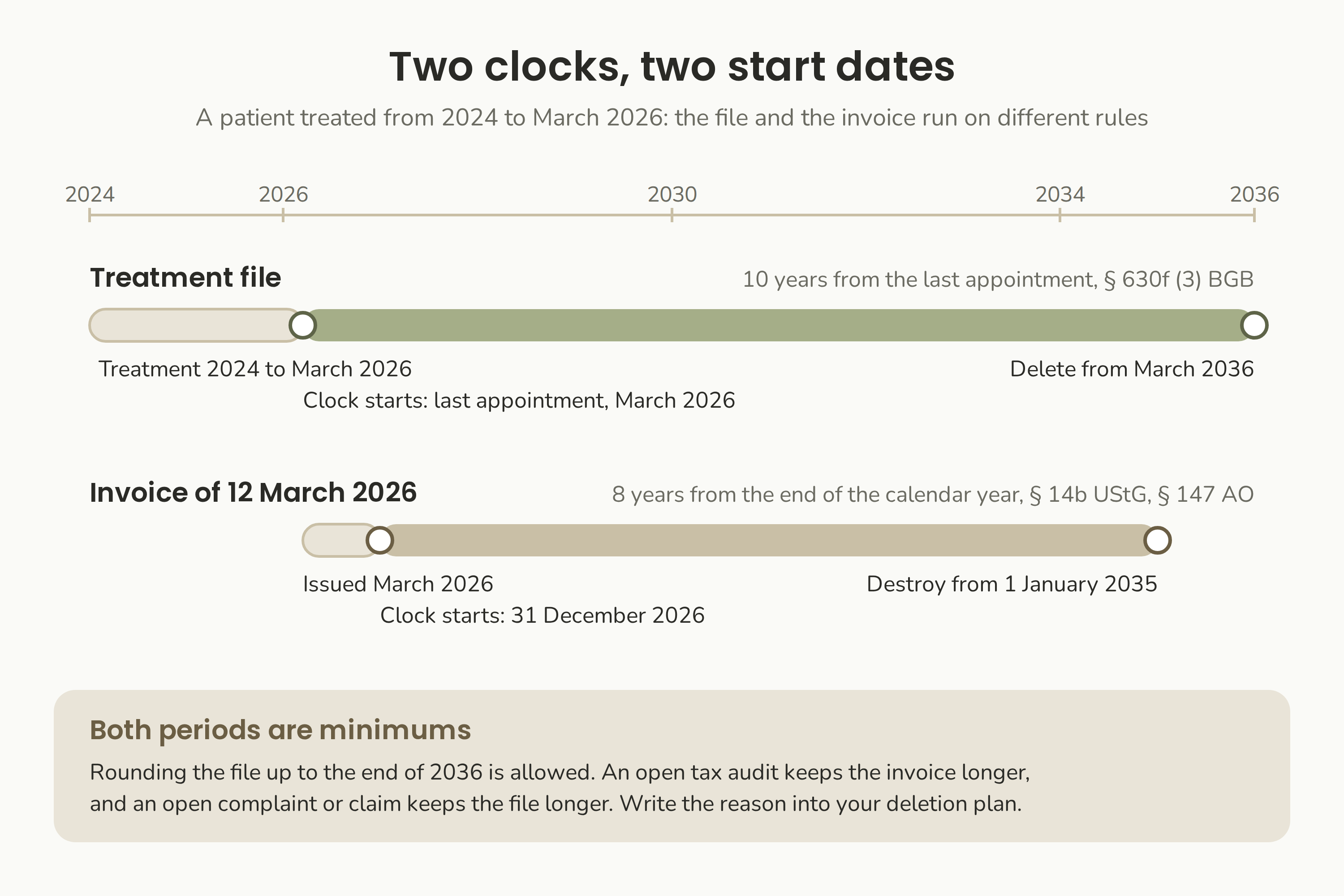
End of treatment means the last contact in one treatment relationship. A patient who returns after a long break starts a new treatment, and the old entries sit in the same file. The practical rule is therefore to count the ten years from the last appointment.
Many practices round the date up to the end of the calendar year, so there is one deletion date per year. That is allowed, because ten years is a minimum.
For tax records the law names the start date itself. § 147 (4) AO starts the period at the close of the calendar year of the last entry, the invoice date or the receipt of the voucher. An invoice dated 12 March 2026 therefore starts its clock on 31 December 2026. It may be destroyed from 1 January 2035.
One exception stops the tax clock. Under § 147 (3) AO the period does not end while the records still matter for a tax year the tax office can still assess. An open audit or a late tax return keeps the vouchers of that year in the cabinet until the matter is closed.
May you keep the patient file longer than ten years?
Sometimes, and only for a reason you can name. The DSGVO obliges you to delete personal data once its purpose and the legal retention period have ended. Claims for injury to body or health can be raised for up to 30 years, so many practices keep files longer. You need to decide this once, and write the decision down.
The reason to keep files longer is liability. A claim against a treating person normally expires three years after the end of the year in which the patient learned of the damage (§ 195 and § 199 (1) BGB). For damage to life, body or health the outer limit is 30 years from the act (§ 199 (2) BGB). It runs whether or not the patient knew about the damage.
If a file is missing in such a case, § 630h (3) BGB presumes that any measure you did not document was not taken. Without the file you cannot show what you did.
The reason to delete is data protection. Art. 5 (1) e DSGVO allows storage only as long as the purpose requires. Art. 17 (3) b DSGVO blocks a patient's request to delete while a legal retention duty runs. Art. 17 (3) e DSGVO allows storage for legal claims.
A limitation period is no retention duty by itself. Keeping a file beyond ten years therefore needs a legitimate interest that you weigh against the patient's interest, and a note that says why.
| Situation | What to do with the file after ten years |
|---|---|
| Normal course, no complaint, no open question | Delete it, and log the deletion with the date |
| The patient complained, or a claim or insurance case is open | Keep it until the matter is closed, then delete |
| Unusual course, a possible injury, or a treatment you still think about | Keep it, record why, and set a review date up to 30 years after the treatment |
| The patient was a minor | Count the ten years as for an adult, and apply the same reasoning for a longer period |
| The patient asks you to delete the file early | Decline for the ten years, cite Art. 17 (3) b DSGVO in your answer |
| A tax audit for that year is still open | Keep the invoices and vouchers, the treatment file follows its own rule |
Write these decisions into a deletion plan of one page. It lists each record type, its period, the start date, who deletes it and how. The retention periods also belong in the privacy notice you hand to new patients, as our guide to the practice privacy policy shows. A patient who asks for access under Art. 15 DSGVO is entitled to the same periods in the answer.
What happens to the files when you close your practice?
The duty stays with you. Closing the practice does not end the ten years, and a successor may only take over files with the patient's consent. You keep the files yourself in a locked place, or you hand them to a successor or a custodian under a written agreement that protects confidentiality.
The file is confidential under the treatment contract (§ 630a and § 241 (2) BGB). Handing it to another practitioner is a disclosure, even if that person takes over your rooms and your telephone number. Doctors have detailed rules for this in their professional codes. The Heilpraktiker act contains no professional code, so the civil-law duty of confidentiality and the DSGVO apply directly.
Ask each patient in writing whether the file may go to the successor. Keep the files of those who say no sealed with you.
Tell your patients about the closure in good time and name the place where they can still ask for their file. The right to inspect and copy the file under § 630g BGB continues for the whole retention period. If your files are electronic, export them before you cancel the practice software. Check the data processing agreement for what the provider deletes at the end of the contract and how long you have to download a copy.
How to store and destroy records the right way
Store paper files locked and electronic files with change tracking and backups. Keep them readable for the whole period, and destroy them so nobody can restore them. Paper goes through a shredder rated for health data, electronic copies are deleted together with their backups, and you log each deletion with the date.
| Record | How to store it | How to destroy it |
|---|---|---|
| Treatment file on paper | Locked cabinet, access only for you and your staff | Shredder of security level P-4 or higher, or a certified disposal service |
| Treatment file in practice software | Software with a change log, backups, export possible at any time | Delete the record in the software and let the backups rotate out; note the backup period |
| Signed consent forms | Keep the original sheet or the signed PDF with the file | Together with the file |
| Invoices received as PDF | Keep the PDF itself, readable and exportable for eight years | Delete the file and its backup copies after the period |
| Paper vouchers | Original, or a documented scan under the GoBD | Paper after a documented scan, the scan after eight years |
For the treatment file, § 630f (1) BGB requires that a later change leaves the original entry readable and shows when the change was made. Practice software does this with a change log. A plain word processor or a spreadsheet does not. Keep signed originals, such as consent forms, on paper or as a signed PDF, because a scan of a signature is weaker evidence than the sheet itself.
Tax records have their own rules. The GoBD are the tax office's principles for keeping books and records in electronic form (BMF letter of 28 November 2019, as amended on 11 March 2024). They allow you to scan paper vouchers and destroy the paper if you document the scanning process. An invoice that arrived as a PDF stays a PDF, in a form you can still open and export at the end of eight years.
Destruction must be final. Health data falls into the highest protection class of DIN 66399, the German standard for destroying data carriers. That class calls for a shredder of security level P-4 or higher. A disposal service that collects your files is a processor under Art. 28 DSGVO and needs a data processing agreement before the first bin leaves the practice.
Electronic files need the same care. Delete the record in the practice software, in your email, in the booking tool and in your backups as they rotate. Note in the deletion plan how long a backup can still hold a deleted file.
Keep a short deletion log. It names what was destroyed, when, by whom and how. If a patient or the supervisory authority ever asks what happened to a file, the log is your answer.
This article is general information, not legal or tax advice. Talk to a lawyer or your Steuerberater for your own case.
About this blog
This blog is written by the team at Vitalmyn, who build an ordering service for practitioner recommendations. They read German health, tax and data protection law closely because their own work depends on it. Articles here are general guides for practising Heilpraktiker.
Frequently asked
Does the ten-year rule in § 630f BGB apply to Heilpraktiker?
Yes. § 630f BGB binds every treating person under a treatment contract, and § 630a BGB names anyone who provides medical treatment, which includes Heilpraktiker. You must keep the treatment file for ten years after the treatment ends, unless another law sets a longer period.
Did the retention period for invoices change in 2025?
Yes. Since 1 January 2025 invoices and other accounting vouchers are kept for eight years instead of ten (§ 14b UStG, § 147 (3) AO). Books, records and the yearly income statement stay at ten years. The shorter period applies to every voucher whose ten years had not yet run out on that date.
May I keep a patient file for 30 years because of the limitation period?
Only with a reason you can name. The 30-year limit in § 199 (2) BGB is not a retention duty, and the DSGVO expects deletion once the purpose and the legal period have ended. A complaint, an open claim or an unusual course of treatment justifies keeping the file longer. Write the reason into your deletion plan and set a review date.
What do I do with the files when I close my practice?
You remain responsible for the full ten years. Keep the files yourself in a locked place, or hand them to a successor or a custodian under a written agreement. A successor may receive a file only if the patient consents. Tell your patients about the closure and name the place where they can still ask for their file.
Can a patient demand that I delete the file before ten years are over?
No. Art. 17 (3) b DSGVO excludes the right to erasure while a legal retention duty applies, and § 630f (3) BGB is such a duty. Answer the request within one month, explain the period and name the date on which the file will be deleted.
Sources
- § 630f BGB, documentation of the treatment
- § 630a BGB, the treatment contract
- § 630g BGB, inspection of the treatment file
- § 630h BGB, burden of proof in liability for treatment errors
- § 199 BGB, start of the regular limitation period and maximum periods
- § 85 StrlSchG, retention of radiation records
- § 241 BGB, duties arising from an obligation
- § 147 AO, rules for the retention of records
- § 4 UStG, tax-free supplies
- § 14b UStG, retention of invoices
- § 41 EStG, payroll account
- Regulation (EU) 2016/679 (DSGVO), Art. 5, 15, 17, 28 and 30
- § 630f BGB on dejure.org, with the amending act of 3 February 2026 (BGBl. 2026 I No. 28), in force since 6 February 2026
- Federal Ministry of Finance, GoBD letter of 28 November 2019 as amended on 11 March 2024 (copy at the Bavarian tax office)
- Deutsches Aerzteblatt, DIN 66399 and the destruction of data carriers
- Fourth Bureaucracy Relief Act of 29 October 2024 (BGBl. 2024 I No. 323)
- Heilpraktikergesetz (HeilprG)
Written by
Vitalmyn Team
Editorial team
We are building the ordering service for practitioner recommendations. Here we write down what we learn about recommending, practice finances and advertising law, so you do not have to dig it up yourself.