
No. A Heilpraktiker, a state-licensed non-medical practitioner, does not have to connect to the ePA (elektronische Patientenakte), the electronic patient record of the statutory health insurers. Today a Heilpraktiker practice cannot connect at all, because the law does not list the profession among those allowed in. Your own documentation duties under § 630f BGB stay exactly as they were.
Since 2025 almost every patient who walks into your practice has an ePA, and some ask whether you can see it or add to it. Practice software vendors talk about "ePA-ready" systems, and doctors' practices have had to use the record since October 2025. This guide covers what the ePA is, why your practice stands outside it, which duties still apply and how to work with a patient's record.
What is the ePA and who gets one?
The ePA is a lifelong electronic record that a patient's health insurer provides and the patient controls. Doctors, pharmacies and hospitals that treat the patient read and add documents such as findings, discharge letters, lab results and the medication list. The patient decides who may look in and can hide or delete single documents.
Since 15 January 2025 the statutory insurers have set up the "ePA for everyone" (German: ePA fuer alle) for all their members. Nobody has to apply. A patient who does not want one has to object, which is why the system is called an opt-out model.
The nationwide roll-out followed on 29 April 2025. Since 1 October 2025, practices connected to the health telematics network must use the record in daily work (gematik, ePA for everyone).
Privately insured patients are a different case. Private insurers may offer an ePA since 2025, but they do not have to. A privately insured patient has to sign up and create a health ID through the insurer's app (PKV-Verband, 16 April 2025). In practice, many of your privately insured patients have no ePA at all.
The record lives in the Telematikinfrastruktur (TI), the closed network of the German health system. Only institutions with a TI connection can read or write an ePA. That connection, and the cards it needs, is where the Heilpraktiker question is decided.
Why can a Heilpraktiker practice not connect to the ePA?
The law names every profession that may access the ePA, and Heilpraktiker are not on the list. § 352 SGB V names nineteen groups, from doctors and pharmacists to nurses, midwives and paramedics, each with their staff. A profession not named has no access, and the patient cannot grant it in the app.
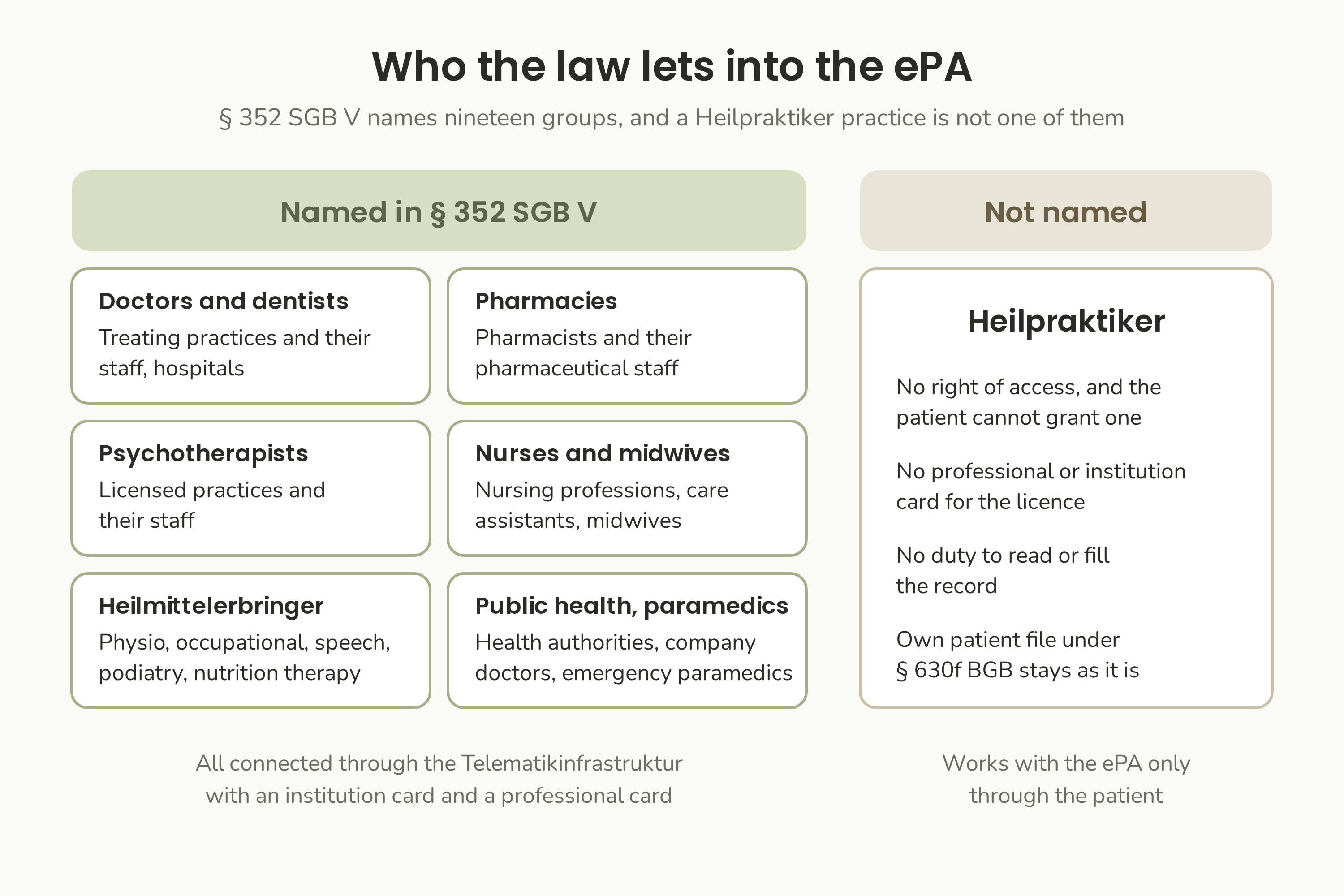
To reach the TI, a practice needs an institution card (SMC-B) and the person needs an electronic health professional card (eHBA). For professions without a state approbation, the electronic health professions register (eGBR) issues these cards. It does so only for professions the law has brought into the network, for example nurses, midwives, physiotherapists and speech therapists. A Heilpraktiker licence is not among them, so there is no card to apply for.
The reason behind both is the role of the Heilpraktiker in the system. The SGB V governs statutory health insurance. A Heilpraktiker is not a contracted provider of the statutory insurers, bills the patient directly, and sits outside the structures the ePA was built for. The ePA is an insurance tool first and a medical record second.
| Group | Named in § 352 SGB V | TI connection | ePA duty since |
|---|---|---|---|
| Doctors and dentists | Yes | Required | 1 October 2025 |
| Pharmacies | Yes | Required | 1 October 2025 |
| Hospitals | Yes | Required | 1 October 2025 |
| Psychotherapists | Yes | Required | 1 October 2025 |
| Licensed Heilmittelerbringer (physio, occupational, speech, podiatry, nutrition therapy) | Yes | Required from 1 October 2027 | After connection |
| Heilpraktiker | No | Not possible | None |
Nothing in the current law changes this soon. The ePA for everyone, the e-prescription and the electronic therapy prescription were all designed around the insurers' contracted providers. A Heilpraktiker practice is not in any of those plans.
Does the 1 October 2025 ePA duty apply to your practice?
No. The duty to use the ePA since 1 October 2025 applies only to practices and institutions that are connected to the TI. It obliges them to read the record before treatment where relevant and to file certain documents in it. Your practice is not connected, so the duty cannot reach you and nobody can fine you for it.
The same goes for the second deadline you may have read about. Heilmittelerbringer with a statutory insurance licence under § 124 SGB V, such as physiotherapists and speech therapists, were due to connect by 1 January 2026. In November 2025 the Bundestag moved that date to 1 October 2027 (Deutsches Aerzteblatt, November 2025; § 360 SGB V). That deadline is about the Heilmittel licence, not about the Heilpraktiker licence.
One group sits on both sides. A physiotherapist with a sectoral Heilpraktiker licence, or a Heilpraktiker who runs a licensed physiotherapy practice, connects to the TI as a Heilmittelerbringer. The access they get covers the treatment they give under that licence. It does not turn the Heilpraktiker part of the practice into an ePA user.
If a software vendor tells you that your practice must get "ePA-ready", ask which legal duty they mean. For a pure Heilpraktiker practice there is none. What a good practice software must do for you is keep your own patient file in order, which is the next section.
Which documentation duties still apply to a Heilpraktiker?
You must keep a complete patient file for every treatment, on paper or electronically, and keep it for ten years. This duty comes from the treatment contract rules of the civil code, which apply to every person who treats patients, Heilpraktiker included (§ 630a BGB). The ePA does not replace that file and never did.
§ 630f BGB sets out what the file must contain and how it must be kept. The entries must be made at the time of treatment or straight after. If you change an entry later, the original must stay readable and the date of the change must be visible. An electronic file must guarantee the same, which is why a plain word processor is not enough.
| What goes in the file | Example from a Heilpraktiker practice |
|---|---|
| Medical history (Anamnese) | The intake conversation and the questionnaire the patient filled in |
| Diagnoses | Your working diagnosis and how it changed over time |
| Examinations and their results | What you examined, measured or tested, and the findings |
| Findings from others | Lab reports, doctors' letters and imaging the patient brought along |
| Treatments and their effects | What you did in each session, dosages, and how the patient responded |
| Information given and consents | What you explained about the treatment and its risks, and the patient's consent |
The ten-year clock starts when the treatment ends, not when it starts. For a patient you see once a year, the file stays open. Other laws can set longer periods, for example under the infection protection rules (see our guide to the IfSG duties of a Heilpraktiker).
Your patient file is also personal health data in the sense of data protection law. The patient can ask for a copy at any time, and you must keep the file safe from access by anyone else. If a provider hosts your practice software, you need a data processing agreement with them. Our guide to AVV contracts covers what that contract must say.
How can you work with a patient's ePA without being connected?
You can work with the patient's record through the patient, who is its owner. The patient can show you documents from the ePA app, export them to you, and upload documents you give them. None of this needs a TI connection, and all of it is lawful as long as the patient decides.
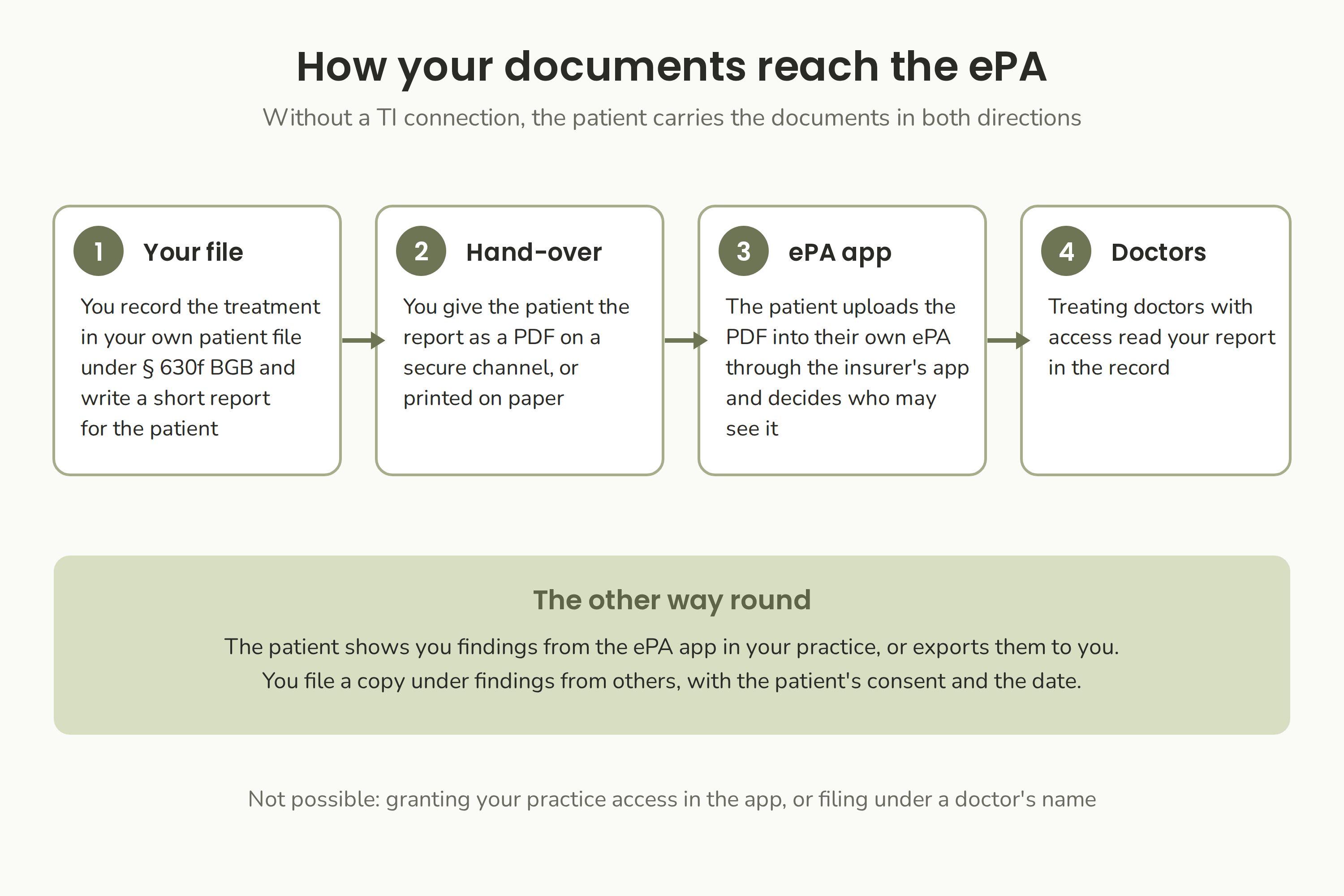
The ePA app lets patients upload their own documents as PDF and a few other file formats (gematik, ePA for everyone). A report you write for a patient, a summary of findings or a list of what you recommended can go in that way. Write it so a doctor can follow it, and hand it to the patient as a PDF on a secure channel or on paper. Keep your own copy in the patient file.
The other direction works the same way. A patient can show you a lab result or a discharge letter in the app, or export it and send it to you. You then file it under findings from others. Ask for documents at the appointment, not by plain email, because unencrypted email with health data is a risk for both of you.
Two things you cannot do. You cannot ask the patient to grant your practice access to the ePA, because the app only offers the professions named in the law. And you cannot ask a cooperating doctor to file your documents under their name, because the record must show who wrote what. Everything else stays as it was before the ePA: share findings with the patient's consent, through the patient or by letter.
A patient who has objected to the ePA changes nothing for you. Your file, your consent forms and your reports are the same with or without the record.
What should a Heilpraktiker practice do now?
Treat the ePA as the patient's tool and your own file as your duty. You need no new contract, no card, no connector and no new software for the ePA itself. What is worth an hour of your time is a short routine for the moments when the ePA meets your practice.
- Check your own file against § 630f BGB. Every treatment has an entry made on the day, changes are traceable, and the file is kept for ten years after the treatment ends.
- Prepare a one-page report template. A patient who wants your findings in their ePA gets a PDF they can upload, written in plain words for the next practitioner.
- Decide how you receive documents. Prefer a look at the app in the practice, a printout or an encrypted route. Say so on your website and in your privacy notice, as our privacy policy guide for Heilpraktiker describes.
- Record consent for every exchange. When a patient asks you to send a report to a doctor or brings findings for your file, note the request and the date.
- Answer the vendor question once. If your practice software claims an ePA function, ask for the legal basis. For a Heilpraktiker practice there is none today, so judge the software by its patient file, its backups and its data processing agreement.
Keep an eye on the law. The list in § 352 SGB V can change, and the professional associations of Heilpraktiker follow the topic. If the list ever changes, the duty and the access will arrive together, with a deadline and the cards to match. Until then, the answer to the question in the title stays no.
This article is general information, not legal advice. Talk to a lawyer or your professional association for your own case.
About this blog
This blog is written by the team at Vitalmyn, who build an ordering service for practitioner recommendations. They read German health and data protection law closely because their own work depends on it. Articles here are general guides for practising Heilpraktiker.
Frequently asked
Can a patient give a Heilpraktiker access to their ePA?
No. The ePA app only offers the professions named in § 352 SGB V, such as doctors, pharmacies and psychotherapists. A patient can instead show you documents in the app, export them to you, or upload a report you wrote for them.
Does a Heilpraktiker need an eHBA or an SMC-B card?
No. These cards connect a practice to the Telematikinfrastruktur. The electronic health professions register issues them only for professions the law has brought into the network, and a Heilpraktiker licence is not among them.
Does the ePA replace the patient file of a Heilpraktiker?
No. § 630f BGB obliges every treating practitioner, Heilpraktiker included, to keep a complete patient file and to store it for ten years after the treatment ends. The ePA is the patient's record and sits next to your file, not in its place.
What happens if a Heilpraktiker also runs a licensed physiotherapy practice?
The physiotherapy practice connects to the Telematikinfrastruktur as a Heilmittelerbringer, by 1 October 2027 at the latest. The access covers the physiotherapy treatment under that licence. The Heilpraktiker side of the practice stays outside the ePA.
Sources
- § 352 SGB V, access to the elektronische Patientenakte by providers and other entitled persons
- § 360 SGB V, connection of providers to the Telematikinfrastruktur
- § 630a BGB, the treatment contract
- § 630f BGB, documentation of the treatment
- gematik, the ePA for everyone: start, opt-out, mandatory use and the ePA app
- PKV-Verband, press release of 16 April 2025: privately insured people can use the ePA for everyone
- Deutsches Aerzteblatt, November 2025: TI connection of Heilmittelerbringer postponed to 1 October 2027
Written by
Vitalmyn Team
Editorial team
We are building the ordering service for practitioner recommendations. Here we write down what we learn about recommending, practice finances and advertising law, so you do not have to dig it up yourself.