
As a Heilpraktiker, a state-licensed non-medical practitioner, you file an advance VAT return (Umsatzsteuervoranmeldung, or UStVA) only for the taxable part of your practice. Treatment fees are VAT-exempt and need no return. If your taxable sales stay under the small business line, you file none at all. Above it, you file each quarter or each month through ELSTER.
A letter from the tax office asks for your advance VAT return, or your tax adviser mentions it. You are not sure the question even applies to a practice. Our guide to VAT for Heilpraktiker explains which parts of a practice are taxable. This guide takes the return itself apart, from who has to file one to the deadlines, the permanent extension and what goes on the form.
What is an advance VAT return?
An advance VAT return is a short electronic report to the tax office. In it you declare the VAT you collected in a period and the VAT you paid on purchases, and you pay the difference. § 18 (1) UStG sets the rule. The return is due by the tenth day after the period ends, and the payment is due the same day.
The return is an advance on your annual VAT. At the end of the year you file an annual VAT return under § 18 (3) UStG, which adds up the year and settles any difference. The advance returns are how the tax office receives the money during the year instead of once in the summer after.
You send the return through ELSTER, the tax office's online portal, with a certificate that identifies you. Paper forms are no longer accepted, except in cases of undue hardship on application. Accounting software can send the same data through the ELSTER interface, and a tax adviser can file on your behalf.
| Question | Answer | Rule |
|---|---|---|
| What is declared | VAT collected on taxable sales, input tax on purchases, the difference | § 18 (1) UStG |
| When | By the tenth day after the period ends, payment the same day | § 18 (1) UStG |
| How | Electronically through ELSTER or accounting software, with a certificate | § 18 (1) UStG |
| Period | The calendar quarter, or the month above 9,000 euros of VAT a year | § 18 (2) UStG |
| Settlement | The annual VAT return adds up the year and settles the difference | § 18 (3) UStG |
Does a Heilpraktiker with only exempt treatments file one?
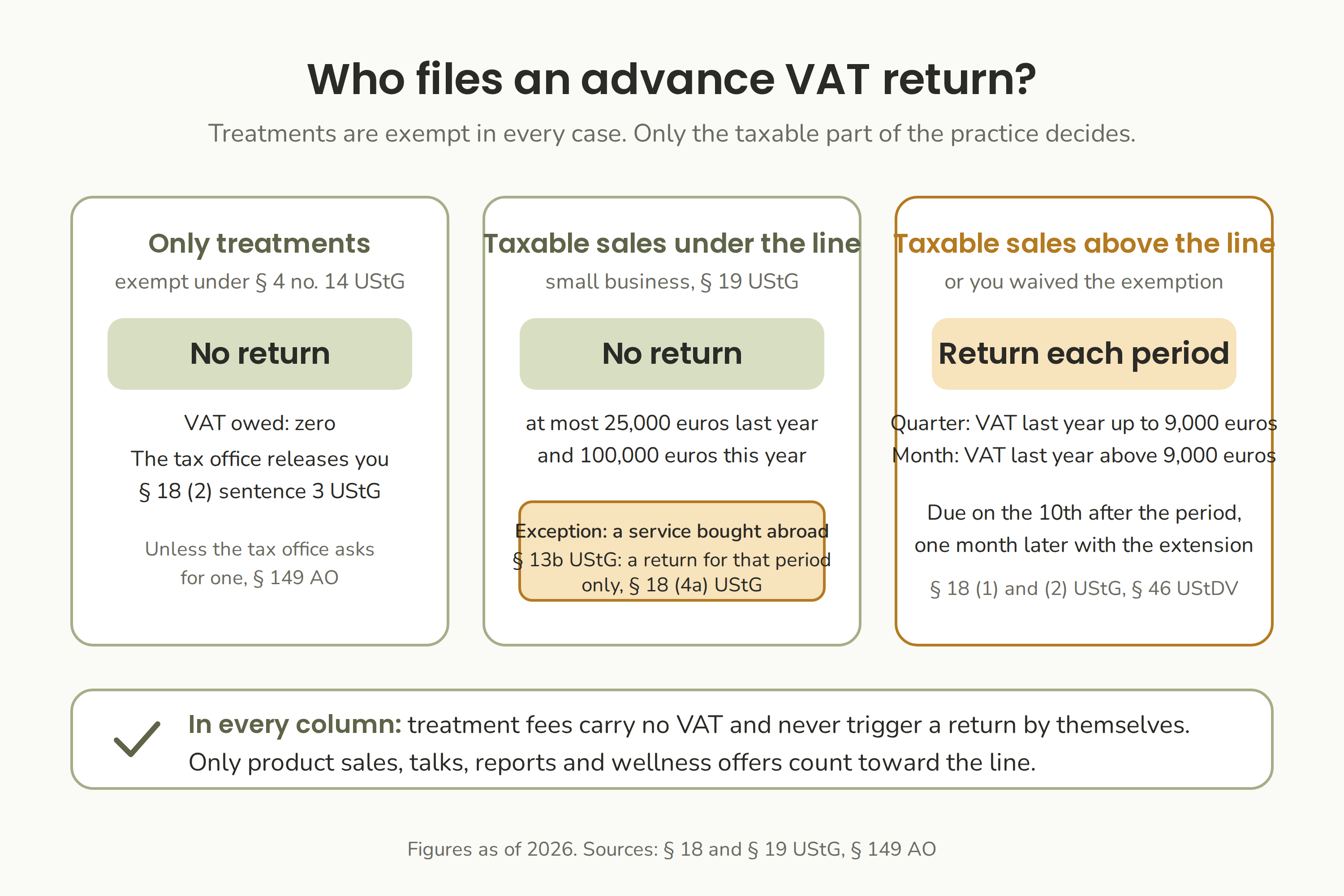
No, in practice. Treatments in human medicine with a therapeutic aim are VAT-exempt under § 4 no. 14 UStG. A practice that only treats collects no VAT, so its annual VAT is zero.
§ 18 (2) sentence 3 UStG then lets the tax office release it from advance returns. The release is possible when the VAT for the previous year was at most 2,000 euros.
The release is a decision of the tax office, not something that happens by itself. Most practices receive it with their tax registration, where the questionnaire asks what kind of sales you expect. If you state only exempt treatments, the tax office usually sets no advance returns. If you never received a written release and are unsure, ask your tax office or your tax adviser to confirm it in writing.
Two things stay true even then. The tax office can ask you for a return at any time under § 149 (1) AO, and then you file one. And the moment you add taxable sales, such as products a patient takes home, the question starts again, as the next two sections show.
Do you file an advance VAT return as a small business?
No, with one exception. While the small business exemption under § 19 UStG applies, § 19 (1) sentence 2 UStG switches off the filing duties of § 18 (1) to (4) UStG. You send no advance VAT returns and, since the 2024 tax year, no annual VAT return either. The exemption applies when your taxable sales were at most 25,000 euros last year and stay at most 100,000 euros this year, as of 2026.
For a Heilpraktiker the two rules stack. Treatment fees are exempt under § 4 no. 14 UStG and do not count toward the 25,000 euro line. So a practice with 70,000 euros of treatment fees and 8,000 euros of product sales is a small business for its taxable part and files no returns. Our guide to the small business exemption explains how the line is counted.
The exception is VAT you owe on purchases rather than on sales. If you buy a service from a business abroad, you owe the German VAT on it yourself under § 13b UStG. Practice software from another EU country or ads from a company outside Germany are typical cases. § 18 (4a) UStG then requires an advance return, and § 19 (1) sentence 2 leaves that duty in place.
You file only for the periods in which such a purchase happened, declare the VAT on it, and pay it. You cannot reclaim it, because a small business has no input tax deduction.
When does a mixed practice have to file?
A practice files advance VAT returns once its taxable sales have passed the small business line and VAT applies to them. Taxable sales above 25,000 euros in a year mean VAT on your taxable sales from the next 1 January. Above 100,000 euros within a year, VAT starts with the sale that crosses the line (§ 19 (1) UStG). From that day the returns are part of your routine.
The same applies if you gave up the small business exemption on purpose under § 19 (3) UStG, for example to reclaim the VAT on a stock of products. The waiver binds you for five years, and so do the returns. Treatments stay exempt in every case, so the return only ever carries the taxable part of the practice.
| Your practice | Advance VAT returns? | Rule |
|---|---|---|
| Only treatments with a therapeutic aim | No, after the tax office has released you | § 4 no. 14 UStG, § 18 (2) sentence 3 UStG |
| Treatments plus taxable sales of at most 25,000 euros last year and 100,000 euros this year | No, except for a period with a purchase under § 13b UStG | § 19 (1) sentence 2 UStG, § 18 (4a) UStG |
| Treatments plus taxable sales above the line | Yes, each quarter or each month | § 18 (1) and (2) UStG |
| You waived the small business exemption | Yes, for at least five years | § 19 (3) UStG, § 18 (1) UStG |
| The tax office asked you for one | Yes, for the periods it names | § 149 (1) AO |
A worked example makes the switch concrete. A practice receives 80,000 euros of treatment fees in 2025 and sells supplements for 26,000 euros net. The treatment fees do not count, but the 26,000 euros are above the 25,000 euro line.
From 1 January 2026 the practice charges VAT on its product sales and files advance VAT returns. The treatment fees stay exempt and appear in the return only as exempt sales.
Monthly or quarterly: which period applies to you?
The calendar quarter is the standard period. You file each month if your VAT for the previous year was above 9,000 euros. If it was at most 2,000 euros, the tax office can release you from returns (§ 18 (2) UStG). These figures apply since 2025 and are unchanged for 2026, and until 2024 the lines were 7,500 and 1,000 euros.
"VAT for the previous year" means the VAT you owed after deducting input tax, not your sales. A practice with 30,000 euros of product sales at 7 percent owes 2,100 euros of VAT before input tax, which is far below 9,000 euros. So for almost every Heilpraktiker practice the quarter is the period. The table shows the three cases.
| VAT owed last year | Period in 2026 | Returns a year |
|---|---|---|
| At most 2,000 euros | Quarter, or no returns if the tax office releases you | 4 or 0 |
| More than 2,000 up to 9,000 euros | Quarter | 4 |
| More than 9,000 euros | Month | 12 |
What applies in the year you open your practice?
A new business normally files each month in the year it starts and the year after (§ 18 (2) sentence 4 UStG). That rule is suspended for the tax years 2021 to 2026 by sentence 6 of the same paragraph. In those years the expected VAT of the current year decides the period. If the practice ran only part of the previous year, that year's actual VAT is scaled up to a full year.
For a practice opened in 2026 with taxable sales above the small business line, the quarter is therefore the period unless you expect more than 9,000 euros of VAT. You state the expected figure on the tax registration questionnaire. Whether the suspension continues after 2026 is for the legislator to decide, so check the current text of § 18 (2) UStG before you plan 2027.
Choosing the month on purpose
If last year's returns gave you a refund of more than 9,000 euros, you may choose the month instead of the quarter (§ 18 (2a) UStG). That happens when input tax exceeds VAT, for example after a large purchase of equipment. The choice is made by filing the January return by 10 February and binds you for the year. It is rare in a practice, and a refund that size is worth a conversation with your tax adviser anyway.
What are the deadlines, and how does the permanent extension work?
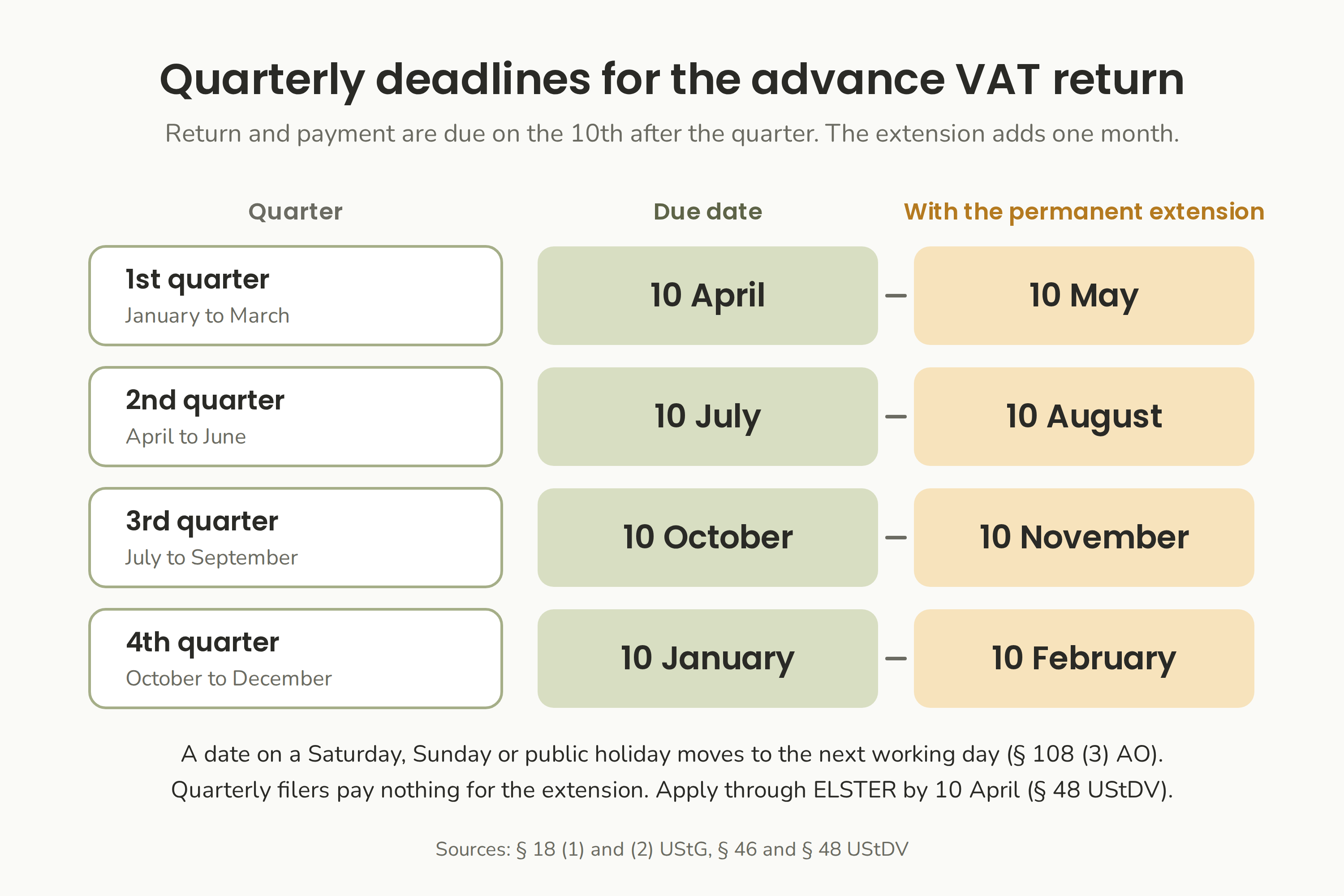
Each return is due on the tenth day after the period ends, and the VAT is due the same day (§ 18 (1) UStG). On application, the tax office extends both deadlines by one month (§ 46 UStDV). The extension is permanent: once granted, it applies until you or the tax office end it.
| Period | Return and payment due | With the permanent extension |
|---|---|---|
| January to March | 10 April | 10 May |
| April to June | 10 July | 10 August |
| July to September | 10 October | 10 November |
| October to December | 10 January | 10 February |
A date that falls on a Saturday, Sunday or public holiday moves to the next working day (§ 108 (3) AO). Monthly filers work with the same tenth day, one period at a time.
How to apply for the permanent extension
You apply through ELSTER, before the first return the extension should cover is due (§ 48 (1) UStDV). For a quarterly filer that means by 10 April for the current year. The tax office refuses the application only if it sees the tax claim at risk, and it can revoke an extension for the same reason (§ 46 UStDV). There is no fee.
Quarterly filers pay nothing for the extension. Monthly filers pay a special prepayment (Sondervorauszahlung) of one eleventh of last year's advance payments with the application, and again each year by 10 February (§ 47 UStDV). The prepayment is credited against the December return at the end of the year (§ 48 (4) UStDV). For a practice that files each quarter, the extension is a month of breathing room at no cost.
What a late return costs
A late return can draw a late filing surcharge under § 152 AO. A late payment draws a late payment surcharge of 1 percent of the rounded amount for each month begun (§ 240 AO). For bank transfers there is a grace period of three days before the payment surcharge applies (§ 240 (3) AO). A direct debit mandate to the tax office removes the risk of a late payment, because the office collects on the due date.
What goes into the return for a practice?
The return reports your taxable sales at 7 and 19 percent, the VAT on them, the input tax on your purchases, and the amount you pay or get back. Your exempt treatment fees also go in, on the line for exempt sales without input tax deduction, so the tax office can reconcile the return with your annual figures. The exempt fees carry no VAT and change nothing in the amount due.
| Line in the return | What a practice enters | Rule |
|---|---|---|
| Exempt sales without input tax deduction | Treatment fees with a therapeutic aim | § 4 no. 14 UStG |
| Taxable sales at 7 percent | Products in the reduced rate, net | § 12 (2) UStG |
| Taxable sales at 19 percent | Products at the standard rate, talks, reports, net | § 12 (1) UStG |
| VAT owed under § 13b UStG | Services bought from businesses abroad | § 13b UStG |
| Input tax | VAT on purchases for your taxable sales, such as stock | § 15 (1) UStG |
Input tax deserves a careful line. You may deduct the VAT on purchases that serve your taxable sales, for example the products you resell. You may not deduct the VAT on costs of your exempt treatments, such as treatment supplies (§ 15 (2) UStG).
Costs that serve both, such as rent or software, are split by a reasonable key, usually the share of taxable sales in total sales (§ 15 (4) UStG). Agree the key with your tax adviser once and keep it.
Which rate a supplement carries depends on its customs classification, as the VAT guide explains. The rate on the purchase invoice from your supplier is a good first indicator, but it is the product, not the supplier, that decides.
A simple routine for the year
Keep treatment fees and taxable sales apart on every invoice, close the books of each quarter in the first week after it ends, and file before the tenth. With the permanent extension you have a month more, but the figures are ready anyway. The table shows when to do what.
| When | What to do |
|---|---|
| Every invoice | Treatment on one line with the § 4 no. 14 note, products on another with the VAT rate |
| First week after each quarter | Add up taxable sales by rate, input tax on purchases, and any purchase under § 13b UStG |
| By the 10th, or the 10th of the next month with the extension | File the return through ELSTER and check that the payment or direct debit is in place |
| January | Compare last year's VAT with the 2,000 and 9,000 euro lines and note your period for the new year |
| By 10 April | Apply for the permanent extension if you want it, or keep the one you have |
| After the annual return | Compare the four returns with the annual return and correct a quarter if a figure was wrong |
A corrected figure is not a problem if you act on it. A return that turns out to be wrong is corrected by filing it again for that period, or in the annual return at the latest. What the tax office does not like is a figure you knew about and left.
This article is general information, not tax or legal advice. Talk to your tax adviser for your own case. The thresholds are the figures for 2026. All law texts were read on gesetze-im-internet.de on 7 November 2026.
About this blog
This blog is written by the team at Vitalmyn. We build an ordering service for practitioner recommendations, and we write guides on the business side of running a Heilpraktiker practice in Germany.
Frequently asked
Does a Heilpraktiker have to file an advance VAT return?
Only for the taxable part of the practice. Treatments with a therapeutic aim are exempt under § 4 no. 14 UStG, so a practice that only treats owes no VAT and is usually released from the returns by the tax office under § 18 (2) sentence 3 UStG. Returns become due once taxable sales such as product sales have passed the small business line.
Does a small business have to file an advance VAT return?
No. § 19 (1) sentence 2 UStG switches off the filing duties of § 18 (1) to (4) UStG while the exemption applies. The one exception is VAT owed on a service bought from a business abroad under § 13b UStG. For such a period § 18 (4a) UStG requires a return even from a small business.
Is the advance VAT return filed monthly or quarterly?
The quarter is the standard period. The month applies if the VAT owed for the previous year was above 9,000 euros. If it was at most 2,000 euros, the tax office can release you from the returns altogether. These are the figures for 2026 under § 18 (2) UStG.
When is the advance VAT return due?
By the tenth day after the period ends, together with the payment (§ 18 (1) UStG). A quarterly filer files by 10 April, 10 July, 10 October and 10 January. With the permanent extension under § 46 UStDV each deadline moves one month later. A date on a weekend or public holiday moves to the next working day.
What does the permanent extension cost?
Nothing for a quarterly filer. A monthly filer pays a special prepayment of one eleventh of last year's advance payments with the application and again each year by 10 February (§ 47 UStDV). The prepayment is credited against the December return (§ 48 (4) UStDV).
Which period applies to a practice opened in 2026?
The monthly rule for new businesses in § 18 (2) sentence 4 UStG is suspended for the tax years 2021 to 2026. In 2026 the expected VAT of the current year decides, so a new practice files each quarter unless it expects more than 9,000 euros of VAT. You state the expected figure on the tax registration questionnaire.
Sources
- § 18 UStG, VAT returns and advance returns
- § 19 UStG, small business exemption
- § 4 UStG, tax exemptions (no. 14: treatments in human medicine)
- § 13b UStG, reverse charge on services from abroad
- § 15 UStG, input tax
- § 12 UStG, tax rates
- § 46 UStDV, extension of the deadlines
- § 47 UStDV, special prepayment
- § 48 UStDV, procedure for the extension
- § 108 AO, deadlines falling on a weekend or holiday
- § 149 AO, the tax office may request a return
- § 152 AO, late filing surcharge
- § 240 AO, late payment surcharge
- ELSTER, the tax office's online portal
Written by
Vitalmyn Team
Editorial team
We are building the ordering service for practitioner recommendations. Here we write down what we learn about recommending, practice finances and advertising law, so you do not have to dig it up yourself.