As a Heilpraktiker, a state-licensed non-medical practitioner, you use the small business VAT exemption under § 19 UStG within two limits. Last year's taxable sales must be at most 25,000 euros, this year's at most 100,000 euros. Treatment fees are VAT-exempt and do not count. Only product sales, talks, reports and wellness offers do.
Your practice software shows 70,000 euros of fees, and a few hundred packs of supplements went over the counter. Now your tax adviser asks whether you are still a small business. Our guide to VAT for Heilpraktiker explains which parts of a practice are taxable at all. This guide takes the small business rule itself apart, from the sales that count to the invoices and returns while the exemption applies.
What is the small business exemption under § 19 UStG?
The small business exemption lets a business with low taxable turnover charge no VAT at all. Since 1 January 2025, § 19 (1) UStG makes those sales VAT-exempt under two conditions. Total turnover was at most 25,000 euros last year, and it stays at most 100,000 euros this year. The exemption applies by itself, with no application.
Three things follow while the exemption applies. You show no VAT on your invoices. You reclaim no input tax, which is the VAT on your own purchases. And you send no VAT returns to the tax office, which has its own section below.
For a Heilpraktiker the rule sits on top of another one. Treatments with a therapeutic aim are VAT-exempt under § 4 no. 14 UStG, whatever your turnover. The small business exemption is about the taxable part of the practice, which is everything else. If your practice only treats and sells nothing, the two lines in § 19 never come into play.
Which sales count toward the 25,000 euro line?
Only your taxable sales count: products a patient takes home, talks and seminars, reports for insurers, beauty and wellness offers. Treatment fees are exempt under § 4 no. 14 UStG. § 19 (2) UStG takes sales that are exempt under § 4 nos. 11 to 29 out of the total turnover. The total is counted net and by the money you received.
Three counting rules decide the figure.
- Net. Total turnover is measured without VAT. Under the old rule it was counted gross. The Federal Ministry of Finance confirms the net count in its letter of 18 March 2025.
- Money received. A sale counts in the year the payment arrives (§ 19 (2) sentence 1 UStG). A December invoice paid in January counts for the new year.
- Fixed assets are left out. Selling your old treatment couch or the practice car does not count (§ 19 (2) sentence 2 UStG).
| Income in your practice | Counts toward the line? | Why |
|---|---|---|
| Treatment fees with a therapeutic aim | No | Exempt under § 4 no. 14 UStG, taken out by § 19 (2) UStG |
| Supplements, books or aids a patient takes home | Yes, net | A sale of goods |
| Talks, seminars, articles | Yes, net | No treatment |
| Reports for an insurer, an authority or an employer | Yes, net | No therapeutic aim, section 4.14.1 of the VAT application decree |
| Beauty or wellness offers without a medical reason | Yes, net | No therapeutic aim |
| Subletting a room of your practice to a colleague | No | Letting is exempt under § 4 no. 12 UStG, taken out by § 19 (2) UStG |
| Selling the old treatment couch or the practice car | No | Fixed assets, § 19 (2) sentence 2 UStG |
An example makes the count concrete. A practice receives 70,000 euros of treatment fees, 9,000 euros for supplements and 1,500 euros for a talk at a pharmacy. Its total turnover under § 19 UStG is 10,500 euros. It stays well below the line, and the 70,000 euros never enter the sum.
What are the small business limits for 2026?
For 2026 the limits are 25,000 euros of total turnover in 2025 and 100,000 euros during 2026, both net. They came into force on 1 January 2025 and are unchanged for 2026. Before 2025 the limits were 22,000 and 50,000 euros, counted gross and with a forecast for the current year.
The 2025 reform changed more than the figures. The table shows what a practice feels from the change. It is based on the current text of § 19 UStG and the BMF letter of 18 March 2025.
| Rule | Until 2024 | Since 2025, also in 2026 |
|---|---|---|
| Last year's total turnover | At most 22,000 euros, gross | At most 25,000 euros, net |
| This year's total turnover | Expected to stay at most 50,000 euros, gross, judged at the start of the year | At most 100,000 euros, net, measured as the year runs |
| Crossing the current-year line | The exemption held for the whole year if the forecast was honest | The exemption ends with the sale that crosses 100,000 euros |
| Legal effect | VAT not levied | Sales are VAT-exempt |
| VAT returns | Annual return required up to the 2023 tax year | No advance returns and no annual return |
| E-invoices to business customers | Duty to issue, like every business | No duty to issue (§ 34a UStDV) |
The move from gross to net gives a little more room. Under the old rule a practice with 21,000 euros of net product sales at 7 percent VAT was close to the line. Under the new rule the same practice is 4,000 euros below it.
What applies in the year you open your practice?
In the year you open your practice there is no previous year to look at. The 25,000 euro line then applies to your actual taxable sales in that first year, as section 19.1 of the VAT application decree sets out. You start as a small business by default. The sale that pushes you above 25,000 euros already carries VAT.
Two details of the old rule are gone. A part-year is no longer converted into a full year, so a practice opened in September is measured on four months of real sales. And the first year's figure is a hard line rather than a forecast. Once crossed, the exemption ends at that moment (IHK Darmstadt on the small business rule).
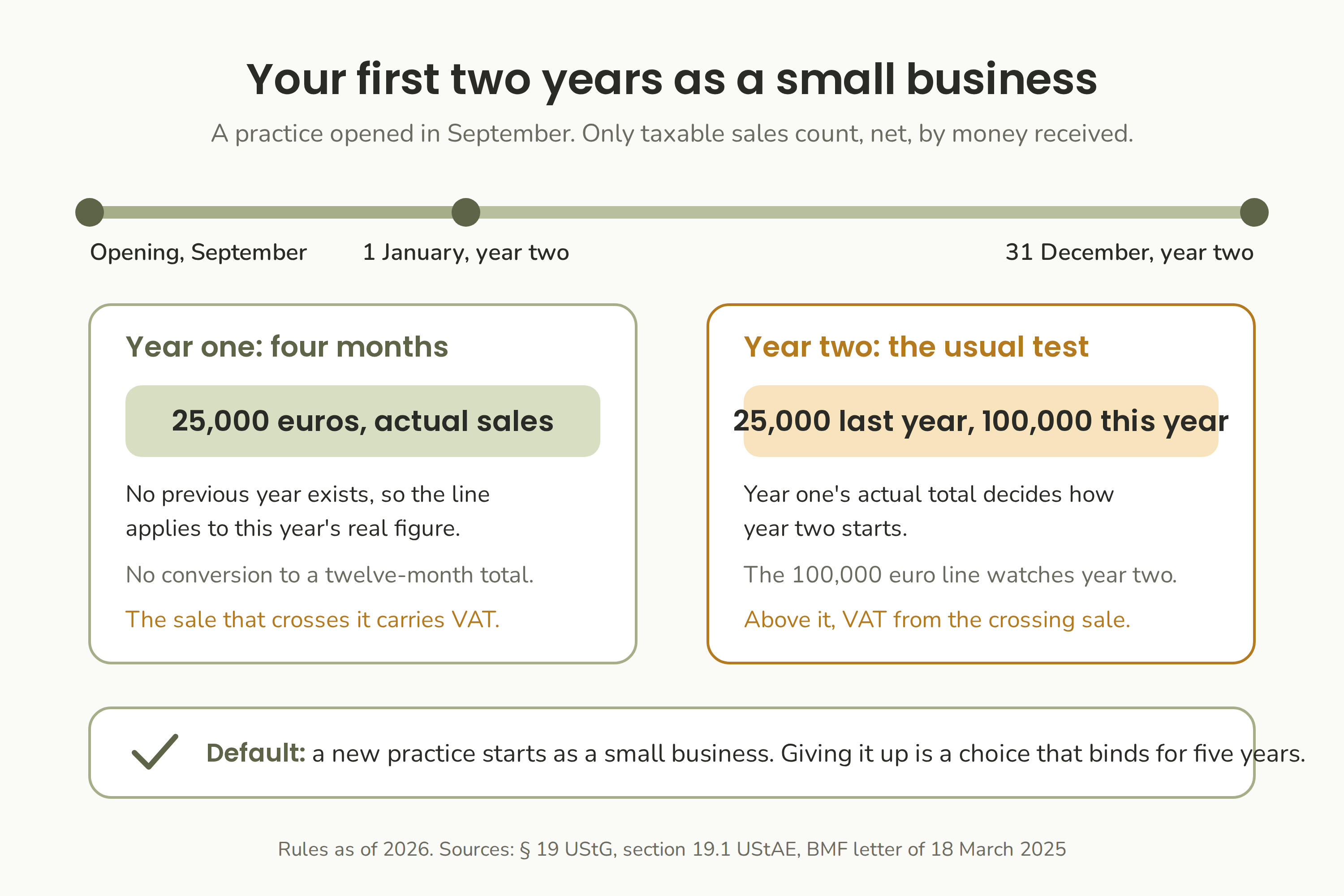
In your second year the usual two-limit test takes over. Your first year's actual total turnover decides whether the second year starts VAT-exempt, and the 100,000 euro line watches the second year as it runs. You declare whether you use the exemption on the tax registration questionnaire when you open the practice. Ticking the box to give it up there is a waiver and binds you for five years.
What happens when you cross a limit?
Which limit you cross decides when VAT starts. Total turnover above 25,000 euros in a year means VAT on your taxable sales from the next 1 January (§ 19 (1) UStG). Total turnover above 100,000 euros within a year ends the exemption at once, with the sale that crosses the line. Your treatments stay exempt in both cases.
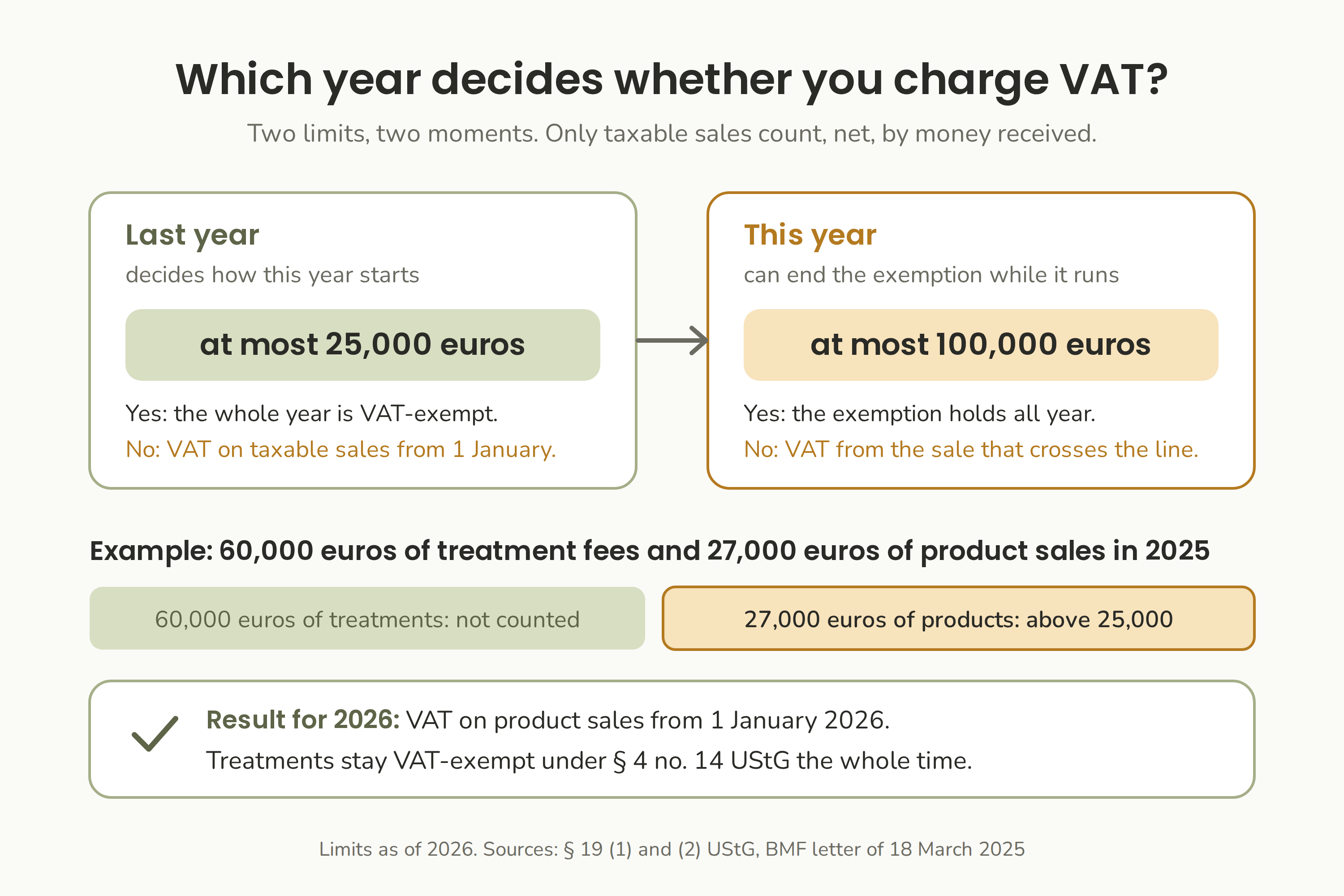
The 100,000 euro case is the harsher one, because it strikes in the middle of a year. The sale that crosses the line is taxable in full, and so is every sale after it (BMF letter of 18 March 2025). For a practice that mainly treats, 100,000 euros of taxable sales is rare. The 25,000 euro case is the one to watch.
What changes on the day VAT starts
From that day your taxable sales carry VAT and your duties grow. Supplements carry 7 or 19 percent, depending on their customs classification, as the VAT guide explains. You decide whether to raise your prices by the VAT or absorb it. The table lists what changes, with the rule behind each line.
| What changes | Detail | Rule |
|---|---|---|
| Product invoices | Show the net amount, the VAT rate and the VAT amount | § 14 (4) UStG |
| Advance VAT returns | Filed through ELSTER, the tax office's online portal, each quarter. Each month if last year's VAT was above 9,000 euros (as of 2026) | § 18 (2) UStG |
| Input tax | You reclaim the VAT on purchases for your taxable sales, such as stock | § 15 (1) UStG |
| Stock bought while exempt | A later correction of input tax may be possible. Ask your tax adviser before the switch | § 15a UStG |
| Treatments | Nothing changes. They stay exempt, and the VAT on their costs stays an expense | § 4 no. 14 UStG, § 15 (2) UStG |
Getting back below the line
The exemption is not lost for good. The law tests the two limits afresh every year (§ 19 (1) UStG). If a later year's total turnover falls back to 25,000 euros or less, the exemption applies again from the following 1 January, by itself. The only thing that stops that is a waiver you declared yourself (§ 19 (3) UStG).
Should you give up the exemption?
You can give up the exemption and charge VAT on purpose (§ 19 (3) UStG). The declaration goes to the tax office in any form. It is due by the last day of February of the second calendar year after the year it should apply to. For 2026 that is 28 February 2028. The waiver binds you for at least five calendar years.
For a Heilpraktiker the waiver changes nothing about treatments. They stay exempt under § 4 no. 14 UStG, and the VAT on their costs stays a plain expense (§ 15 (2) UStG). The waiver only touches the taxable part of the practice. It can pay off when that part carries large costs with VAT, such as a stock of products or equipment used only for courses.
Who your customers are matters too. A company that books you for a talk reclaims the VAT on your invoice (§ 15 (1) UStG), so it costs the company nothing. A private patient cannot, so VAT on products either raises the price or comes out of your margin. Run the figures with your tax adviser before you declare anything, because the five years cannot be cut short.
What must your invoices show as a small business?
An invoice for sales under the small business exemption needs fewer details than a normal VAT invoice. § 34a UStDV lists them. You need the names and addresses of both sides, your tax number or VAT ID, the date, and what was sold and how much. Then the total in one amount and a note that the small business exemption under § 19 UStG applies, with no VAT rate and no VAT amount.
| Situation | What the invoice must show | Rule |
|---|---|---|
| Products under the small business exemption | One total and the note that the small business exemption applies | § 34a UStDV |
| Treatment and products on one invoice | Separate lines: the § 4 no. 14 note on the treatment, the § 19 note on the products | § 14 (4) no. 8 UStG, § 34a UStDV |
| Invoice of up to 250 euros | The short form: name and address of the seller, date, goods, total and the exemption note | § 33 UStDV |
| Invoice to a business customer | Paper or PDF stays allowed. A small business never has to issue an e-invoice | § 34a UStDV, last sentence |
Since 1 January 2025 every business in Germany must be able to receive e-invoices, your practice included (BMF FAQ on e-invoicing). An email inbox is enough for that. Issuing them is another matter, because § 34a UStDV lets a small business always send its invoices on paper or as a PDF. Our guide to e-invoicing for Heilpraktiker walks through the receiving side and the dates for everyone else.
Do you file VAT returns as a small business?
No. While the exemption applies, § 19 (1) sentence 2 UStG switches off the filing duties of § 18 (1) to (4) UStG. You send no advance VAT returns, and since the 2024 tax year no annual VAT return either. The tax office can still ask you for a return under § 149 (1) AO, and then you file one.
Keep the figures anyway. The exemption rests on a number, and the tax office may ask how you arrived at it. Your profit statement for income tax already lists your income. A clean split between treatment fees and taxable sales in your books serves both purposes.
One exception is easy to miss. If you buy a service from abroad, such as online software from another EU country, you owe the German VAT on it yourself (§ 13b UStG). For that VAT you file a return even as a small business (§ 18 (4a) UStG). The exemption covers the VAT on your sales and leaves the VAT you owe on purchases untouched.
A simple routine to track the line during the year
Keep treatment fees and taxable sales apart from the first invoice, and add up the taxable column every month. Then you know in January whether the new year is exempt, and you see the 100,000 euro line coming months ahead. The routine takes a few minutes a month. The table shows when to do what.
| When | What to do |
|---|---|
| Every invoice | Put the treatment on one line with the § 4 no. 14 note and the products on another |
| Every month | Add up the taxable column: net, by money received, fixed assets left out |
| October | Compare the year's taxable total with 25,000 euros. Above it, prepare VAT from 1 January: prices, invoice template, ELSTER access |
| January | Last year's final figure decides this year. Write it down with the date |
| Whenever the taxable total nears 100,000 euros | Talk to your tax adviser before the sale that would cross the line |
This article is general information, not tax or legal advice. Talk to your tax adviser for your own case. The thresholds are the figures for 2026. All law texts were read on gesetze-im-internet.de on 27 October 2026.
About this blog
This blog is written by the team at Vitalmyn. We build an ordering service for practitioner recommendations, and we write guides on the business side of running a Heilpraktiker practice in Germany.
Frequently asked
Do treatment fees count toward the 25,000 euro small business line?
No. Treatments with a therapeutic aim are exempt under § 4 no. 14 UStG, and § 19 (2) UStG takes sales exempt under § 4 nos. 11 to 29 out of the total turnover. Only taxable sales such as products, talks, reports and wellness offers count, measured net and by money received.
Is the small business limit net or gross since 2025?
Net. Since 1 January 2025 total turnover under § 19 UStG is measured without VAT. Until 2024 the 22,000 and 50,000 euro limits were counted gross.
What happens when a Heilpraktiker crosses the small business limit?
Above 25,000 euros of taxable sales in a year, VAT applies to taxable sales from the next 1 January. Above 100,000 euros within a year, the exemption ends with the sale that crosses the line. Treatments stay exempt in both cases.
Does a small business have to file VAT returns?
No. § 19 (1) sentence 2 UStG switches off the filing duties of § 18 (1) to (4) UStG, so there are no advance returns and, since the 2024 tax year, no annual return. The tax office can still request one, and VAT owed on services bought from abroad under § 13b UStG must still be declared.
Does a small business have to send e-invoices?
No. § 34a UStDV lets a small business always send its invoices on paper or as a PDF. Receiving e-invoices is still required since 1 January 2025, and an email inbox is enough for that.
Sources
- § 19 UStG, small business exemption
- § 4 UStG, tax exemptions (no. 14: treatments in human medicine)
- § 18 UStG, VAT returns
- § 13b UStG, reverse charge on services from abroad
- § 15 and § 15a UStG, input tax and its correction
- § 34a UStDV, invoices of small businesses
- § 33 UStDV, invoices of up to 250 euros
- § 149 AO, tax returns on request
- BMF letter of 18 March 2025 on the small business rule since 2025
- VAT application decree (UStAE), sections 4.14.1 and 19.1
- IHK Darmstadt, small business rule and VAT
Written by
Vitalmyn Team
Editorial team
We are building the ordering service for practitioner recommendations. Here we write down what we learn about recommending, practice finances and advertising law, so you do not have to dig it up yourself.