
An Abrechnungsstelle is a billing company that writes, sends and chases your patient invoices for a share of the total. Some also buy the claims outright. For a Heilpraktiker, a state-licensed non-medical practitioner, it pays off in one case. The hours, unpaid invoices and waiting it removes must cost more than its fee, and your patients must agree.
Most Heilpraktiker practices invoice private patients directly and wait. Some of those invoices come back with questions, a few never get paid, and the evening after a full day of treatment goes into paperwork. An Abrechnungsstelle sells you that evening back, at a price. This guide explains what the service does and what it costs. It also covers which law applies when patient data leaves your practice, and how to work out whether the deal is good for you.
What does an Abrechnungsstelle do for a Heilpraktiker?
An Abrechnungsstelle takes your treatment data and turns it into a finished invoice in the patient's letterbox or inbox. It watches the payment, sends reminders, answers the patient's questions about the invoice and, if you want, runs the court reminder procedure. Some providers also pay you before the patient has paid.
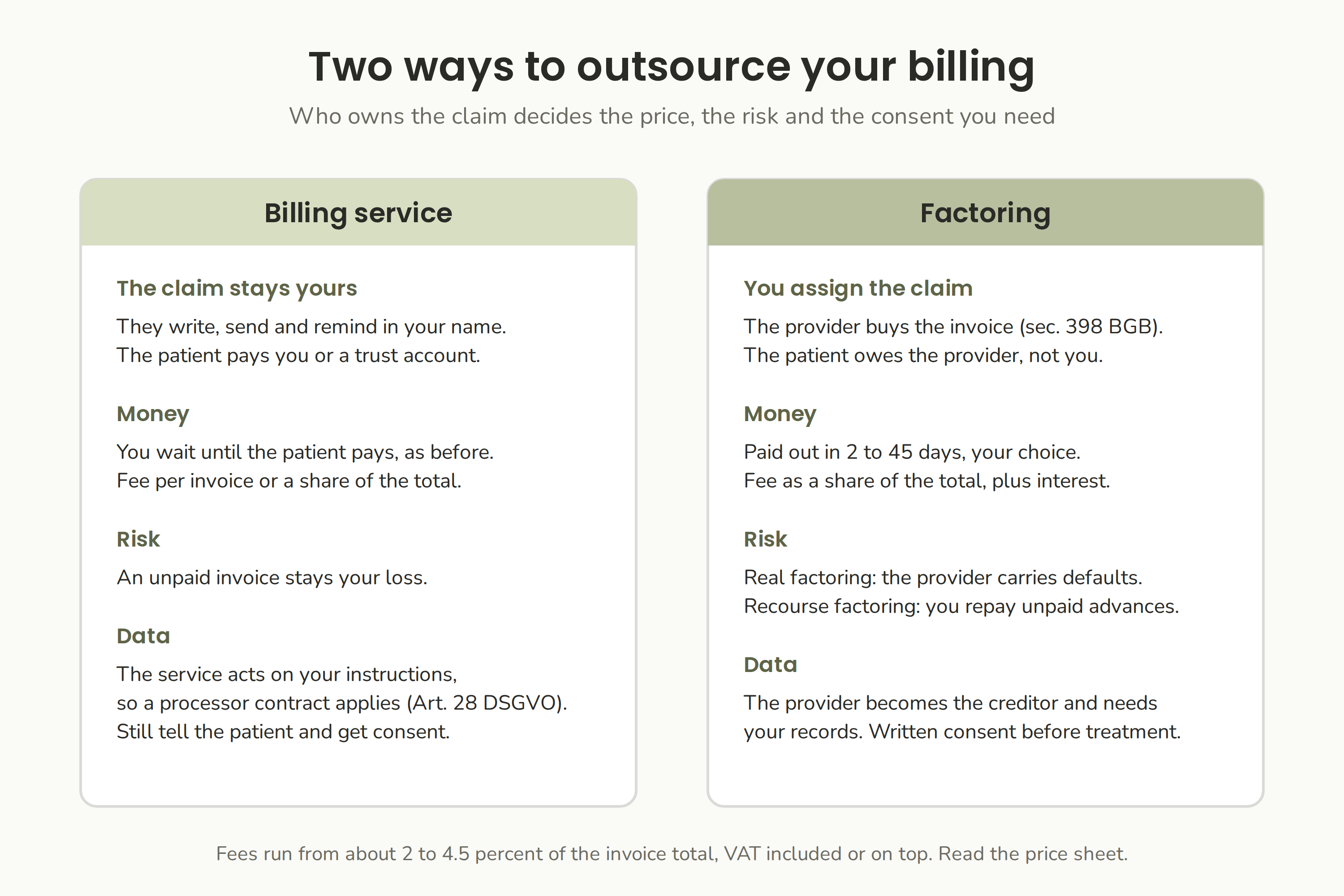
Two models sit behind the word, and the difference matters for cost, risk and consent.
| Billing service | Factoring | |
|---|---|---|
| Who owns the claim | You. The company works in your name | The company. You assign the claim to it (sec. 398 BGB) |
| When you get paid | When the patient pays | After 2, 15, 30 or 45 days depending on the plan, or same day for a surcharge (PVS Reiss) |
| Who carries an unpaid invoice | You | Real factoring: the company. Recourse factoring: you repay the advance |
| The patient pays | You, or a trust account in your name | The company |
| Data | The company is your processor | The company is the new creditor and needs your billing records |
Real factoring means the company buys the claim and keeps the loss if the patient never pays. Recourse factoring means you get the advance. You pay it back when the patient has not paid after a set period, often around 100 days (medizinio, factoring for doctors). The German words are echtes and unechtes Factoring, and the price sheet tells you which one you are reading.
Billing companies that serve Heilpraktiker know the GebüH, the fee schedule for Heilpraktiker, and write the analogue numbers insurers expect. One of them started in 1994 and offers the first ten invoices free (die-abrechnungsstelle.de). Another has worked with Heilpraktiker since 2002 and asks for no minimum turnover (SoliPrax). The larger private billing houses that serve doctors, known as Verrechnungsstellen, have Heilpraktiker desks too (PVS Reiss, Heilpraktiker).
What does an Abrechnungsstelle cost?
Expect a fee between 2 and 4.5 percent of every invoice you hand over, plus smaller charges for postage, fast payouts and court reminders. Factoring adds interest on the money advanced. The fee carries VAT, and because your treatments are VAT-exempt, you cannot reclaim it. The price you compare is the all-in price.
| Cost item | What the market shows | Source |
|---|---|---|
| Base fee | 2 to 3 percent of the invoice volume at medical factoring houses | IWW, factoring for a practice (2018) |
| Base fee, Heilpraktiker provider | A flat 4.5 percent of the invoice total, VAT included, with discounts for volume | SoliPrax, costs |
| Interest | Charged on advances under factoring, like a loan | medizinio |
| Postage | For example 48 cents per paper invoice under 360 euros; email delivery free | SoliPrax, costs |
| Fast payout | Same-day transfer costs extra; 15, 30 or 45 days is cheaper | PVS Reiss, IWW |
| Default cover and court reminders | Priced separately or built into a higher rate | PVS Reiss |
| Minimum term and volume | Often one year; some providers raise the rate below a minimum volume, others bind you to nothing | IWW, die-abrechnungsstelle.de |
The VAT point is the one most price sheets skip. The billing fee is a taxable service, so the provider adds 19 percent VAT or quotes a price with it inside. A business normally gets that VAT back as input tax. Your practice does not, because input tax on costs for VAT-exempt treatment is excluded (sec. 15 (2) UStG).
A quoted 2.5 percent plus VAT is really 2.975 percent for you. Our guide to VAT for Heilpraktiker explains the exemption and what it does to your costs. The fee is a business expense and lowers your taxable profit (sec. 4 (4) EStG). That softens it, but it does not make it free.
When does outsourcing your billing pay off?
Outsourcing pays off when four numbers from your own practice add up to more than the fee. The first is the hours you spend on invoices. The second is the money you lose on unpaid ones, the third the cost of waiting for payment. The fourth is the number of patients who will sign the consent form.
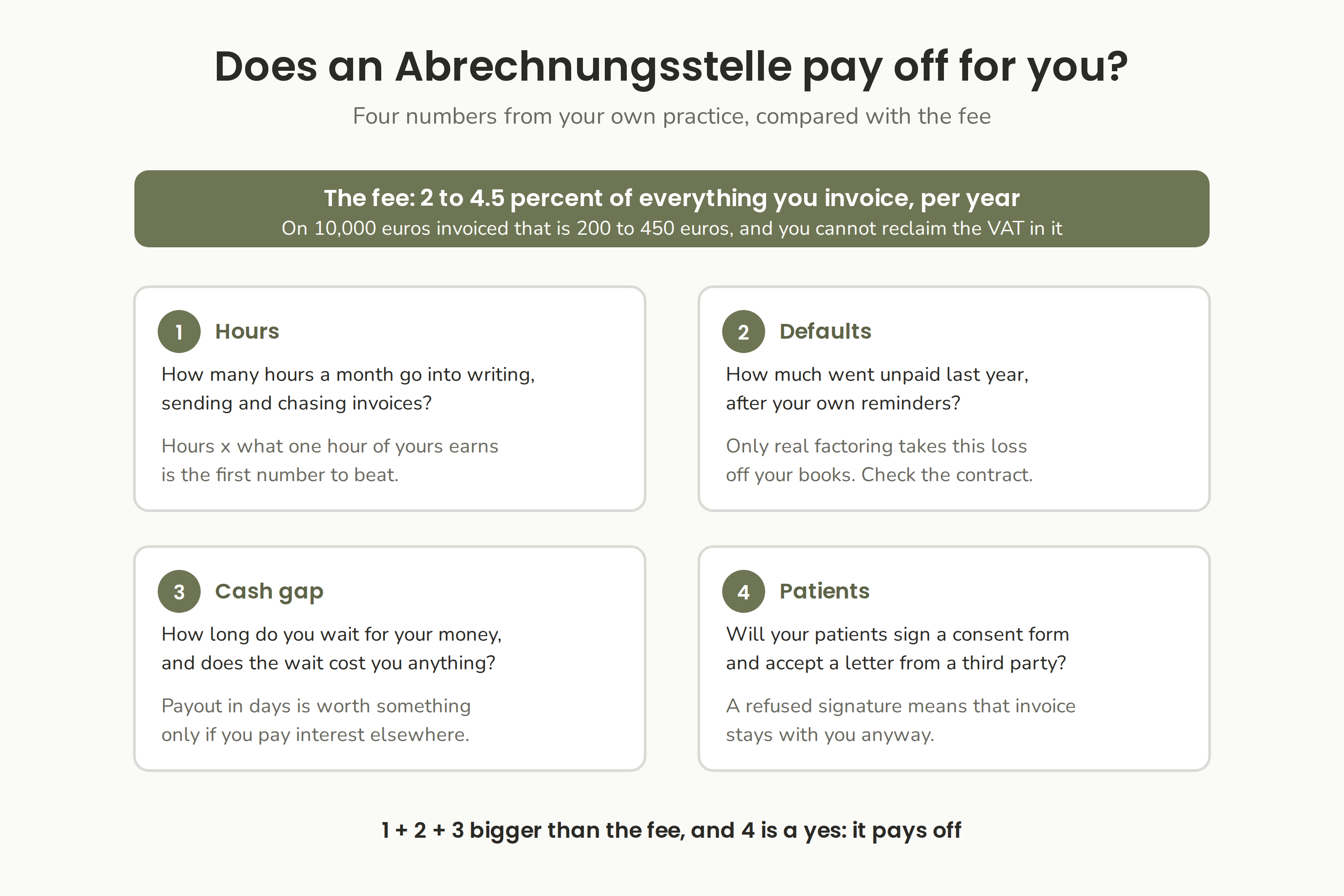
Hours. Count a normal month. Writing invoices, printing, enveloping, checking the bank account, writing the second reminder, explaining a GebüH line on the phone. Multiply by what an hour of treatment earns you.
On 10,000 euros of invoices a fee of 4.5 percent is 450 euros. If billing takes you five hours a month and a treatment hour earns you more than 90 euros, time alone covers the fee. If a family member does the billing for free, it does not.
Unpaid invoices. Take last year's figure after your own reminders. Only real factoring takes that loss off your books, and only for invoices that are formally correct. A wrong GebüH number, a missing treatment date or a fee never agreed in writing voids the default cover (medizinio). The invoice guide lists what a correct invoice carries.
The cash gap. Payout within days sounds good, but it is worth money only when the wait costs you something. If you pay interest on an overdraft while patients take six weeks, the advance has a value you can calculate. If your account comfortably covers the gap, pick the 30 or 45 day plan and pay the lower rate.
Your patients. Every patient must agree before their data goes to a third party, and some will not. A refused signature means that invoice stays with you. One billing trade journal reports that some patients find a letter from a billing company impersonal, and recommends renewing each consent every year (IWW, 2018). Ask yourself how your patients would react, not how a doctor's would.
| It pays off when | It does not when |
|---|---|
| Billing eats hours you could treat in | A helper or family member already does it cheaply |
| Several invoices a year go unpaid despite reminders | Almost everyone pays within the term |
| You bridge the wait with an overdraft | Your account covers six weeks without strain |
| Your patients accept a third party in the money matter | Your patients value the direct relationship above all |
| You send more than a handful of invoices a month | You treat a few patients a week and invoice on the spot |
The invoice volume matters because the fee is a percentage. A practice with a part-time income pays little in absolute terms and saves little. What Heilpraktiker practices typically bring in, and where the money leaks, is the subject of our article on practice income.
May a Heilpraktiker hand patient data to an Abrechnungsstelle?
Yes, with the patient's express consent, given before treatment and documented. The criminal confidentiality rule in sec. 203 StGB does not list Heilpraktiker. The treatment contract, data protection law and your professional code lead to the same place. For factoring the consent also has to cover the assignment of the claim.
Why sec. 203 StGB does not apply, and why it does not help. The criminal rule names doctors, dentists, pharmacists and members of other health professions whose practice or title requires state-regulated training (sec. 203 StGB). Heilpraktiker training is not state-regulated, so the rule does not reach you. A criminal rule applies only to the groups it names (sec. 1 StGB). That removes the risk of prosecution. It removes nothing else.
The treatment contract. Your contract with the patient is a treatment contract under sec. 630a BGB, the same section that covers a doctor. Confidentiality is part of it. A patient who learns from a billing company's letter that her treatment data left your practice has a claim against you, not against them.
Data protection. A diagnosis, a GebüH number and a treatment date are health data under Art. 9 DSGVO. Passing them to a third party needs a legal basis. For a billing company that basis is the patient's explicit consent under Art. 9 (2) (a). A billing service that only works on your instructions is in addition your processor, so you sign a processor contract with it under Art. 28.
Our guide to processor contracts for Heilpraktiker walks through that contract. A factoring company is not your processor. It becomes the creditor and decides for itself what it does with the data, so the patient's consent must cover the whole hand-over.
Your professional code. The code of conduct of the Heilpraktiker associations binds members to confidentiality. Patient data may be passed on only after the patient has released the practitioner from it (BDH, Berufsordnung 2015). The code is not a law, but a complaint to your association is cheap for a patient.
The assignment under factoring. For doctors, the Federal Court of Justice has held since 1991 that assigning a fee claim without the patient's consent is void (IWW, assigning fee claims). The reason is that an assignment forces the doctor to hand over the records (sec. 402 BGB). That breaks confidentiality. In 2013 the court spelled out what a valid consent looks like.
The patient must understand the purpose, who is released from confidentiality, and how far the third party is involved (BGH, III ZR 325/12, German Medical Association on assignment). For a Heilpraktiker the criminal law path is missing. The contract and data protection paths carry the same requirement, so write the consent to the 2013 standard.
| The consent form names | Why |
|---|---|
| The purpose: invoicing, collecting the fee, court reminders if needed | The patient must know what the data is for |
| The company, by name and address | The patient must know who receives it |
| The data: name, address, date of birth, diagnosis, GebüH numbers, dates, amounts | The scope must be clear, not "all necessary data" |
| An express release from confidentiality | A tacit or assumed consent is not enough |
| For factoring: agreement to the assignment, and that objections go to the new creditor | The patient changes creditor and needs to know |
| Date and signature, before the first invoice | Consent after the fact does not make the earlier transfer lawful |
| That the patient may withdraw it, and what happens then | Required under Art. 7 (3) DSGVO |
Hand the form over together with two things you already give before treatment. Those are the cost information in text form (sec. 630c (3) BGB) and the privacy notice for your practice. Most billing companies supply a consent form. Read it against the table before you use it, because the risk of a weak form is yours.
How to choose an Abrechnungsstelle
Compare on the all-in rate for your invoice volume, the payout plan, who carries unpaid invoices, and how the contract ends. Then check that the company knows the GebüH, handles e-invoices and gives you a consent form that holds up.
- All-in rate. Ask for the percentage with VAT, the postage per invoice, the price of a same-day payout and the price of the court reminder procedure. Put them on one line per 10,000 euros invoiced.
- Payout plan. 2, 15, 30 or 45 days, or only when the patient pays. The longer plan is the cheaper one.
- Default cover. Real factoring or recourse factoring, from what invoice amount, and what voids it. Ask whether patients living abroad are covered (PVS Reiss).
- Contract term and exit. Minimum term, notice period, minimum volume, and what happens to open invoices and your data when you leave.
- GebüH and analogue billing. The company should write analogue numbers the way insurers expect and know the Beihilfe maximums. Our GebüH guide explains both.
- E-invoicing. Since 2025 every business must be able to receive e-invoices, and invoices to business customers follow a timetable. Ask what the company sends to a company that pays for an employee's treatment. The rules are in our guide to e-invoicing for Heilpraktiker.
- Software. How the treatment data gets to them. An interface to your practice software saves retyping, an upload portal is the minimum, a fax is a reason to walk away.
- Patient contact. Who answers the patient's call about an invoice, in what tone, and whether instalments are possible. Read a sample reminder before you sign.
- Consent and data. They supply a consent form and, for a billing service, a processor contract. If they offer neither, they have not thought about your side of the law.
Start with a small batch. One provider offers the first ten invoices free (see above), and a month of real invoices tells you more than any brochure.
What are the alternatives to an Abrechnungsstelle?
Most practices do not need one. The alternatives are billing software, a fixed invoicing routine, your tax adviser's office, or a mix that hands over only the overdue invoices. Billing software and a routine cover a practice with a manageable volume at a fraction of the cost.
| Abrechnungsstelle | Billing software | In-house routine | |
|---|---|---|---|
| Cost model | Percentage of every invoice | Fixed amount a month | Your time |
| Who chases unpaid invoices | The company | You, with reminders from the software | You |
| Default risk | Covered under real factoring | Yours | Yours |
| Patient consent needed | Yes, express and before treatment | No third party sees the data | No |
| Gets cheaper as you grow | No | Yes | No |
Billing software for Heilpraktiker. A programme that knows the GebüH, numbers invoices, sends them by email and marks what is paid takes most of the hours out of billing. It costs a fixed amount a month instead of a percentage, so it gets cheaper as you grow. It does not take the default risk and it does not chase anyone.
A routine. Invoice on the day of treatment, or at the latest at the end of the week. Set a payment term of 14 days, send a friendly reminder on day 21 and a formal one on day 35. The court reminder procedure is for the rare case after that. Many unpaid invoices trace back to a late or unclear invoice, and a routine fixes both.
Your tax adviser. Some tax advisers' offices write invoices from your records. They may not chase patients, and the fee is often similar to a billing company, but they already hold your numbers.
A mix. Keep the invoices of regular patients in house and hand the ones that are overdue to a collection service. That buys the chasing without a percentage on everything you invoice.
A short checklist before you sign
Before you sign, you should hold the all-in price for your own invoice volume, know who carries an unpaid invoice, know how you get out, and have a consent form that meets the 2013 standard. The checklist puts those eight points in one place.
- The all-in rate with VAT, postage, fast payout and court reminders, per 10,000 euros invoiced
- Real or recourse factoring, and what voids the default cover
- Payout plan and the price difference between the plans
- Minimum term, notice period, minimum volume, and the exit for open invoices and data
- The consent form checked against the table above, and a processor contract for a billing service
- The consent collected before treatment, with the cost information under sec. 630c (3) BGB
- A sample invoice and a sample reminder read with your patients in mind
- A trial batch before the full volume
This article is general information, not tax or legal advice. Talk to your tax adviser or a lawyer for your own case. All law texts were read on gesetze-im-internet.de and eur-lex.europa.eu on 30 October 2026.
About this blog
This blog is written by the team at Vitalmyn. We build an ordering service for practitioner recommendations, and we write guides on the business side of running a Heilpraktiker practice in Germany.
Frequently asked
What is an Abrechnungsstelle?
A company that writes, sends and chases patient invoices for a practice. As a billing service it works in your name and the claim stays yours. As a factoring company it buys the claim, pays you within days and collects from the patient itself.
What does an Abrechnungsstelle cost a Heilpraktiker?
Between 2 and 4.5 percent of the invoice total, plus postage, a surcharge for same-day payout and the cost of court reminders. Factoring adds interest on advances. The fee carries VAT that a VAT-exempt practice cannot reclaim, so compare the all-in rate.
Does the patient have to agree before a Heilpraktiker uses an Abrechnungsstelle?
Yes. Treatment data is health data under Art. 9 DSGVO and the treatment contract includes confidentiality, so the patient gives express consent before treatment. For factoring the consent also covers the assignment of the claim. A refused consent means that invoice stays with you.
Does sec. 203 StGB apply to Heilpraktiker?
No. The criminal confidentiality rule covers health professions with state-regulated training, which Heilpraktiker training is not. Confidentiality still binds you through the treatment contract under sec. 630a BGB, data protection law and the code of conduct of your association.
Is factoring or a billing service better for a small practice?
A billing service is cheaper and keeps the claim with you. Factoring makes sense when unpaid invoices or a long wait for payment cost you real money. Many small practices need neither and do well with billing software and a fixed invoicing routine.
Sources
- sec. 203 StGB - breach of private secrets
- sec. 630a BGB - the treatment contract
- sec. 630c BGB - duty to inform the patient about costs
- sec. 398 BGB - assignment of a claim
- sec. 402 BGB - duty to hand over information to the new creditor
- sec. 15 UStG - input tax, exclusion for exempt supplies
- Art. 9 DSGVO - processing of health data
- BGH, 10 October 2013, III ZR 325/12 - consent to assigning a fee claim to a billing company
- Bundesaerztekammer, assignment of medical fee claims
- IWW, assigning fee claims to a billing company (2010)
- IWW, factoring: does it pay off for my practice? (2018)
- medizinio, factoring for doctors: models, costs, consent
- BDH, code of conduct for Heilpraktiker (2015)
- SoliPrax, costs of the billing service for Heilpraktiker
- PVS Reiss, billing service for Heilpraktiker
- die-abrechnungsstelle.de, billing service for Heilpraktiker
Written by
Vitalmyn Team
Editorial team
We are building the ordering service for practitioner recommendations. Here we write down what we learn about recommending, practice finances and advertising law, so you do not have to dig it up yourself.