
Before you sign up for practice software as a Heilpraktiker, a state-licensed non-medical practitioner, check six things. Ask where the data is hosted and who can reach it. Check that the data processing agreement (AVV) is complete and how the provider secures the data. Test whether the record meets § 630f BGB and whether you can export everything when you leave.
Every patient file is health data under Art. 9 DSGVO, so the bar is higher than for any other tool in your practice. Most practices choose their software on the calendar and the price. The data protection questions come up a year later, when a patient asks what you hold about them or a provider announces it was hacked. This guide applies to cloud software and to programs installed on your own computer, because both hold the same data.
Why does the DSGVO check come before the signature?
Because the responsibility for patient data stays with you, whatever software you use. The DSGVO calls you the controller and the software provider your processor. You may only use a processor that offers sufficient guarantees for security (Art. 28 (1) DSGVO). That is a choice you have to be able to justify, and the moment to make it is before the first patient is entered.
Patient files are not ordinary personal data. Names, diagnoses, notes and invoices with treatment details are health data, a special category under Art. 9 DSGVO. Processing them is forbidden unless an exception applies. For a practice, the exception is treatment by a health professional who is bound to confidentiality (Art. 9 (2) h and (3) DSGVO).
| Rule | What it asks of you before you sign |
|---|---|
| Art. 9 DSGVO | Treat every patient file as health data, the most protected category |
| Art. 28 (1) DSGVO | Choose only a provider whose security you have checked, and be able to show that you did |
| Art. 30 (5) DSGVO | Keep a record of processing (VVT) even as a solo practice, because health data is involved |
| Art. 32 DSGVO | Expect security measures that match the risk of a leaked diagnosis |
Two of these rules surprise most practices. The security measures must match the risk, and the risk of a leaked diagnosis is high (Art. 32 DSGVO). And the exemption from keeping a record of processing does not apply when special categories are involved (Art. 30 (5) DSGVO). Even a solo practice therefore needs a VVT entry that names the software and its provider.
The fines follow the same logic. A breach of the rules on health data or on transfers outside the EU falls in the upper bracket: up to 20 million euros or four percent of annual turnover, whichever is higher (Art. 83 (5) DSGVO). A missing or incomplete AVV falls in the lower bracket (Art. 83 (4)). For a solo practice the realistic cost is a letter from the supervisory authority and weeks of paperwork. The authority will ask what you checked before you signed.
Where is the data hosted and who can reach it?
Ask the provider for the exact server location, the list of every company that touches the data, and the rule for support access. A provider that cannot answer the three questions in writing is not ready to hold health data. The answers decide whether the transfer rules of Art. 44 to 46 DSGVO apply and who you are really trusting.
The first question is the country. Servers inside the EU or the European Economic Area need no transfer mechanism. Servers in the United States need one. One mechanism is the EU-US Data Privacy Framework, an adequacy decision of the European Commission from July 2023 that covers certified companies. The EU General Court upheld it in September 2025 (case T-553/23); check its current status before you rely on it.
Providers outside the framework need standard contractual clauses under Art. 46 instead. Check that the provider or its host is on the certification list. The AVV must name the transfer basis.
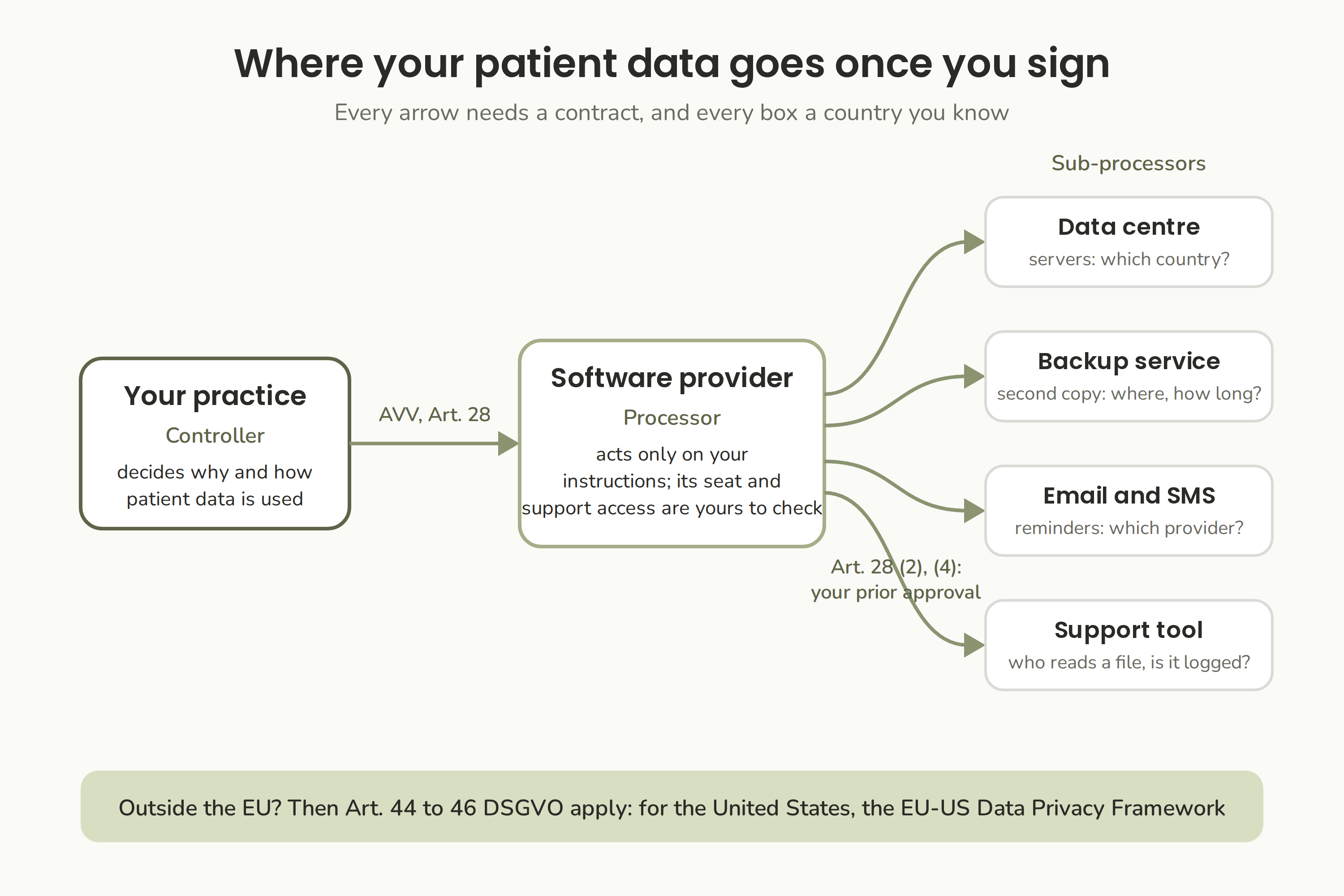
The second question is the chain behind the provider. Almost no software company runs its own data centre. It rents servers, uses a backup service and sends appointment reminders through an email or SMS provider. Each of these is a sub-processor.
The provider may only engage a sub-processor with your prior authorisation, and it must tell you before it adds or changes one (Art. 28 (2) and (4) DSGVO). Ask for the list with company name, country and purpose, and keep it with the contract.
A provider with servers in Frankfurt can still have a parent company outside the EU. The server location decides the transfer rules. The ownership decides which foreign laws can reach the data. The European Data Protection Board asks you to assess that reach as part of your transfer check (Recommendations 01/2020). Ask where the company is seated as well as where the servers stand.
The third question is who can open a patient file on the provider's side. Support staff often can, to fix a problem you reported. That access must be limited to what you asked for and tied to a duty of confidentiality (Art. 28 (3) b DSGVO). Some providers encrypt the files so that only your practice holds the key. That is the strongest answer, and it also means the provider cannot restore a lost password for you.
Does the AVV cover everything Art. 28 asks for?
An AVV is required with every practice software provider that keeps data on its servers, backs up to its cloud or logs in for support. The contract must contain the description of the processing and eight duties of the processor (Art. 28 (3) DSGVO). Which providers need one and what each clause means is explained in our guide to the AVV for Heilpraktiker. This section covers only what matters for software.
Most providers offer the AVV as a document you accept with a click during setup. That is valid (Art. 28 (9) DSGVO), and the click is also the moment most practices stop reading. Download the file, read the five lines in the table, and keep a copy with your VVT. The authority will ask for the contract.
| Line in the AVV | What to look for | Why it matters |
|---|---|---|
| Subject and purpose of processing | Names your practice software, the patient data it holds and the purposes: records, appointments, invoicing | A vague "software services" clause does not describe what you authorised |
| Security annex (TOM) | Concrete measures: encryption, access control, backup cycle, logging | Art. 28 (3) c refers to Art. 32; a list of buzzwords is not a measure |
| Sub-processors | A named list with countries, plus a notice period before changes | Art. 28 (2) and (4) require your prior authorisation |
| Breach notice | The provider informs you without undue delay (Art. 33 (2)) | You must notify the authority within 72 hours of learning of a breach, unless it is unlikely to cause a risk (Art. 33 (1)) |
| End of contract | Return of all data in a usable format, then deletion with confirmation | Art. 28 (3) g; also the only way to meet your own retention duty after you leave |
A model contract published in 2018 by the German association of data protection officers (BvD) for medical practices is a useful comparison. Lay the provider's text next to it. Anything the model has and the provider's text lacks is a question to ask before you sign.
Which security measures must the provider prove?
Art. 32 DSGVO asks for measures appropriate to the risk, taking into account the state of the art. For health data in a practice, that typically means encryption in transit and at rest, a second factor at login and roles that limit who sees what. It also means tested backups and logs that show who opened which record. The provider must describe these measures in the security annex, and you must be able to understand them.
The regulation names four goals: confidentiality, integrity, availability and resilience. It also asks for fast recovery after an incident and regular testing of the measures (Art. 32 (1) DSGVO). The table turns those goals into questions you can put to a sales contact.
| Goal under Art. 32 | Question for the provider | Good answer |
|---|---|---|
| Confidentiality | Is the data encrypted on the server and on the way to my browser? Who holds the keys? | Encrypted at rest and in transit; ideally a key only your practice holds |
| Confidentiality | Can I require a second factor at login for every user? | Yes, and it can be enforced for all accounts of the practice |
| Confidentiality | Can I give a receptionist or a locum access to the calendar without the treatment notes? | Roles per user with separate rights for records, calendar and invoicing |
| Integrity | Are changes to a record logged with user, time and the earlier content? | Yes, and the log cannot be edited; this is also what § 630f BGB asks for |
| Availability | How often is a backup taken, where is it stored and when was a restore last tested? | Daily or more often, kept in a second EU location, restore tested on a schedule |
| Resilience | What happens if the provider's servers go down during my practice hours? | A stated recovery time and a way to reach the day's appointments offline |
| Testing | Has an independent party tested the security, and may I see the summary? | A current penetration test or an ISO 27001 certificate for the hosting |
A provider that installs software on your own computer shifts most of these duties to you. The encryption of the hard drive, the backup and the second factor are then your job. With local software, write those measures into your own VVT and carry them out.
Does the patient record meet § 630f BGB?
The German treatment law sets rules for the record itself, and your software has to follow them. Under § 630f BGB you must document the treatment in a record, on paper or electronically, close in time to the treatment. Corrections and additions are allowed only if the original content stays recognisable and the time of the change is recorded. An electronic record must guarantee that.
A record you can silently overwrite fails § 630f BGB, even if the provider is perfectly DSGVO-compliant. Ask to see what happens when you edit yesterday's note. The earlier version and the time of the change must still be visible, and that history must be part of any export. The rule applies to Heilpraktiker because the treatment contract in § 630a BGB covers everyone who promises medical treatment, not only doctors.
The retention period follows the same paragraph. You must keep the record for ten years after the end of the treatment, unless other rules require a longer period (§ 630f (3)). The software must therefore keep records for at least that long, and you must be able to take them with you when you leave. How long a Heilpraktiker must keep patient records explains the periods in detail.
Patients also have a right to read their file (§ 630g BGB) and a right to a copy under Art. 15 DSGVO, within a month (Art. 12 (3)). Software that can export one patient's full record, with history, as a readable PDF makes that a five-minute job. Software that cannot turns every request into an afternoon of work.
| § 630f BGB asks for | What to test in the demo |
|---|---|
| Documentation close in time to the treatment | Can a note be dated to the session, and does the system record when it was actually written? |
| Changes recognisable with original content and time | Edit a saved note; the old text and the edit time must remain visible |
| Ten years of retention after the end of treatment | Does the provider delete inactive patients, and after how long? Deletion before ten years is a problem |
| Full record on request (§ 630g) | Export one patient to PDF, including the change history and attached documents |
Can you export and delete everything when you leave?
Before you sign, test the exit. You need a full export of every patient record in a format you can read without the provider. You also need the provider's commitment to delete its copies afterwards, at your choice and on your instruction (Art. 28 (3) g DSGVO). The first protects your ten-year retention duty, the second is the law. Both belong in the contract, not in a support email.
Many providers export a CSV table of patient names and appointments but not the treatment notes, the attached lab reports or the change history. That is not a record you can keep for ten years. Ask for a sample export during the trial and open it on a computer without the software. If a document is missing, the provider will not add it later for free.
Deletion is the other half. Once you have the export and have checked it, the provider must erase or return everything and delete existing copies. Good practice is a stated period that includes backups, and a written confirmation when it is done. A month is normal. Ask how long backups survive after deletion, and get the answer in writing.
Patients can also ask you to delete their data under Art. 17 DSGVO. For treatment records the answer is usually no, because the retention duty in § 630f BGB overrides the request (Art. 17 (3) b DSGVO). Your software should still be able to delete what you are not obliged to keep. Examples are marketing consent or a cancelled appointment that never became treatment. It should record the deletion.
How do you compare providers?
Put the same twelve questions to every provider in writing and keep the answers. A provider that answers all twelve clearly has done the work the DSGVO expects. One that answers with "we are DSGVO-compliant" and nothing else has not.
| # | Question | Where the answer belongs |
|---|---|---|
| 1 | In which country are the servers, and who owns the data centre? | AVV, sub-processor list |
| 2 | Where is the provider's company seated? | Legal notice of the provider |
| 3 | Which sub-processors handle the data, in which country, for what purpose? | AVV annex |
| 4 | Is data encrypted at rest and in transit, and who holds the keys? | Security annex (TOM) |
| 5 | Can a second factor be enforced for every login? | Security annex |
| 6 | Can roles limit a user to the calendar without the records? | Security annex, demo |
| 7 | Are changes to a record logged with the earlier content and the time? | Demo, § 630f BGB |
| 8 | How often are backups taken, where are they kept, when was a restore tested? | Security annex |
| 9 | Who at the provider can open a patient file, when, and is it logged? | AVV, security annex |
| 10 | How and when does the provider inform me of a breach? | AVV |
| 11 | What does a full export contain, and in which format? | Contract, sample export |
| 12 | How long after termination is the data deleted, backups included? | AVV |
Cloud software and software installed on your own computer answer these questions differently. The cloud provider carries the hosting duties and you carry the duty to check it. Local software leaves the hosting duties with you. The table shows who has to do what in each case.
| Duty | Cloud software | Software on your own computer |
|---|---|---|
| Server location and transfer rules | Provider; you check the country and the AVV | Your practice; no transfer unless you use a cloud backup |
| AVV | Required with the provider | Not required unless the vendor accesses data for support or updates |
| Encryption and backup | Provider, described in the TOM | You: disk encryption, a tested backup, a copy outside the practice |
| Second factor and roles | Provider's feature, your setting | Your computer and the program's own user management |
| Change history under § 630f BGB | Software feature; test it | Software feature; test it |
| Export at the end | Contract clause; test the sample | Your files; check the format can be opened without the program |
| Record of processing (VVT) | One entry naming the provider | One entry naming the program and your own measures |
Write your decision down in one page: which provider, which answers, which risks you accepted and why. That page is your evidence under Art. 28 (1) and Art. 5 (2) DSGVO that you chose carefully. Review it once a year and whenever the provider changes a sub-processor. If your website offers online booking through the same provider, add it to your privacy policy as well.
This article is general information, not legal advice. Talk to a lawyer, your data protection authority or your professional association for your own case.
About this blog
This blog is written by the team at Vitalmyn, who build an ordering service for practitioner recommendations. They read German health and data protection law closely because their own work depends on it. Articles here are general guides for practising Heilpraktiker.
Frequently asked
Does a Heilpraktiker need an AVV with the practice software provider?
Yes, if the software stores data on the provider's servers, backs up to its cloud or lets the provider log in for support. The provider then processes patient data on your instructions and is a processor under Art. 28 DSGVO. A program that runs only on your own computer and never sends data to the vendor needs no AVV, but you then carry the hosting duties yourself.
Can a Heilpraktiker use practice software with servers in the United States?
Yes, if a transfer mechanism under Art. 44 to 46 DSGVO applies. One mechanism is the EU-US Data Privacy Framework, an adequacy decision of the European Commission from July 2023 that covers certified companies; the EU General Court upheld it in September 2025, so check its current status. Providers outside the framework need standard contractual clauses under Art. 46. Servers inside the EU avoid the question entirely and are the simpler choice for health data.
Does a solo practice need a record of processing for its software?
Yes. The exemption for small organisations in Art. 30 (5) DSGVO does not apply when special categories such as health data are processed. One entry naming the software, the provider, the purposes, the data categories, the retention period and the security measures is enough.
What must practice software do to meet § 630f BGB?
It must keep the record close in time to the treatment, make every later change recognisable with the original content and the time of the change, and keep the record for ten years after the end of treatment. It must also export one patient's full record on request, because the patient may read the file under § 630g BGB and ask for a copy under Art. 15 DSGVO.
Sources
- Regulation (EU) 2016/679 (DSGVO), Art. 5, 9, 15, 17, 28, 30, 32, 33, 44 to 46 and 83
- § 630a BGB, the treatment contract
- § 630f BGB, documentation of the treatment
- § 630g BGB, access to the patient record
- European Data Protection Board, Guidelines 07/2020 on the concepts of controller and processor
- European Data Protection Board, Recommendations 01/2020 on measures that supplement transfer tools
- Datenschutzkonferenz, short paper 13: processing on behalf, Art. 28 DSGVO
- European Commission, EU-US data transfers and the Data Privacy Framework
- EU-US Data Privacy Framework, list of certified organisations
- LDA Bayern, sample 5: record of processing activities for a medical practice
- Berufsverband der Datenschutzbeauftragten Deutschlands (BvD), model data processing agreement for medical practices, 2018
Written by
Vitalmyn Team
Editorial team
We are building the ordering service for practitioner recommendations. Here we write down what we learn about recommending, practice finances and advertising law, so you do not have to dig it up yourself.