As a Heilpraktiker, a state-licensed non-medical practitioner, you file one income tax return (Steuererklärung) each year. It carries your practice profit on the Anlage S form and the profit statement behind it. An annual VAT return follows only above the small business line. A trade tax return follows only when a trade part, such as product sales, makes more than 24,500 euros of profit.
Summer comes, and with it the letter that reminds you of the tax return. The receipts for the year sit in a folder, and you are not sure which forms a practice needs.
This guide lists every annual return a Heilpraktiker practice can owe, who files which one, and the deadlines for the 2025 and 2026 tax years. Your patients search for the same words when they want to deduct your fees. This guide covers the practice's own return.
Which tax returns does a Heilpraktiker practice file?
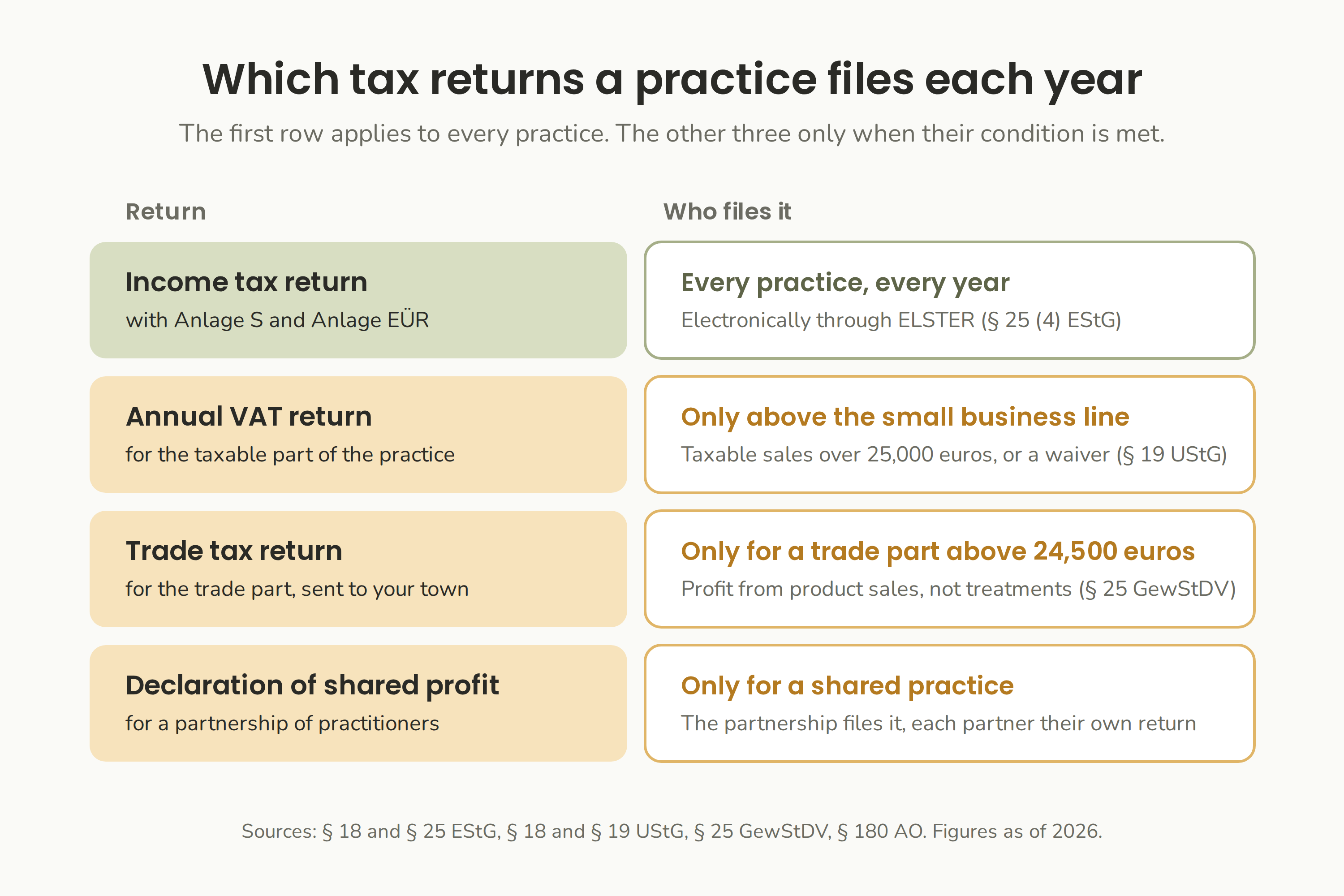
Every practice files an income tax return each year, with the practice profit on Anlage S and the profit statement attached. Three more returns depend on how the practice is set up. The table shows when each one applies.
| Return | Who files it | Rule |
|---|---|---|
| Income tax return with Anlage S and the profit statement | Every practice, every year | § 25 EStG |
| Annual VAT return | Only if your taxable sales are above the small business line, or you waived it | § 18 (3) UStG, § 19 UStG |
| Trade tax return | Only if a trade part, such as product sales, makes more than 24,500 euros of profit | § 25 GewStDV |
| Declaration of shared profit | Only for a partnership of practitioners | § 180 AO |
Most sole practices that only treat file the first row and nothing else. Each extra row comes from a choice you made, such as adding product sales or sharing a practice with a colleague. The sections below go through the returns in the order of the table.
How does the income tax return work for a Heilpraktiker?
Your treatment income is income from self-employed work. § 18 (1) no. 1 EStG names the Heilpraktiker as a liberal profession. So the practice profit goes on Anlage S, the form for self-employed income. You file the return for each calendar year, after it ends (§ 25 (1) and (3) EStG).
The return has to be sent electronically, because you have business income (§ 25 (4) EStG). You use ELSTER, the tax office's online portal, or tax software that sends the same data. A paper return is allowed only on application, in cases of undue hardship.
Anlage S is short. It takes your profit from the profit statement, names the activity and the tax number of the practice, and asks for a few special items. The real work sits in the profit statement, which the next section explains.
Do you have to file a return at all?
Almost every practice must file. A single person with no wage income must file once total income is above the basic tax-free allowance (§ 56 EStDV). The tax office can also ask anyone for a return, and then you file (§ 149 (1) AO). A practice whose profit is above that allowance therefore files every year.
A part-time practice next to a job
Many Heilpraktiker start part-time while they keep a salaried job. Wage tax on the salary does not settle the practice income. You must file a return once your income outside the salary is more than 410 euros a year (§ 46 (2) no. 1 EStG).
A loss in the first years counts too. It lowers the tax on your salary, as long as the practice is run to make a profit in the long term. If the losses go on for years, the tax office may ask whether it is a hobby rather than a business.
| Your situation | Income tax return required? | Rule |
|---|---|---|
| Practice only, single, income above the basic tax-free allowance | Yes | § 56 EStDV |
| Practice only, married and filing jointly, income above twice the allowance | Yes | § 56 EStDV |
| Salaried job plus more than 410 euros of income outside the salary | Yes | § 46 (2) no. 1 EStG |
| The tax office asks for a return | Yes | § 149 (1) AO |
How is the practice profit worked out?
A Heilpraktiker works out the profit as income received minus expenses paid in the year (§ 4 (3) EStG). The result goes on the official form Anlage EÜR, the profit statement, sent electronically with the return (§ 60 (4) EStDV). There is no balance sheet, because the duty to keep full books applies to traders and farmers, not to liberal professions (§ 141 AO).
The profit statement counts money when it moves. A fee counts in the year the patient pays it, and an expense in the year you pay it (§ 11 EStG). One exception matters at the turn of the year. Regular payments, such as rent, that fall within about ten days of 31 December count for the year they belong to.
The table shows where typical practice items go.
| Item | How it counts | Rule |
|---|---|---|
| Treatment fees | Income in the year received | § 11 (1) EStG |
| Rent for the practice rooms, energy, cleaning | Expense in the year paid | § 4 (4) EStG |
| Treatment supplies and small equipment up to 800 euros net | Expense in full in the year bought | § 6 (2) EStG |
| Equipment above 800 euros net, such as a treatment couch | Spread over its useful life as depreciation | § 7 EStG |
| Training, professional liability insurance, association fees, software | Expense in the year paid | § 4 (4) EStG |
| Income tax and income tax prepayments | Not an expense | § 12 no. 3 EStG |
If your practice has product sales next to the treatments, keep the two apart from the start. As a sole practitioner your treatments stay freelance and the product sales become a separate trade. Each one gets its own profit statement, and the product profit goes on Anlage G, the form for trade income. Our guide to trade registration for Heilpraktiker explains when the trade part starts.
The tax office can ask for every receipt behind the figures. Keep invoices and receipts for eight years and your records and annual statements for ten (§ 147 (3) AO, as of 2025). These are tax periods, separate from the periods for patient records.
Does a Heilpraktiker file an annual VAT return?
Only if your practice has taxable sales above the small business line, or you gave up the small business exemption on purpose. Treatments with a therapeutic aim are VAT-exempt under § 4 no. 14 UStG, and they do not count toward the line. A practice that only treats has no taxable sales, so it stays within the small business rule.
While that rule applies, § 19 (1) sentence 2 UStG switches off the VAT filing duties of § 18 (1) to (4) UStG. You send no advance VAT returns and no annual VAT return. You file one only if the tax office asks for it.
VAT owed on a service bought from abroad also needs a return. It takes an advance return for that period and an annual return for that year (§ 18 (4a) UStG).
The line is 25,000 euros of taxable sales last year and 100,000 euros in the current year, as of 2026. Products, talks and reports count, treatment fees do not. Our guide to the small business VAT exemption shows how to count it.
Above the line, the annual VAT return is due on the same day as the income tax return (§ 18 (3) UStG, § 149 AO). It adds up the year and settles the difference to your advance VAT returns. Treatment fees appear in it as exempt sales and carry no VAT.
| Your practice | Annual VAT return? |
|---|---|
| Only treatments with a therapeutic aim | No, unless the tax office asks or you owe VAT on a service from abroad |
| Treatments plus taxable sales within the small business line | No, unless the tax office asks or you owe VAT on a service from abroad |
| Treatments plus taxable sales above the line | Yes, every year |
| You waived the small business exemption | Yes, for at least five years |
Our guide to VAT for Heilpraktiker explains which parts of a practice are taxable in the first place.
When does a Heilpraktiker file a trade tax return?
Only when a trade part of the practice makes more than 24,500 euros of profit in a year (§ 25 (1) no. 1 GewStDV). Treatments never carry trade tax, because they are a liberal profession. Product sales are a trade, and so are wellness offers without a therapeutic aim.
For a sole practitioner, the first 24,500 euros of trade profit a year are free of trade tax (§ 11 (1) GewStG). Below that amount there is no trade tax return to file. Above it, the return goes to the tax office, and your town sets the tax at its local rate. Most of it comes back through your income tax (§ 35 EStG).
A shared practice needs more care. If a partnership has trade income beyond a small share, all of its income can count as trade, treatments included. The trade registration guide sets out the limits the Federal Fiscal Court uses.
What a shared practice files
A partnership of Heilpraktiker files one more return of its own. It declares the shared profit and how it splits between the partners (§ 180 (1) no. 2 a AO). Each partner then puts their share on Anlage S in their own income tax return.
The partnership also files its own profit statement, and the same deadlines apply to it.
When is the tax return due?
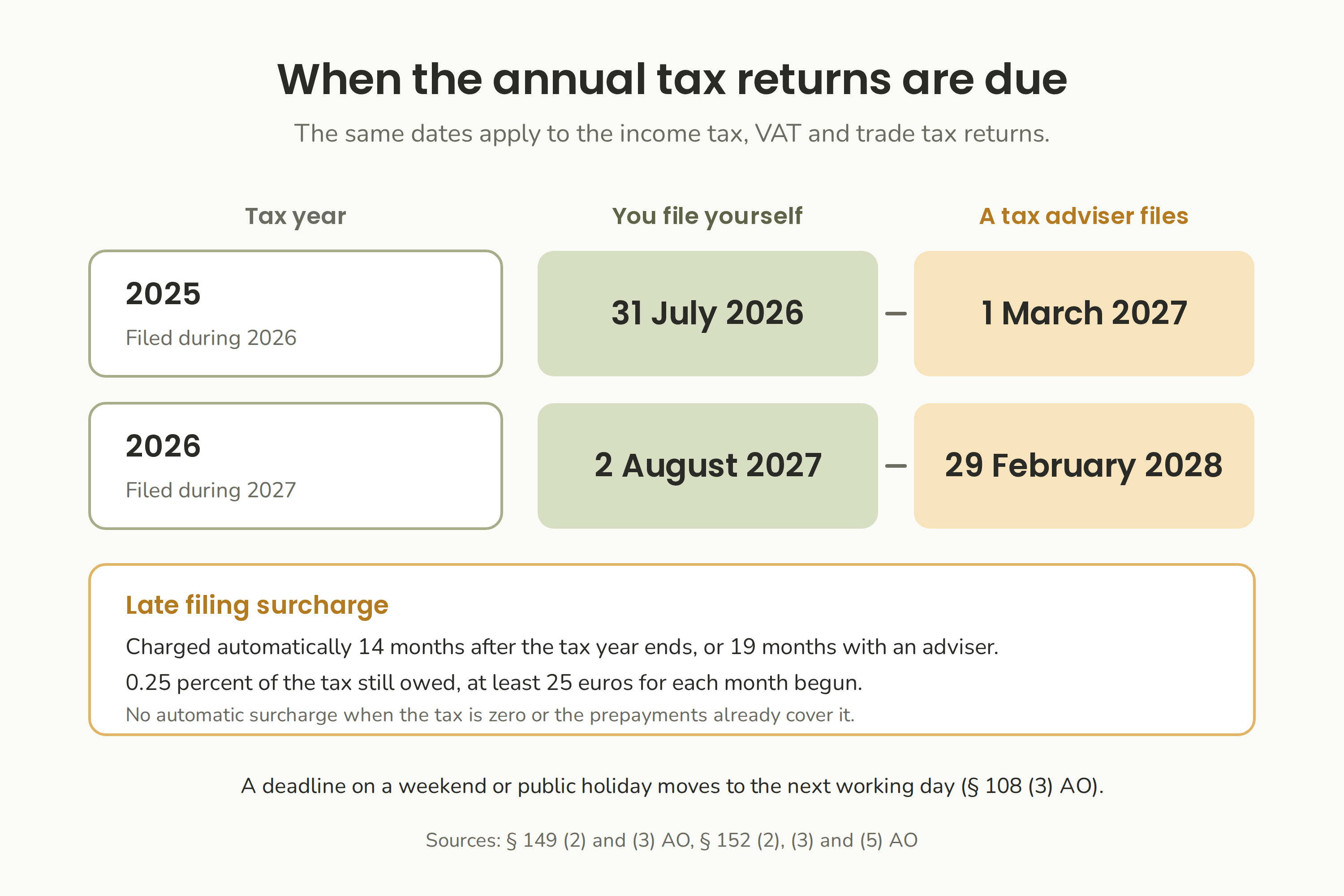
For the 2025 tax year the deadline is 31 July 2026 if you file yourself. If a tax adviser prepares the return, it is due by 1 March 2027 (§ 149 (2) and (3) AO). The same dates apply to the annual VAT return and the trade tax return.
You file within seven months after the year ends, so by 31 July. With an adviser you have until the last day of February in the second year after the tax year. For 2025 that is Sunday 28 February 2027, so the deadline moves to Monday 1 March (§ 108 (3) AO).
| Tax year | You file yourself | A tax adviser files |
|---|---|---|
| 2025 | 31 July 2026 | 1 March 2027 |
| 2026 | 2 August 2027, because 31 July is a Saturday | 29 February 2028 |
The longer adviser deadline is not guaranteed. The tax office can ask for a return earlier, for example after late returns in the past (§ 149 (4) AO). Before your own deadline you can ask for more time, with a reason (§ 109 AO).
What a late return costs
A late return can draw a late filing surcharge (§ 152 AO). Before a set point the tax office decides whether to charge it. After 14 months from the end of the tax year, or 19 months with an adviser, the surcharge is automatic.
It is 0.25 percent of the tax still owed after prepayments, and at least 25 euros, for each month begun (§ 152 (5) AO). No automatic surcharge applies when the tax comes to zero or your prepayments already cover it (§ 152 (3) AO).
Interest is a separate matter. A back payment carries interest of 0.15 percent a month (§ 238 (1a) AO). The interest starts 15 months after the end of the tax year (§ 233a AO). For the 2025 tax year that is 1 April 2027, and it applies even when you filed on time.
What happens after the return: income tax prepayments
Once your first return is assessed, the tax office usually sets income tax prepayments for the current year. You pay them each quarter, on 10 March, 10 June, 10 September and 10 December (§ 37 (1) EStG). They are based on the tax from your last assessment.
The first assessment is often the moment a new practice feels the tax at once. It brings the back payment for the year you filed and the prepayments for the current year together. Setting aside part of each month's profit from the start keeps that moment calm.
Prepayments are set only when they reach at least 400 euros a year and 100 euros per date (§ 37 (5) EStG). If your profit drops, you can apply to lower them with current figures. If it rises, the tax office can raise them, up to 15 months after the year ends (§ 37 (3) EStG).
A simple routine for the practice tax year
Keep the books current through the year, close the year in January, and file well before the summer deadline. A routine turns the return into a few short tasks instead of one long weekend. The table shows when to do what.
| When | What to do |
|---|---|
| Every month | File receipts, record fees and expenses, keep product sales apart from treatments |
| 10 March, 10 June, 10 September, 10 December | Pay the income tax prepayment, or check the direct debit |
| January | Close the year: last fees and expenses, the ten-day rule for regular payments, depreciation |
| By spring | Prepare the profit statement and Anlage S, or hand everything to your tax adviser |
| By 31 July, or the adviser deadline | File the income tax return, plus VAT and trade tax returns where they apply |
| When the assessment arrives | Check it within one month and note the new prepayments |
An objection against a tax assessment must reach the tax office within one month (§ 355 AO). After that, a wrong figure is much harder to correct.
This article is general information, not tax or legal advice. Talk to your tax adviser for your own case. Figures and deadlines are those for the 2025 and 2026 tax years. All law texts were read on gesetze-im-internet.de on 20 November 2026.
About this blog
This blog is written by the team at Vitalmyn. We build an ordering service for practitioner recommendations, and we write guides on the business side of running a Heilpraktiker practice in Germany.
Frequently asked
Which form does a Heilpraktiker use for the practice profit?
Anlage S, the form for income from self-employed work. § 18 (1) no. 1 EStG names the Heilpraktiker as a liberal profession. The profit on Anlage S comes from the profit statement, which you send electronically with the income tax return.
Does a Heilpraktiker have to file an annual VAT return?
Only if taxable sales such as product sales are above the small business line, or you waived the exemption. Treatment fees are exempt under § 4 no. 14 UStG and do not count toward the line. While the small business rule applies, § 19 (1) sentence 2 UStG switches off the annual VAT return. You still file one if the tax office asks, or if you owe VAT on a service bought from abroad.
Does a Heilpraktiker pay trade tax?
Not on treatments, because they are a liberal profession. Product sales or wellness offers without a therapeutic aim are a trade. A sole practitioner pays trade tax only when the trade profit is above 24,500 euros a year. Only then is a trade tax return due (§ 11 GewStG, § 25 GewStDV).
When is the 2025 tax return due?
By 31 July 2026 if you file yourself. If a tax adviser prepares it, by 1 March 2027, because 28 February 2027 is a Sunday. The tax office can set an earlier date for an adviser case under § 149 (4) AO, for example after late returns in earlier years.
What happens if the tax return is late?
The tax office can charge a late filing surcharge under § 152 AO. After 14 months from the end of the tax year, or 19 months with an adviser, the surcharge is automatic. It is 0.25 percent of the tax still owed after prepayments, at least 25 euros for each month begun. It does not apply automatically when the tax is zero or the prepayments cover it.
Does a part-time practice next to a job need a tax return?
Yes, once your income outside the salary is more than 410 euros a year (§ 46 (2) no. 1 EStG). Wage tax on the salary does not cover the practice. A loss from the practice also goes into the return and lowers the tax on the salary.
Sources
- § 18 EStG, income from self-employed work
- § 25 EStG, the annual income tax return and electronic filing
- § 46 EStG, filing duty next to a salary
- § 56 EStDV, who must file an income tax return
- § 4 EStG, profit as income over expenses
- § 11 EStG, income and expenses in the year paid
- § 60 EStDV, the profit statement is sent electronically
- § 37 EStG, income tax prepayments
- § 18 UStG, VAT returns
- § 19 UStG, small business exemption
- § 11 GewStG, trade tax allowance
- § 25 GewStDV, who files a trade tax return
- § 149 AO, filing deadlines
- § 152 AO, late filing surcharge
- § 147 AO, retention periods
- § 180 AO, declaration of shared profit
- § 233a AO, interest on back payments
- ELSTER, the tax office's online portal
Written by
Vitalmyn Team
Editorial team
We are building the ordering service for practitioner recommendations. Here we write down what we learn about recommending, practice finances and advertising law, so you do not have to dig it up yourself.