
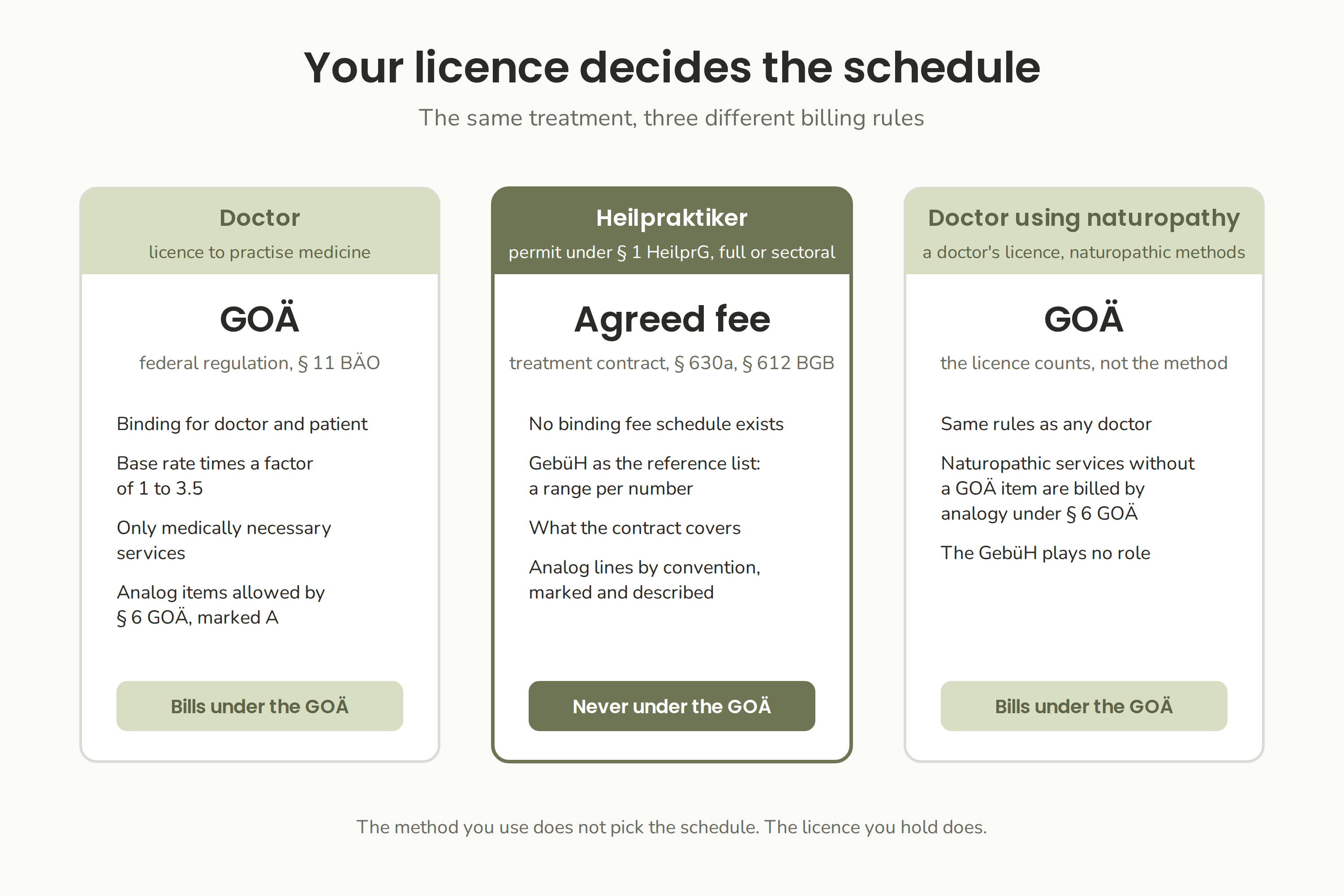
A Heilpraktiker invoice is never written under the GOÄ. The GOÄ is the federal fee regulation for doctors, and § 1 GOÄ limits it to the professional services of doctors. A Heilpraktiker, a state-licensed non-medical practitioner, has no binding fee schedule at all. The invoice follows the agreed fee and names the GebüH, a non-binding list, as its reference.
The question reaches a practice in two ways. A patient's insurer asks why the invoice shows GebüH numbers and not GOÄ ones. Or you hold a doctor's invoice for a similar treatment and wonder whether you could bill the same way. This guide gives the legal answer, shows where GOÄ numbers still touch your desk, and what that means for the refund.
Why the GOÄ does not apply to a Heilpraktiker
The GOÄ applies to doctors because a federal law says so, and to nobody else. § 11 BÄO lets the federal government set doctors' fees by regulation, with the consent of the second chamber. The GOÄ is that regulation, and its first sentence covers the professional services of doctors (§ 1 GOÄ).
GOÄ stands for Gebührenordnung für Ärzte, the fee schedule for doctors. A Heilpraktiker practises medicine without a doctor's licence, under a permit granted by § 1 HeilprG. No law gives the government the power to set Heilpraktiker fees, and no such regulation exists. The fee is a matter of contract between you and your patient.
The same logic runs through the whole family of fee schedules. Dentists bill under the GOZ. Licensed psychological psychotherapists bill under the GOP, which simply applies the GOÄ to their work (§ 1 GOP). Each schedule names its profession, and none of them names the Heilpraktiker.
| Profession | Fee schedule | Legal nature | Binding |
|---|---|---|---|
| Doctor | GOÄ | Federal regulation under § 11 BÄO | Yes |
| Dentist | GOZ | Federal regulation | Yes |
| Licensed psychological psychotherapist | GOP, which applies the GOÄ | Federal regulation | Yes |
| Heilpraktiker, full or sectoral permit | None. The GebüH serves as a reference | Treatment contract, § 630a and § 612 BGB | No |
May a Heilpraktiker bill under the GOÄ?
No. The billing guides written for the profession are blunt about it: cite the GOÄ in parallel if it helps, do not apply it (Paracelsus, part 2, 2022). A GOÄ item may explain what you did. It may not be the basis of the line.
Three things go wrong when a Heilpraktiker invoice is written under the GOÄ anyway.
- The reviewer reads it as a doctor's invoice. An invoice built on GOÄ items is checked against GOÄ rules. Those include the limit to medically necessary services and the factor rules in § 5 GOÄ. You cannot meet rules that were not written for you (Paracelsus, part 1, 2022).
- It can read as a claim to a licence you do not hold. A lawyer who specialises in Heilpraktiker law advises writing your title exactly as licensed on every invoice. A document that looks like a doctor's invoice sends the opposite signal (Sasse, 2020).
- The refund table does not match. Private insurers and Beihilfe offices refund Heilpraktiker services against the GebüH, the Hufeland directory or their own list. A GOÄ number has no row in those tables, so the line comes back with a question.
The confusion has a historical reason. The GebüH of 1985 was largely derived from the GOÄ of its time, so numbers and service texts look alike (Paracelsus, part 2, 2022).
What the GebüH is, and why it is not a fee schedule either
The GebüH is a list of average fees from a 1985 survey by the Heilpraktiker associations, converted to euros in 2002 (BDH). It has no force of law. Your fee is what you agree under the treatment contract (§ 630a BGB). Where nothing was agreed, the usual fee applies, and insurers read the GebüH range as usual (§ 612 BGB).
The BDH, the largest Heilpraktiker association, puts it in one sentence. A Heilpraktiker is free in setting the fee, because no legally binding fee schedule exists for the profession (BDH). The PKV service portal says the same from the insurers' side. The GebüH is not an official fee schedule, and the price of a Heilpraktiker treatment is not fixed (PKV portal).
How the list is built and what the common numbers look like is covered in our guide to the GebüH. It also shows how to agree your fee in text form. This article stays with the comparison.
How GOÄ and GebüH differ in practice
The GOÄ and the GebüH differ in who they bind, how a price is formed and which services may be billed. They also differ in what happens with a service that is not listed. One is a regulation with the force of law, the other a list that insurers read as a reference. The table puts the two side by side.
| GOÄ | GebüH | |
|---|---|---|
| Who uses it | Doctors | Heilpraktiker, as a reference |
| Legal nature | Federal regulation with the force of law | List published by professional associations |
| Binding | Yes, for doctor and patient | No. The agreed fee counts |
| How a price is formed | Base rate times a factor of 1 to 3.5. Above 2.3 the invoice needs a written reason (§ 5 GOÄ) | A range per number. The agreed amount goes on the line |
| Which services may be billed | Only medically necessary ones, unless the payer asked for more (§ 1 GOÄ) | What the treatment contract covers |
| Service not listed | Analog billing under § 6 GOÄ, marked with an A | Analog billing by convention of the profession, marked and described on the line |
| Last changed | Regulation of 1982, version of 1996. A reform is in preparation | Survey of 1985, euro conversion of 2002 |
| VAT | Treatment is exempt under § 4 no. 14 UStG | Treatment is exempt under § 4 no. 14 UStG |
One row deserves a second look. Under the GOÄ, a doctor may bill an unlisted service by analogy to a comparable item, and § 6 GOÄ says so in writing. The GebüH has no such paragraph. In the Heilpraktiker practice, analog billing is a convention that insurers accept, with a marker and a short description on the line. Our invoice guide shows how that line is written.
When GOÄ numbers still show up in a Heilpraktiker practice
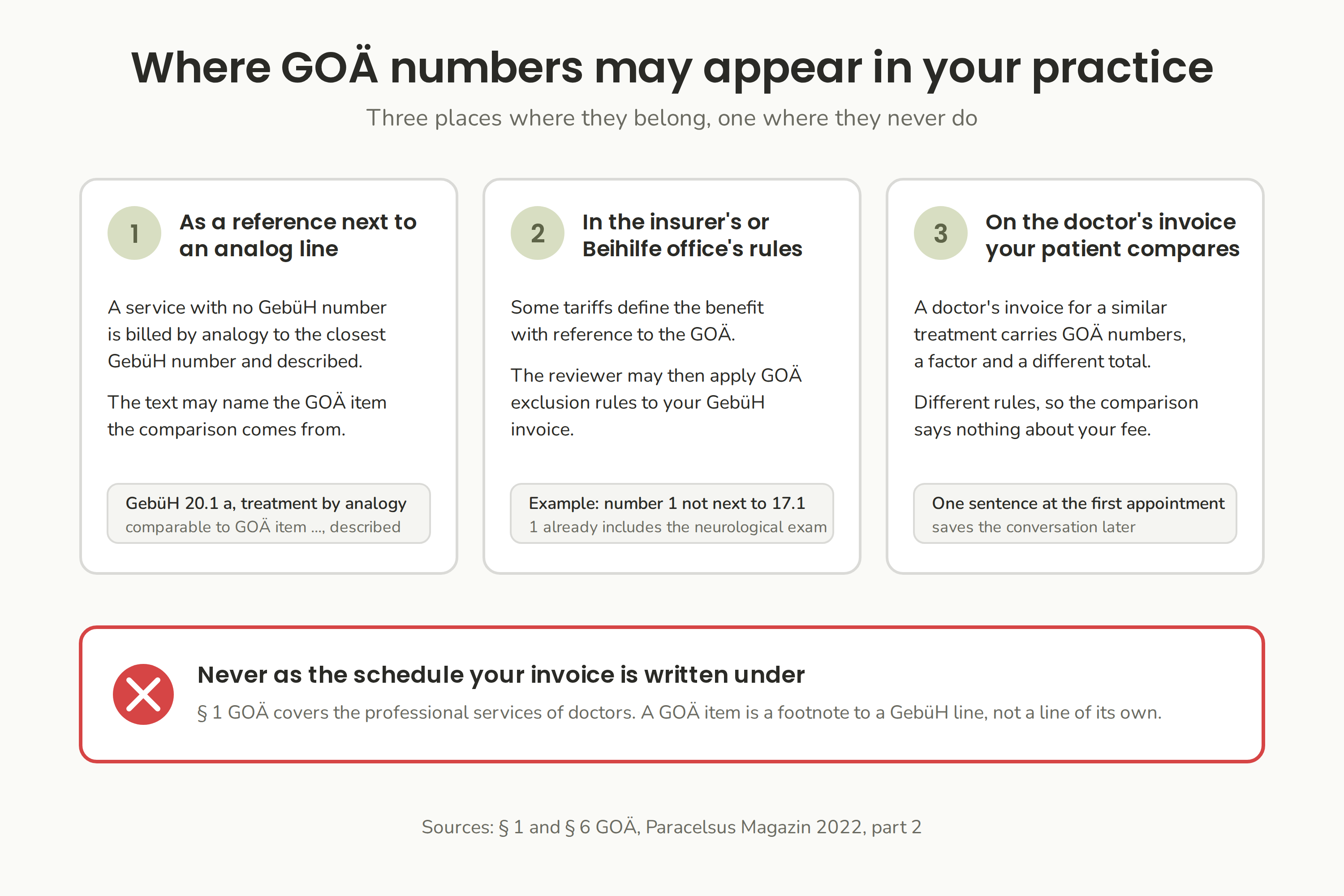
GOÄ numbers reach a Heilpraktiker practice in three legitimate ways. They appear as a reference next to an analog line, inside an insurer's rules, and on the doctor's invoice a patient compares with yours. None of the three makes the GOÄ your schedule.
As a reference for an analog line. When a service has no GebüH number, you bill it by analogy to the closest number and describe it. The billing guide recommends naming the catalogue the comparison comes from, which may be the GOÄ, the Hufeland directory or another list (Paracelsus, part 2, 2022). The GOÄ item is a footnote to a GebüH line.
In the insurer's or Beihilfe office's rules. Some tariffs define their benefit with reference to the GOÄ, and a reviewer may then apply GOÄ exclusion rules to your GebüH invoice. The guide gives an example. Number 1 is not billed next to 17.1, because 1 already includes the neurological examination (Paracelsus, part 2, 2022). Knowing the GOÄ logic helps you read such a letter, and it changes nothing about what you bill under.
On the invoice your patient compares with yours. A doctor's invoice for a similar treatment carries GOÄ numbers, a factor and a different total. The comparison tells your patient nothing about your fee, because the two documents rest on different rules. A short sentence at the first appointment saves that conversation later.
What private insurers and Beihilfe refund
Private insurers refund Heilpraktiker services against the GebüH, the Hufeland directory or a list of their own, within the limits of the tariff. Beihilfe offices refund up to a maximum per GebüH number. In neither case does a GOÄ number help, and in both cases the refund goes to the patient.
The PKV service portal describes the tariff side. Most insurers refer to the GebüH and pay, depending on the tariff, the minimum or the maximum rate of the range. Some tariffs use the Hufeland directory or an insurer's own list instead. Refunds are often 75 to 100 percent of the invoice, capped per year at 500 or 1,000 euros. The basic and standard tariffs cover no Heilpraktiker services at all (PKV portal).
For federal civil servants, Beihilfe accepts a Heilpraktiker fee only up to the maximum per number in annex 2 of the federal Beihilfe regulation. The table lists GebüH numbers with their service texts and a euro amount, and it names no GOÄ items (annex 2 BBhV). Three examples from the table:
| GebüH number | Service | Beihilfe maximum |
|---|---|---|
| 1 | Examination beyond the usual extent | 12.50 euros |
| 2a | Homeopathic first case history, at least one hour | 80.00 euros |
| 21.1 | Acupuncture including pulse diagnosis | 23.00 euros |
Anything above the refund stays with the patient, however well the fee was agreed (Paracelsus, part 2, 2022). Your fee claim does not depend on the refund. What the reviewer needs to see on the invoice, from the treatment date to the diagnosis, is in our invoice guide.
Does the new GOÄ change anything for Heilpraktiker?
No. The GOÄ reform covers doctors, and nothing in it extends to Heilpraktiker. Until it is in force, the GOÄ of 1982 stays the binding schedule for doctors. The GebüH stays the reference for your invoices in its 2002 version, whatever happens to the GOÄ.
Where the reform stands in November 2026. The German medical assembly approved the joint draft of the medical association and the private insurers in May 2025. The draft went to the federal health ministry in June 2025, and an updated version followed in July 2026. The ministry is preparing its own draft regulation, and the medical association calls 1 January 2028 a realistic start date (German Medical Association). The government has not set a date.
What does move for your practice are the Beihilfe maximum amounts in annex 2 BBhV, which the federal government amends from time to time. Check the current table once a year.
Sectoral Heilpraktiker: physiotherapy and psychotherapy
A sectoral permit limited to physiotherapy or psychotherapy gets the same answer. The GOÄ does not apply, and neither does the GOP, which names licensed psychological psychotherapists and nobody else (§ 1 GOP). The fee is agreed under the treatment contract, and the GebüH is the reference where it has a fitting number.
The Beihilfe table shows which GebüH chapters exist for physical treatment (annex 2 BBhV). Few of them match a modern physiotherapy session one to one. That is why many practices agree a session fee and name the closest number.
| GebüH chapter | Service area |
|---|---|
| 20 | Massage and breathing therapy |
| 34 and 35 | Joint and spinal treatment, osteopathy |
| 36 to 39 | Baths, packs and electrotherapy |
For psychotherapy under a sectoral permit, the tariff decides more than the schedule. Many private tariffs and Beihilfe rules treat psychotherapy by a Heilpraktiker differently from physical treatment, and some exclude it. Ask your patient to check before the first session. The fee you agree stays valid either way.
A short check before the next invoice
The check takes a minute per invoice. It covers the basis of each line, the analog marker, the fee agreement, your title and the VAT note. The last point is what your patient knows about the refund. Six points, and the GOÄ appears in none of them as the basis of a line.
- Every line names a GebüH number or the agreed fee as its basis. No line is written under a GOÄ item.
- An analog line carries the marker and a short description. It may name the GOÄ item it leans on as a reference in the text.
- The fee was agreed in text form before the first treatment, as § 630c BGB requires for cost information.
- Your title appears exactly as licensed, and a sectoral permit is written out in full.
- The invoice carries the note that the treatment is exempt from VAT under § 4 no. 14 UStG. What that exemption covers is in our VAT guide.
- Your patient knows that the refund depends on the tariff, and where to find the insurer's table.
This article is general information, not tax or legal advice. Talk to your tax adviser or a lawyer for your own case. All law texts were read on gesetze-im-internet.de on 9 November 2026.
About this blog
This blog is written by the team at Vitalmyn. We build an ordering service for practitioner recommendations, and we write guides on the business side of running a Heilpraktiker practice in Germany.
Frequently asked
May a Heilpraktiker bill under the GOÄ?
No. The GOÄ applies to the professional services of doctors under § 1 GOÄ and § 11 BÄO. A Heilpraktiker has no binding fee schedule at all. The fee is agreed with the patient, and the invoice names GebüH numbers as reference. A GOÄ item may be cited to explain an analog service, never used as the basis of the line.
What is the difference between GOÄ and GebüH?
The GOÄ is a federal regulation with the force of law, binding for doctors, built on a base rate times a factor of 1 to 3.5. The GebüH is a list of average fees from a 1985 survey by the Heilpraktiker associations, converted to euros in 2002, with a range per number and no legal force. Both are read by insurers and Beihilfe offices when they check a refund.
Why does my patient's insurer mention GOÄ rules on a Heilpraktiker invoice?
Some tariffs and Beihilfe rules define their benefit with reference to the GOÄ. A reviewer may then apply GOÄ exclusion rules to your GebüH invoice, for example that number 1 is not billed next to 17.1 because 1 already includes the neurological examination. The GebüH was derived from the GOÄ of its time, so the structures match.
Does the new GOÄ apply to Heilpraktiker?
No. The reform was approved by the German medical assembly in May 2025 and handed to the health ministry. The medical association calls 1 January 2028 a realistic start. It covers doctors only. For Heilpraktiker the GebüH stays unchanged, and what moves are the Beihilfe maximum amounts.
Sources
- § 1 GOÄ - scope: professional services of doctors
- § 5 GOÄ - the fee range and factor
- § 6 GOÄ - analog billing of services not listed
- § 11 BÄO - the power to set doctors' fees by regulation
- § 1 HeilprG - practising medicine without a doctor's licence
- § 1 GOP - fee schedule for psychological psychotherapists
- GOZ - fee schedule for dentists
- § 612 BGB - the usual fee
- § 630a BGB - the treatment contract
- § 630c BGB - duty to inform the patient about costs
- § 4 UStG - VAT exemption for treatment
- § 6 BBhV and annex 2 - Beihilfe maximum amounts for Heilpraktiker services
- BDH: billing for Heilpraktiker (German)
- BDH: the fee list for Heilpraktiker (German)
- PKV service portal: Heilpraktiker treatment and the refund (German)
- Paracelsus Magazin, correct invoicing in the Heilpraktiker practice, part 1 (2022)
- Paracelsus Magazin, correct invoicing in the Heilpraktiker practice, part 2 (2022)
- German Medical Association: status of the GOÄ reform (German)
- Lawyer Dr. René Sasse, invoicing and practice name (2020)
Written by
Vitalmyn Team
Editorial team
We are building the ordering service for practitioner recommendations. Here we write down what we learn about recommending, practice finances and advertising law, so you do not have to dig it up yourself.