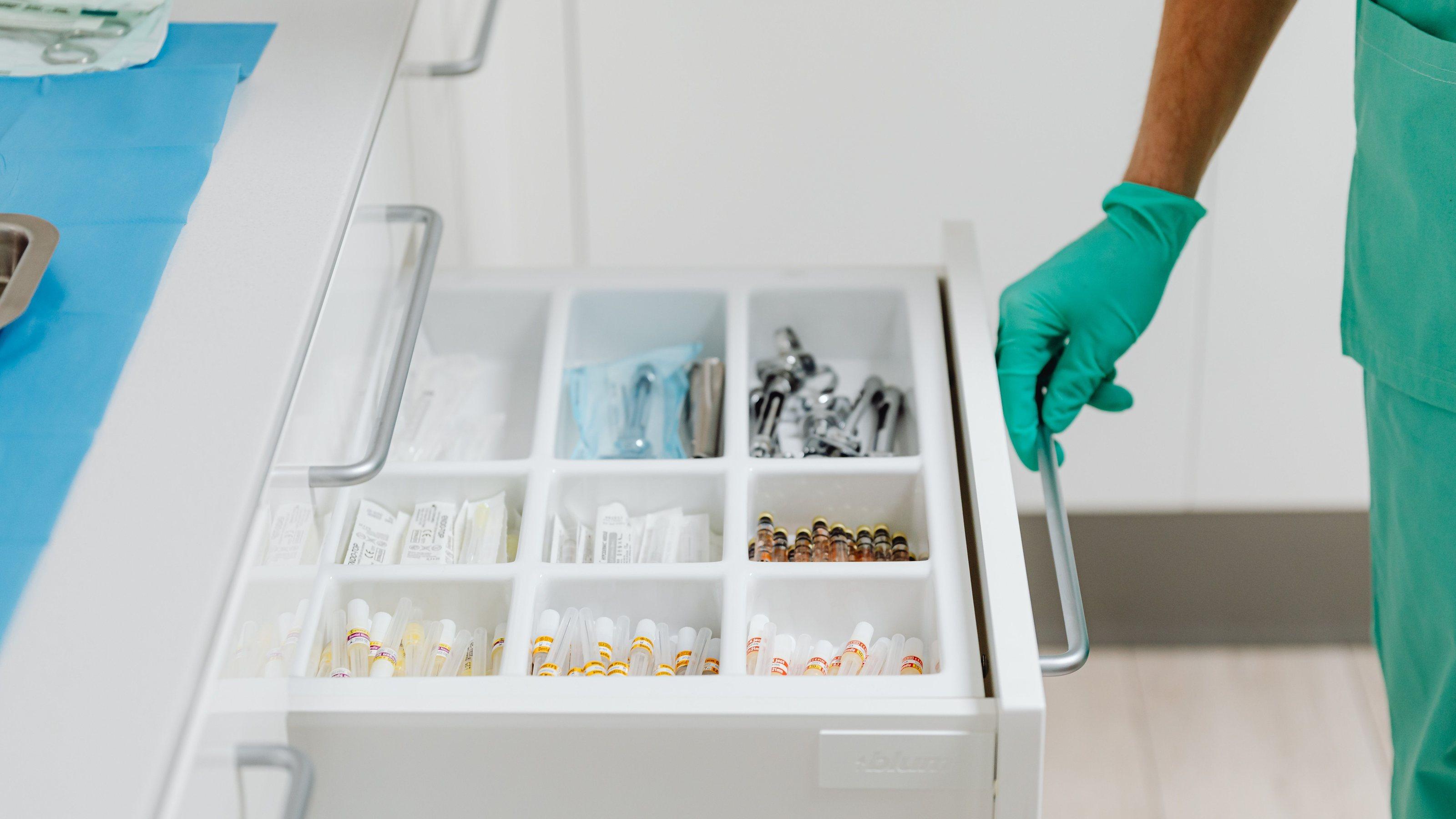
Praxisbedarf for a Heilpraktiker means everything a practice uses up or works with. That covers hygiene supplies, injection materials, simple diagnostic devices, room fittings and paperwork. Several of these items come with legal duties, from device checks under the MPBetreibV to sharps disposal, medicine limits and tax.
As a Heilpraktiker, a state-licensed non-medical practitioner, you reorder supplies every few weeks. A supplier catalogue lands in your inbox, the glove box is nearly empty, and the question is what you actually have to keep in stock. This guide sorts the supplies by area and shows which ones come with legal duties. All law texts were read on gesetze-im-internet.de and the issuing bodies' sites on 4 November 2026.
What counts as Praxisbedarf in a Heilpraktiker practice?
Praxisbedarf is the general German word for practice supplies. It covers consumables like gloves and swabs, reusable instruments, small devices like a blood pressure monitor, room fittings and printed forms. The law has no fixed list for Heilpraktiker. What you need follows from the methods you use.
A practice that works only with talking and nutrition advice needs little more than a desk, hand hygiene and good records. A practice that gives injections, draws blood or uses cupping and acupuncture needs more. Each invasive method brings its own hygiene, disposal and documentation duties.
The table sorts the usual supplies into five areas. Use it as a starting point and strike out what your methods do not need.
| Area | Typical supplies | Rule that applies |
|---|---|---|
| Hygiene | Hand and surface disinfectant, single-use gloves, paper towels, couch covers | State hygiene rules under § 23 IfSG, if you work invasively |
| Injections and blood draws | Syringes, cannulas, safety cannulas, skin antiseptic, swabs, plasters, sharps container | KRINKO recommendation, TRBA 250, LAGA M 18 |
| Diagnostics | Blood pressure monitor, stethoscope, thermometer, reflex hammer, tongue depressors | MPBetreibV, for devices |
| Methods | Acupuncture needles, cupping glasses, moxa, tapes | MPBetreibV § 8, if you reprocess reusable items |
| Room and paperwork | Examination couch, lockable cabinet, patient records, invoice forms, first-aid kit | Record-keeping duties, DGUV rules if you employ staff |
What is the difference between Praxisbedarf and Sprechstundenbedarf?
Sprechstundenbedarf is a term from the statutory health insurance system. Doctors with a health insurance licence order certain supplies on a special prescription form, and the health fund pays. Praxisbedarf is what any practice buys and pays for itself. As a Heilpraktiker you only ever buy Praxisbedarf.
The rules for Sprechstundenbedarf sit in regional agreements between the Associations of Statutory Health Insurance Physicians and the health funds. In Hesse, for example, panel doctors order these supplies on form 16, only for patients of the statutory funds (KV Hessen, agreement on Sprechstundenbedarf).
Heilpraktiker are outside that system. You cannot order Sprechstundenbedarf, and no health fund refunds your supplies. Every glove and every swab is a business expense you pay yourself, which is why the tax section further down matters.
Which devices bring duties under the MPBetreibV?
The Medizinprodukte-Betreiberverordnung (MPBetreibV), the ordinance for people who operate medical devices, applies to your practice as soon as you use a medical device on patients. A new version came into force in 2025, and most paragraph numbers changed. Four device duties matter most for a typical practice, plus the instruction of users.
The current text is the MPBetreibV of 14 February 2025, last amended on 31 October 2025 (MPBetreibV 2025). Older guides and supplier pages still quote the old numbers, so check the paragraph before you rely on it.
The inventory for active devices
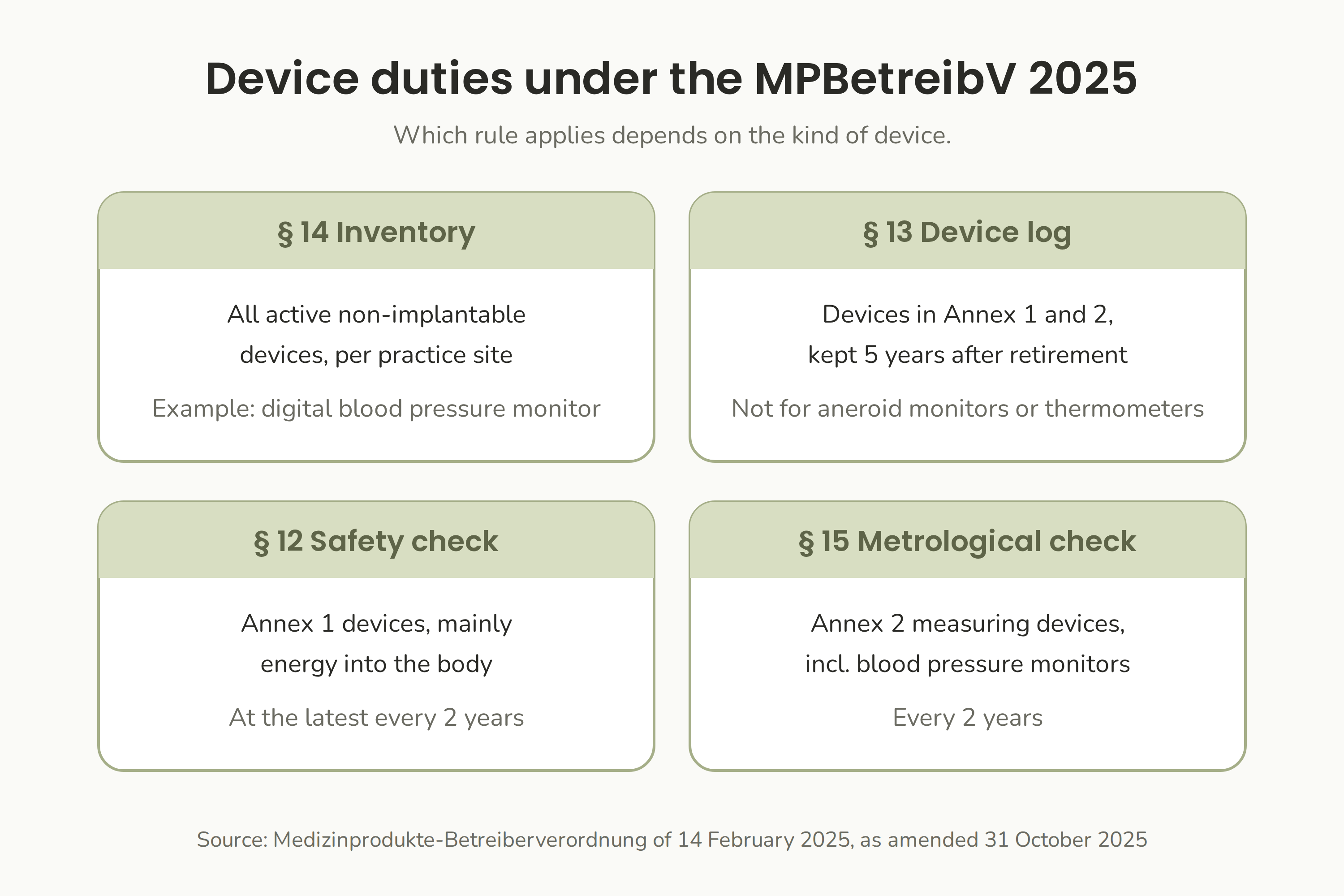
Under § 14 MPBetreibV you keep an inventory, the Bestandsverzeichnis, of all active non-implantable medical devices at each practice site. "Active" means the device runs on electricity or another energy source. A digital blood pressure monitor, an electrotherapy device or a bioresonance device all count.
For each device the inventory lists the name, type, serial or lot number and year of purchase. It also names the manufacturer and its address, any internal ID number and where the device stands.
Any format is fine, from a spreadsheet to a binder. Small practices get no exemption; only devices handed over to the patient for keeps are left out (§ 3 MPBetreibV). Our free medical device inventory tool builds the list for you.
The device log for listed devices
Under § 13 MPBetreibV, devices listed in Annex 1 and Annex 2 of the ordinance need a device log, the Medizinproduktebuch. It records the instruction of users, checks, faults and repairs. You keep it for five years after the device leaves service.
Electronic compact fever thermometers are exempt. So are mercury and aneroid blood pressure monitors, the classic cuff with a dial. Most Heilpraktiker practices only meet the log duty through a digital blood pressure monitor or an electrotherapy device.
Safety and metrological checks
Annex 1 devices, mainly devices that send energy into the body, need a safety check, the sicherheitstechnische Kontrolle. Under § 12 MPBetreibV it is due at the latest every two years. The manufacturer no longer sets a longer interval.
Annex 2 devices with a measuring function need a metrological check, the messtechnische Kontrolle (§ 15 MPBetreibV). Non-invasive blood pressure monitors are on that list, with a check every two years. The clock starts at the end of the year the device went into use. Mercury and aneroid monitors need no device log, but they still need this check.
| Device | Inventory (§ 14) | Device log (§ 13) | Regular check |
|---|---|---|---|
| Digital blood pressure monitor | Yes | Yes | Metrological check every 2 years (§ 15) |
| Aneroid blood pressure monitor | No, not active | No | Metrological check every 2 years (§ 15) |
| Electrotherapy device for nerve and muscle stimulation | Yes | Yes | Safety check at the latest every 2 years (§ 12) |
| Electronic compact fever thermometer | Yes | No | None |
Instruction before use
Only people with the right training or experience may use a medical device (§ 4 MPBetreibV). Before you first use an Annex 1 device, the manufacturer or its agent tests it on site. It also instructs a person you name (§ 11 MPBetreibV). Both steps go into the device log.
What do you need for injections and sharps?
If you inject or draw blood, your supplies follow three sets of rules. The KRINKO recommendation covers skin antisepsis, TRBA 250 covers safety cannulas, and TRBA 250 with LAGA M 18 covers disposal. Together they decide which swabs, cannulas and containers you keep. A practice without needles can skip this section.
Skin antisepsis and single-use items
The reference for hygiene during injections is the KRINKO recommendation on punctures and injections. KRINKO is the commission for hospital hygiene at the Robert Koch Institute (KRINKO, punctures and injections, 2011).
It asks for skin antisepsis right before the puncture, with the contact time the product names. Spray and swab are both fine. Health offices use this recommendation when they inspect a practice, so your antiseptic and swabs belong on the order list.
Safety cannulas when you employ staff
TRBA 250 is the technical rule for biological agents in health care. Its current edition dates from November 2025 (TRBA 250, BAuA). Section 4.2.5 asks for safety devices, such as cannulas with a needle shield, for three tasks. These are blood draws, other punctures to take body fluids, and placing a vascular access.
The rule protects employees. Without staff, you are bound mainly where others could be harmed, such as cleaners or waste handlers (§ 1 BioStoffV). Once you employ an assistant, safety cannulas become a duty for those tasks. Many solo practitioners use them anyway, because a needlestick injury hurts the owner too.
Sharps containers and waste
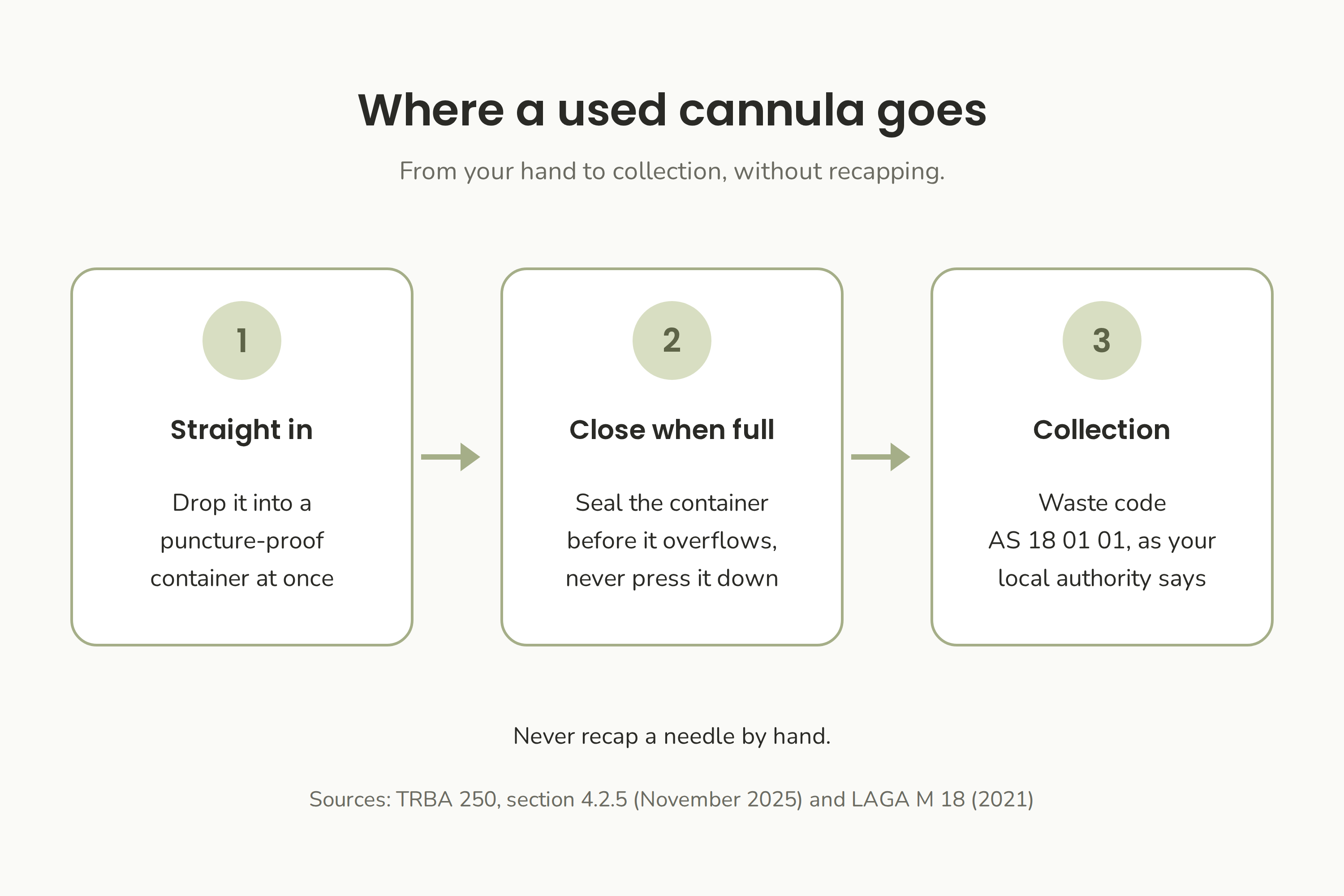
Used sharps go straight into a closable, puncture-proof single-use container. This comes from TRBA 250, section 4.2.5, and from the disposal guide LAGA M 18 for health care waste (LAGA M 18, 2021). Never recap a needle by hand.
| Waste | Waste code | How it leaves your practice |
|---|---|---|
| Needles, cannulas, lancets | AS 18 01 01 | Puncture-proof single-use container, closed when full |
| Blood-soiled swabs, gloves, single-use items | AS 18 01 04 | Tear-proof bags, kept apart from household waste |
| Clean paper and packaging | 15 01 xx | Normal paper or packaging recycling |
Your local waste authority decides how the closed containers are collected, so the rules differ from town to town. Some accept them with residual waste, others ask for a disposal company. Ask once and note the answer in your hygiene plan.
Do you need a hygiene plan and a first-aid kit?
If you work invasively, your state may require a written hygiene plan. Under § 23 (5) IfSG the states may ask practices of other health professions that do invasive work to keep one, and many do. The health office may inspect these practices (§ 23 (6) IfSG). A first-aid kit is a duty once you employ staff.
Hesse is a good example. Its hygiene ordinance asks for a hygiene plan with a cleaning and disinfection plan. The district of Giessen spells out what that means for Heilpraktiker practices (Giessen district, hygiene rules for Heilpraktiker practices, 2025).
Your plan names each product on your shelf, what it is used for and how long it needs to act. Kept up to date, it doubles as your order list. Our guide to the Infektionsschutzgesetz for Heilpraktiker covers the inspection side.
For first aid, the accident insurance rule DGUV Vorschrift 1, § 25, requires first-aid material (DGUV Vorschrift 1). For a small practice, one small first-aid kit to DIN 13157 is enough (DGUV Information 204-022). A self-employed Heilpraktiker is not compulsorily insured (§ 4 (3) SGB VII), so a solo practice is not bound. It is still sensible to keep one, because patients and visitors can fall or faint.
Which medicines may a Heilpraktiker keep in the practice?
You may keep non-prescription medicines for use in your own practice, but you buy pharmacy-only ones through a pharmacy. Prescription-only medicines are closed to you, because only a doctor, dentist or vet may prescribe them (§ 48 AMG). That limit shapes what your practice cupboard can hold.
The Arzneimittelgesetz (AMG), the German Medicines Act, sets the rules for your stock. The table shows where each kind of medicine comes from.
| Kind of medicine | May you keep it? | Where it comes from |
|---|---|---|
| Prescription-only | No | Closed to Heilpraktiker (§ 48 AMG) |
| Pharmacy-only | Yes, for use in your practice | Only through a pharmacy (§ 43 AMG) |
| Freely available | Yes | Pharmacy, drugstore or supplier |
| Free samples, non-prescription | Yes | From the manufacturer (§ 47 (3) AMG) |
Wholesalers may not supply you directly. The only exceptions are medical gases and leeches (§ 47 AMG).
Keep medicines in a lockable cabinet and check expiry dates on a fixed day each month. Write that day into your hygiene plan, so it is not forgotten when the practice gets busy.
Supplements count as food in Germany, so the AMG does not cover them (§ 2 (3) AMG). Stocking them in the practice for patients raises VAT and trade questions instead. Our guide to VAT for Heilpraktiker covers them.
How are practice supplies taxed?
Practice supplies are business expenses and lower your taxable profit (§ 4 (4) EStG). If your income is exempt from VAT, you pay VAT on every purchase and cannot reclaim it. Your real cost is therefore the gross price including 19 percent VAT, which is higher than the net price many catalogues show first.
The VAT exemption for medical work in § 4 Nr. 14 UStG has a downside here. Exempt income rules out the input tax deduction, the refund of VAT you paid on purchases (§ 15 (2) UStG). Compare supplier prices including VAT, because that is what leaves your account.
Devices and fittings that last longer than a year follow a different rule. Low-value assets up to 800 euros can be written off in full in the year of purchase (§ 6 (2) EStG). For a VAT-exempt practice the 800 euros include VAT, because you cannot deduct it (§ 9b EStG). A 900 euro couch is spread over several years.
| Purchase | Example | Tax treatment for a VAT-exempt practice |
|---|---|---|
| Consumables | Gloves, swabs, disinfectant | Full expense in the year of purchase, gross price |
| Low-value device | Blood pressure monitor for 120 euros | Full write-off if 800 euros or less, VAT included |
| Larger device or furniture | Couch for 900 euros | Spread over its useful life |
If your practice uses the small business VAT exemption under § 19 UStG instead, the result is the same. You cannot reclaim input tax there either (§ 19 UStG).
A checklist before you reorder
Before your next order, run through these seven questions. Each one points to the rule behind it, so you can check the source when you are unsure. The list takes a few minutes and catches the checks and dates that slip in a busy month.
- Does your inventory list every active device, with serial number and location? (§ 14 MPBetreibV)
- Is the metrological check of your blood pressure monitor due this year? (§ 15 MPBetreibV)
- Does your hygiene plan name every disinfectant on your shelf and its contact time? (§ 23 IfSG)
- Do you have enough puncture-proof containers, and do you know how your local authority collects them? (LAGA M 18)
- If you employ staff, are safety cannulas in stock for blood draws? (TRBA 250, section 4.2.5)
- Are all medicines in the cupboard within date and bought through a pharmacy? (§ 43 AMG)
- Did you compare prices including VAT? (§ 15 UStG)
This article is general information, not tax or legal advice. Talk to your tax adviser, a lawyer or your health office for your own case.
Frequently asked
What is the difference between Praxisbedarf and Sprechstundenbedarf?
Sprechstundenbedarf is a statutory health insurance term. Doctors with a health insurance licence order certain supplies on prescription form 16 and the health fund pays. Praxisbedarf is what any practice buys and pays for itself. Heilpraktiker are outside the statutory system and only buy Praxisbedarf.
Does a Heilpraktiker need a Bestandsverzeichnis?
Yes, as soon as the practice uses an active non-implantable medical device, such as a digital blood pressure monitor or an electrotherapy device. § 14 MPBetreibV 2025 asks for an inventory per practice site, with no exemption for small practices.
How often must a blood pressure monitor in a practice be checked?
Non-invasive blood pressure monitors are in Annex 2 of the MPBetreibV and need a metrological check every two years (§ 15 MPBetreibV 2025). The clock starts at the end of the year the device went into use.
Can a Heilpraktiker buy medicines from a wholesaler?
No. § 47 AMG does not let wholesalers supply Heilpraktiker directly, apart from medical gases and leeches. Pharmacy-only medicines for use in the practice are bought through a pharmacy (§ 43 AMG). Prescription-only medicines are closed to Heilpraktiker (§ 48 AMG).
Sources
- MPBetreibV 2025, full text
- KRINKO, hygiene during punctures and injections (2011)
- TRBA 250, edition November 2025 (BAuA)
- § 1 BioStoffV - scope
- LAGA M 18, disposal of health care waste (2021)
- § 23 IfSG - hygiene in medical facilities
- Giessen district, hygiene rules for Heilpraktiker practices in Hesse, 2025
- DGUV Vorschrift 1 - principles of prevention
- DGUV Information 204-022 - first aid in the workplace
- § 4 SGB VII - exemptions from compulsory insurance
- § 43 AMG - pharmacy-only medicines
- § 2 AMG - definition of medicines
- § 47 AMG - supply by wholesalers
- § 48 AMG - prescription-only medicines
- KV Hessen, Sprechstundenbedarf agreement (2020)
- § 4 EStG - business expenses
- § 6 EStG - valuation, low-value assets
- § 9b EStG - input tax in acquisition costs
- § 4 UStG - VAT exemptions
- § 15 UStG - input tax deduction
- § 19 UStG - small business VAT exemption
Written by
Vitalmyn Team
Editorial team
We are building the ordering service for practitioner recommendations. Here we write down what we learn about recommending, practice finances and advertising law, so you do not have to dig it up yourself.